












- ANALIZA
- WIADOMOŚCI
India’s trade agreement with the United States – another piece of the puzzle

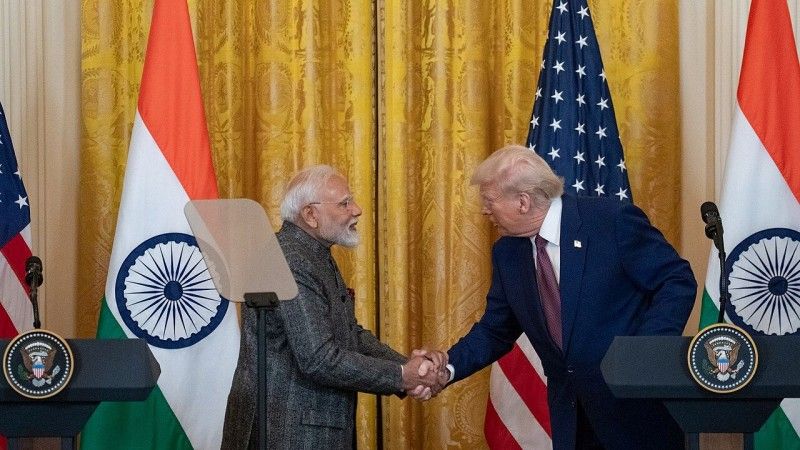
In recent weeks, events have unfolded that could reshape the global economy. India has announced two major trade agreements: one with the EU and another with the US. Is this the consolidation of a democratic alliance?
Difficult negotiations
Donald Trump’s return to power in the United States, along with the tariff policy he reinstated, has had far-reaching consequences across the globe. One effect was the acceleration of negotiations on a Free Trade Agreement (FTA) between the EU and India. Another was a marked shift in the dynamics of relations between New Delhi and Washington. Both processes reached their climax in recent weeks.
After a year of intensified talks, Ursula von der Leyen and Narendra Modi announced in Delhi on January 27 that the final text of the EU–India FTA had been agreed. Less than a week later, Donald Trump declared that the United States and India had reached a bilateral trade deal. The full texts of both agreements remain undisclosed. The EU–India FTA is currently undergoing „legal scrubbing,” a process expected to take from several weeks to several months. Even less is known about the substance of the deal with the United States, beyond a handful of brief official statements.
Yet even on the basis of limited information, certain conclusions can be drawn. Above all, the agreement appears to bring to a close a nearly year-long and increasingly acrimonious trade and political dispute. Negotiations between India and the United States unfolded in shifting atmospheres – initially cordial, sustained by memories of the warm Modi –Trump rapport during Trump’s first term, then progressively colder. The breaking point came in August 2025, when the United States imposed 50 percent tariffs on most Indian products. In the months that followed, Indian exports contracted sharply, and many firms counted heavy losses.
The triumphant announcement of the EU–India FTA – explicitly framed by Antonio Costa as a counterweight to American trade policy – seems to have triggered renewed momentum on the other side of the Atlantic. Trump wasted no time. On February 2, he held a phone call with Modi and promptly proclaimed success: there was a deal.

What is in the deal?
The central provision is a bilateral reduction of tariffs to 18 percent. The agreement covers a broad range of Indian exports, including textiles and apparel, leather and footwear, plastics and rubber, organic chemicals, home décor, artisanal goods, and machinery. It also provides preferential tariff-rate quotas for automotive parts and lower effective rates in sectors such as pharmaceuticals and generics. For its part, India is to eliminate or reduce tariffs on all U.S. industrial goods and a wide array of American food products, including dried distillers« grains, tree nuts, fresh and processed fruit, soybean oil, wine, and spirits. Considerable attention has also been devoted to non-tariff barriers, such as import licensing, quantitative restrictions in medical devices, and the establishment of rules of origin.
In many respects, the deal resembles the EU–India FTA. A closer reading, however, suggests it is somewhat narrower, encompassing fewer sectors and offering less potential for deep, structural cooperation than its European counterpart. Contrary to the expectations voiced by some American politicians, India did not agree to include a wide range of agricultural products. As with the EU agreement, tariff reductions largely apply to goods not produced domestically in India – such as tree nuts (primarily almonds, walnuts, and pistachios) – or to products that are uncompetitive in quality, such as certain alcoholic beverages.
A particularly sensitive issue, long emphasized by Trump, concerns India’s purchases of discounted Russian oil – amounting to some $60 billion annually. Following his February 2 conversation with Modi, the U.S. president announced: „He \[Modi\] agreed to stop buying Russian oil, and to buy much more from the United States and, potentially, Venezuela.” Securing such a commitment would indeed constitute a notable achievement for Trump. According to media reports, India is expected to honor existing contracts with Russia but to refrain from signing new supply agreements from March onward. Yet statements by Indian officials – such as Foreign Secretary Vikram Misri, who emphasized that „India will not rely on any single source for crude oil and will continue to diversify imports to protect national interest” – suggest that a complete cessation is unlikely. A substantial reduction, however, may well be in the cards. Time will tell.
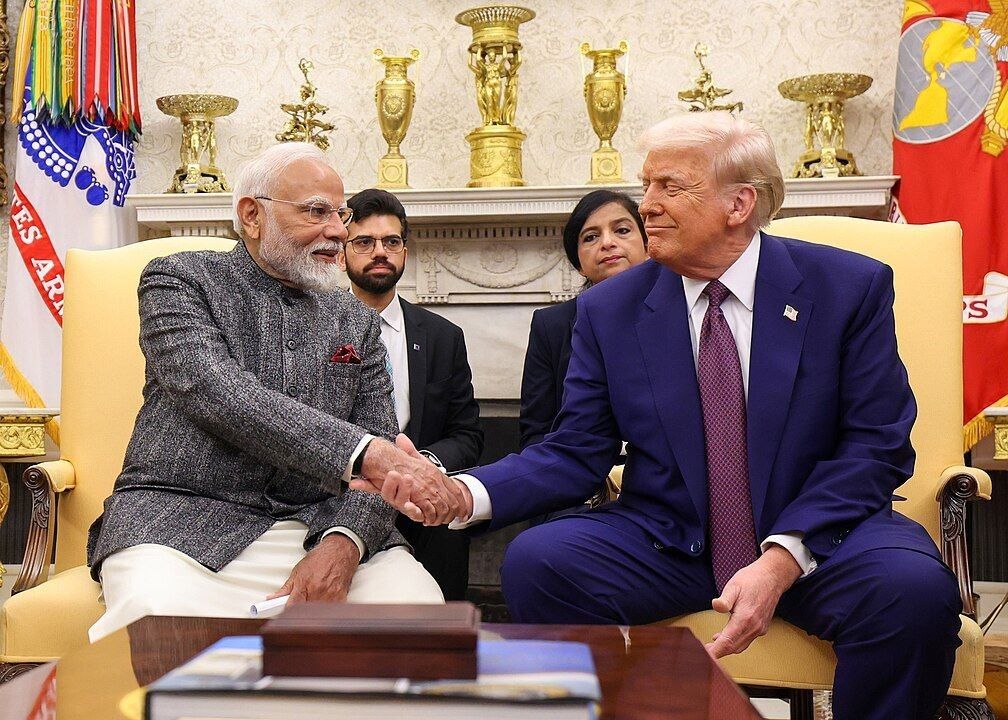
Vasudhaiva Kutumbakam – the world is one family
Irrespective of this – admittedly crucial – question, the U.S.–India trade agreement forms another piece in a rapidly evolving global puzzle. Democratic states are drawing closer together. India has also concluded a security cooperation agreement with the EU, with implications extending to the Indo-Pacific. The United States, for its part, is likely to elevate cooperation within the Quad framework. China can hardly view these developments with equanimity.
At the same time, India recently hosted Vladimir Putin with considerable ceremony, formally inaugurated its BRICS presidency, and convened a meeting of sherpas. It is clear that India will not become unequivocally pro-Western – neither now nor in the foreseeable future. It will remain, above all, pro-Indian, guided by its doctrine ofVasudhaiva Kutumbakam – the world is one family – an outlook that calls for dialogue with all, about everything. Nevertheless, the conclusion of two major trade agreements marks a significant moment, one that may well alter the balance of power in the global arena.


