












- KOMENTARZ
- WIADOMOŚCI
NB8 supports Ukraine’s NATO path

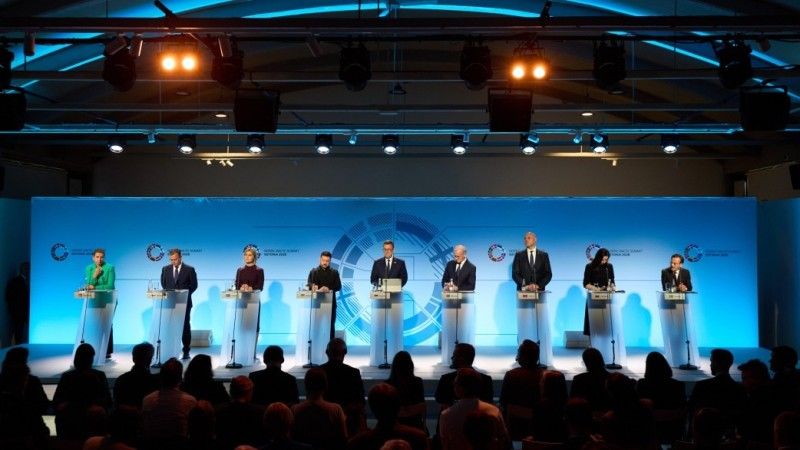
Photo. President of Ukraine
The Tallinn summit showed that the Nordic-Baltic Eight is no longer only a regional consultation format. It is becoming one of the most active political groups in Europe on Ukraine, Russia and NATO’s northeastern flank. Its message was clear – as it has been for the last 4 years – that Ukraine is already a partner for the Baltic and Nordic states.
The leaders of Sweden, Norway, Finland, Denmark, Iceland, Lithuania, Latvia and Estonia met in Tallinn with Ukrainian President Volodymyr Zelenskyy. In their joint statement, they supported Ukraine’s irreversible path towards full Euro-Atlantic integration, including NATO membership, and backed Ukraine’s accession to the European Union as quickly as possible.
The NB8 countries are not speaking about Ukraine as a distant partner or a future problem to be solved after the war. They are presenting Ukraine as a state that already contributes directly to Euro-Atlantic security through battlefield experience, technological innovation and defence-industrial potential. This is an important shift, because it changes the logic of the discussion.
The summit also comes at an important moment. The NATO summit in Ankara on 7–8 July 2026 is approaching, and Ukraine is expected to take part. For Kyiv, the Tallinn declaration strengthens the political argument that NATO should not treat Ukraine only through the language of support packages, but through the language of future membership and security integration. For the Nordic and Baltic states, this is also a question of their own security. They understand that Russia’s war against Ukraine is directly linked to the security of the Baltic Sea region, the Arctic, the eastern flank and the whole Euro-Atlantic area.
See also 

The EU dimension is equally important because the NB8 leaders called for the opening of all negotiating clusters for Ukraine in June or July 2026 without further delay. They also stated that Ukraine’s EU membership would be one of the key security guarantees for both Ukraine and Europe. This is a significant formulation because it shows that for the Nordic-Baltic region, enlargement is no longer only an institutional process.
The practical element of the summit was also visible in the drone agreement signed by Ukraine and Latvia. The Drone Deal format is important because it connects Ukrainian battlefield experience with the resources, funding and industrial capacities of partner states. Ukraine has become one of the most important drone warfare laboratories in the world. The task for Europe is to turn this experience into production, doctrine and joint capability development.
President Zelenskyy also used the summit to underline three priorities: more active diplomacy, stronger air defence cooperation and progress on Ukraine’s EU accession process. His message was direct: Europe cannot protect itself without Ukraine. This is not only a political slogan. It reflects the reality of a war in which Ukraine has generated operational knowledge that many NATO states do not have, especially in drones, electronic warfare, air defence, battlefield adaptation and mass mobilisation of technology.
The Nordic-Baltic countries remain united in their support for Ukraine and their commitment to a just and lasting peace.
— Margus Tsahkna (@Tsahkna) June 10, 2026
"Our aim is to achieve a comprehensive, just and lasting peace, based on international law and the UN Charter. We will work to put Ukraine in the strongest…
The NB8 format has gained importance since Russia’s full-scale invasion in 2022 and since Finland and Sweden joined NATO. It brings together countries that are geographically close to Russia, politically committed to Ukraine and increasingly coordinated on sanctions, hybrid threats, energy infrastructure, military aid and regional resilience. These states may not individually have the weight of Germany, France or the United Kingdom, but together they can shape the European debate and increase pressure on larger capitals.
It is also worth noting that the NB8 meetings often take place in different formats. Depending on the topic and political context, the Nordic-Baltic countries invite partners from outside the group, including Ukraine, the United States or other European states. This flexibility is one of the advantages of the format. It allows the NB8 to act faster than larger institutions and to build issue-based coalitions around security, sanctions, resilience, drones, IT, demining or support for Moldova and Ukraine.
This is why Tallinn should not be seen only as another pro-Ukrainian declaration. It was also a signal that smaller and medium-sized European states can organise themselves politically and strategically when larger formats move too slowly. In the current security environment, regional formats matter more than before. They help maintain pressure, coordinate assistance and keep Ukraine high on the European agenda.
See also

For Poland, this is also an important lesson. The Nordic-Baltic states are building influence through consistency, coordination and practical support. They are not waiting for the largest European powers to define the whole agenda. This is particularly relevant for the entire eastern and northeastern flank of NATO, where the threat from Russia is not abstract, but direct.
If Ukraine is described as a strategic partner of NATO, if its EU membership is treated as a security guarantee, and if its battlefield experience is seen as an asset for the whole Alliance, then Europe is moving towards a new understanding of its own defence. At the same time, Ukraine must prove itself worthy of this European trust.


