












- KOMENTARZ
- WIADOMOŚCI
40 days of Ukrainian deep strikes: Will the Russians rebel?

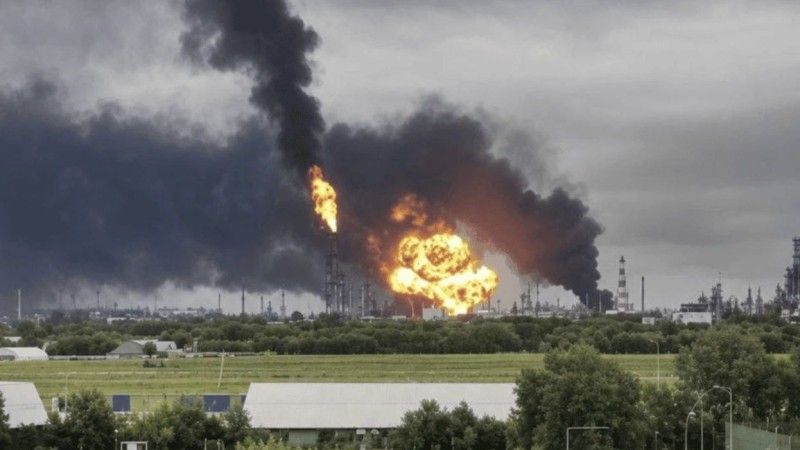
Photo. Генеральний штаб ЗСУ / General Staff of the Armed Forces of Ukraine / Facebook
Back in June, Ukrainian President Volodymyr Zelenskyy announced the launch of a 40-day “influence operation” aimed at persuading Russia to end the war against Ukraine. The deadline passed on 4 August. What have the Ukrainians managed to achieve during this time?
The operation by the Ukrainian services, which concluded last week, ultimately resulted in over 100 successful attacks on Russian fuel, energy, and logistics infrastructure. “For now, the strikes on the energy sector have hurt Russia significantly, and the blows to logistics are an equally important action, as they hit e-commerce to some extent and thus the bypassing of sanctions,” said Dr Michał Patryk Sadłowski from the University of Warsaw.
A message to specific audiences
When asked about the objective of Ukraine’s actions, he indicated that in addition to inflicting losses that financially weaken the Russian war machine, the Ukrainians were also keen to send specific messages to various groups. This refers to both domestic and foreign audiences. “Ukraine is demonstrating externally that it is not only trying to defend itself but also to deliver offensive blows, which in the future could ensure that any potential freezing or termination of the conflict remains permanent,” he says, noting that the attacks are also a signal directed at those external and internal observers who increasingly doubt the sense of continuing to support Kyiv. “The success of recent operations is also a signal that aid for Ukraine is not being consumed by corruption, and we know that recently this has once again become one of the main topics in the press and the general discussion about Ukraine itself,” he added.
In the case of Russia, the recent Ukrainian actions are particularly painful for at least two reasons. The unprecedented attacks on Russian energy and logistics infrastructure have weakened the capacity of the fuel sector in Russia, which is significant in the context of the Kremlin’s war machine’s operations.
According to Michał Sadłowski, Ukraine also aims to achieve one further effect. This time, it concerns a clear signal to Russian society, demonstrating the mounting costs of a war that has been waged for over four years. There is also another aspect to all of this – through the recent attacks, the Ukrainians also want to demonstrate the inefficiency of the Russian authorities.
Kremlin propaganda is still working intensively to convince the Russian population that in this defensive war, Russia "is in the black," as it has already recovered part of its historical territories. However, Ukraine, wanting to win this war or maintain its independence, must attempt to destabilise such a socio-political arrangement in Russia
noted Dr Sadłowski.
The expert also indicated that the current actions by the Ukrainians could prove to be a “wake-up call” for a large portion of Russians who for years have lived as if the war with Ukraine did not actually exist. “Russia analysts point to the following paradox in this regard: despite fundamental political changes in Russia after 24 February 2022, including the totalitarisation of the system, in the social sphere, and especially regarding consumption etc., Russians are trying to live as they did before 24 February 2022,” he said.
See also 

How will Russians react?
Given that these attacks can no longer be ignored, and it is impossible to dismiss the effects of the strikes – as their consequences hit virtually every Russian to a greater or lesser extent – the question arises whether the Russian population will interpret these attacks, and especially their consequences, as government inefficiency, or perhaps direct their anger and frustration entirely towards the Ukrainian side.
There is still no clear answer, at least for me, to the question of whether Ukrainian attacks/retaliations on Russian territory will prove in the short term to be a tool that would force the Russian population not only into deeper reflection but perhaps into some clearer form of expressing dissatisfaction towards the authorities, not to mention attempts at self-organisation. Furthermore, the scale of repression still means that the vast majority of the population prefers to "keep quiet," assuming that V. Putin will pass eventually anyway
Dr Michał Patryk Sadłowski from the University of Warsaw.
He added that Russians continue to focus primarily on their personal and family lives, or they may conclude that the recently experienced decline in the quality of life is the price of sacrifice as part of the “defensive struggle” against the West.
See also

Fear of a return to the 1990s
Within Russian society, there are also people who care about not losing the war with Ukraine for one specific reason. Namely, it concerns fears of… a return to the 1990s.
“They believe that a Russian defeat could be linked to the collapse of the state, perhaps even its partial disintegration, revolution, civil war, or other forms of chaos, which would primarily worsen their material, professional, and living status. And thus, the chaos of 1991 would repeat itself,” says the expert, noting that today’s Kremlin propaganda reports that the “good era” of modern Russia only began with Vladimir Putin coming to power, i.e., from the year 2000.
Finally, there remains the question of the aforementioned Vladimir Putin and his approach to this war. According to Michał Sadłowski, the Russian leader stays convinced that his actions can ultimately lead to the collapse of Ukraine. “He is certainly playing for the maximum objective in this regard, meaning a level of fatigue in Kyiv that could even lead to the destabilisation of the Ukrainian state, which would enable the pushing through of at least an initial framework for the geopolitical decoupling of Ukraine from the West, with the aim of subjugation to Russia,” he says, noting that any concessions from the Kremlin may only occur when the internal situation of the Russian Federation deteriorates to such an extent that it threatens the loss of power.


