












- OPINIA
- KOMENTARZ
- WIADOMOŚCI
The Baltic as a ‘battlespace’: When diplomacy and Special Operations Forces work together [OPINION]

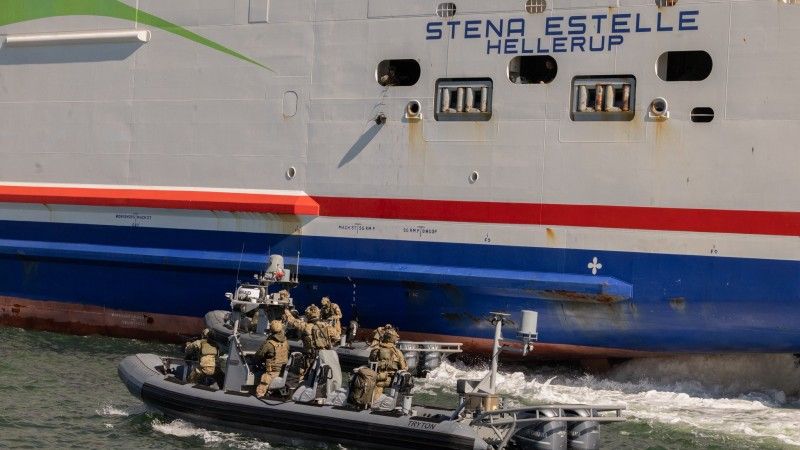
Photo. Marcin Maniewski, Ministerstwo Spraw Zagranicznych
Ten member states of the Council of the Baltic Sea States (CBSS), the European Union, the European Maritime Safety Agency (EMSA) and NATO seated around one table. A five-hour tabletop exercise, the first exercise in CBSS history to employ a hybrid-threat scenario format, followed by a dynamic demonstration of the Polish Special Operations Forces« capabilities in the presence of the region’s foreign ministers.
Following Russia’s full-scale invasion of Ukraine in 2022, Finland and Sweden decided to join the North Atlantic Alliance. It was at that point that the Baltic Sea began to be described, in simplified media shorthand, as a so-called »NATO inland sea«. For analysts and planners, however, it remains a maritime area riddled with gaps — in legislation, procedures and the architecture for sharing information. The recent ORKAN 26 exercise sought to identify those gaps before an adversary could exploit them.
Poland's Presidency of the Council of the Baltic Sea States
ORKAN 26 was organised by the Polish Special Operations Component Command and the Ministry of Foreign Affairs as a major event within the programme of Poland’s presidency of the Council of the Baltic Sea States. Participants included the CBSS member states of Denmark, Finland, Germany, Latvia, Lithuania, Norway, Poland and Sweden, alongside representatives of the European Union, the European Maritime Safety Agency and NATO’s Command Task Force Baltic. The format had a clearly defined purpose: to strengthen regional cooperation in countering hybrid threats, particularly those posed by Russia’s shadow fleet and by threats to critical infrastructure in the Baltic Sea. In this context, ORKAN 26 served as an instrument of diplomacy — enabling effective coordination between partners while demonstrating the state’s ability to respond to threats efficiently and credibly.

The scenario: The 'Shadow Fleet' as a system
Twenty-one vessels with opaque ownership arrangements, each of which, considered individually, remained compliant with maritime law. Taken together, however, they formed a coordinated network positioned with precision around critical Baltic infrastructure: power and telecommunications cables, gas pipelines and LNG terminals. The vessels claimed that they were waiting for the Strait of Hormuz to reopen, providing them with a lawful pretext that was difficult to challenge. At the same time, one vessel staged a false medical emergency, which escalated into the seizure of a passenger ferry carrying 340 civilians. The remaining vessels continued to circle close to critical infrastructure. Over the course of five hours, participants faced simultaneous incidents across the maritime, cyber, energy, information and intelligence domains. The fundamental question confronting them was simple: when should they respond, and how?
Technological innovation: A fully automated system
ORKAN 26 was the first exercise in the Baltic Sea region to be conducted using a fully automated system for delivering scenario data. The organisers developed and implemented a solution integrating ten separate scenario strands — one for each participant — into a single, coherent master scenario. In real time, the system distributed more than 230 exercise injects, reproducing the pace and complexity of a multidomain hybrid crisis.
This made it possible to achieve something that conventional tabletop exercises rarely provide: each delegation saw a different part of the operational picture, exactly as would happen during a real crisis. The asymmetric distribution of information was a deliberate feature of the exercise, not a technical limitation.
Dynamic capability demonstration: Special Operations Forces in the Port of Gdynia
On the second day of the exercise, 29 May, the Polish Special Operations Forces conducted a dynamic capability demonstration in the presence of CBSS foreign ministers and representatives of the EU and NATO. The FORMOZA Military Unit, supported by S-70i helicopters from the GROM Military Unit, as well as assets from the Polish Air Force and Navy, carried out a boarding operation against a passenger ferry. The operation involved simultaneous boarding from the sea and the air. Assault teams approached the stern in fast boats, while another team inserted from a helicopter onto the forward deck. Two F-16 multirole aircraft provided air support, while Polish Navy vessels secured the surrounding maritime zone. The entire operation was completed within fifteen minutes.
For the first time in CBSS history, a tabletop exercise culminating in a presentation to ministerial-level officials was accompanied by a dynamic demonstration of kinetic capabilities. The message was very clear and unambiguous: the Polish Special Operations Forces are part of the regional security architecture. They represent a permanently ready capability, visible to allies and credible as an instrument of deterrence.

Challenges involved in responding to hybrid threats
ORKAN 26 provided an opportunity to examine three major challenges associated with responding to hybrid threats.
- The threshold problem - the limit of response. None of the individual incidents provided sufficient grounds for forceful action. Taken together, however, they formed the recognisable pattern of a coordinated campaign. Hybrid threats are deliberately designed to remain below the threshold that would trigger a decisive response. Authorities must therefore respond to the pattern as a whole, rather than treating every incident in isolation.
- Fragmented competencies. The most difficult question during a hybrid crisis is often not what should be done, but who has the authority to decide. The Border Guard, armed forces, police and crisis-management authorities each have their own mandate, yet no single institution is responsible for the entire situation.
- Real time data, even incomplete, entails a strategic value. Sharing intelligence and situational data immediately, despite gaps or uncertainty, is often more valuable than withholding it until complete confidence has been achieved. Persistent uncertainty is the preferred operating environment for a hybrid campaign.
SOF as an instrument of foreign policy
The cooperation between the Ministry of Foreign Affairs and the Special Operations Component Command in preparing a tabletop exercise for the Council of the Baltic Sea States — followed by a dynamic capability demonstration in front of foreign ministers — amounted to a deliberate presentation of a model in which special operations forces operate not only in the military sphere, but also as an instrument for implementing national foreign policy.
In this way, Poland is signalling its readiness to develop regional capabilities across their full political, military and operational dimensions. Within this architecture, the Special Operations Forces serve as a vanguard: capable of operating below the threshold of armed conflict, within a multidomain environment and under complex circumstances that resist straightforward legal classification. ORKAN 26 was not a propaganda display. It was an exercise in building awareness — and a test of readiness. Both objectives carry equal strategic value.


