












- ANALIZA
- WIADOMOŚCI
The Geo-economic and strategic dimension of Xi Jinping's visit to Egypt

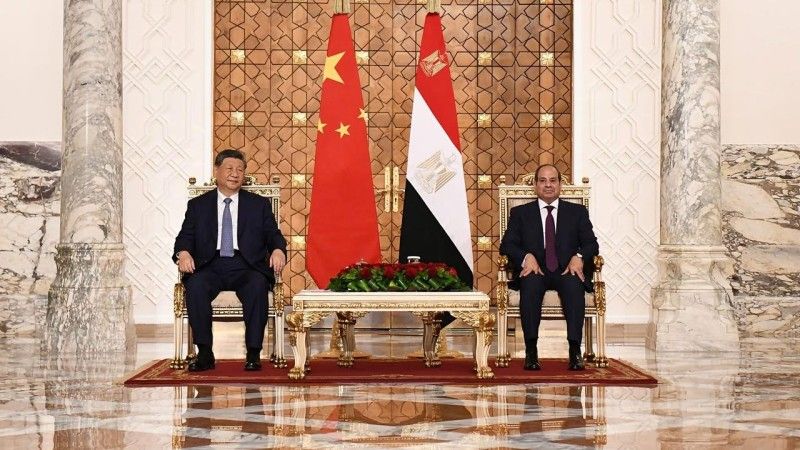
Photo. @SISEGY / X.com
The state visit of the President of the People’s Republic of China, Xi Jinping, to Cairo, which began on September 1st, 2026, took place at a special moment in Sino-Egyptian relations, marking the seventieth anniversary of the establishment of diplomatic relations between the two countries. The anniversary nature of the meeting was utilised by Cairo and Beijing to emphasise the durability of mutual relations and their growing political, economic, and strategic significance. At the same time, the scale and symbolism of the event indicated that its significance went beyond the bilateral dimension and was part of a broader process of transformations in the balance of power in the Middle East.
A special element of the summit was the personal guided tour given to Xi Jinping by President Abdel Fattah el-Sisi through the newly opened Grand Egyptian Museum. This gesture had both protocol and political significance. The museum, similar to the construction of the New Administrative Capital, is among the flagship projects of the “New Republic of Egypt” concept, aimed at emphasising the modernisation of the state, infrastructural development, and the rebuilding of its position as a key actor in the Arab and African world. The implementation of Egyptian megaprojects is significantly supported by Chinese investments, whose total value exceeds 10 billion USD. The visit of the Chinese leader to the facility was thus not solely a demonstration of respect for Egyptian cultural heritage, but also constituted an element of conscious symbolic diplomacy, through which the authorities in Cairo connect the historical rank of Egypt with a narrative of its contemporary developmental aspirations.
In this approach, the Grand Egyptian Museum became a space for presenting two dimensions of Egyptian statehood: civilisational continuity and modernisation ambitions. This is particularly significant from the perspective of the policy of President el-Sisi, whose legitimisation is largely based on presenting the state as capable of implementing large-scale infrastructural projects and regaining its regional position. The symbolic dimension of the visit was complemented by the publication of synchronised articles in the state media of both countries, in which the need for further expansion of pragmatic cooperation was emphasised. Thus, the anniversary of establishing diplomatic relations was utilised not only to serve as a reminder of their durability, but also to create a political narrative justifying the further deepening of the partnership.
Visit amid regional destabilisation
The summit took place against the background of an exceptionally unstable security situation in the Middle East, determined primarily by the American-Iranian war, the ongoing conflict in the Gaza Strip, and the increase in threats in the Red Sea. The accumulation of these crises was of particular significance to Egypt, whose economic and strategic position is directly linked to the stability of the maritime routes leading through the Red Sea and the Suez Canal. Disruptions to shipping and the restriction of transit traffic translated into a drastic drop, reaching sixty percent, in revenue from Suez Canal transit fees.
These consequences should be viewed more broadly than as a temporary reduction in budget revenues. The Suez Canal is one of Egypt’s most important strategic assets and a primary source of state revenue, and its significance extends beyond the financial dimension. The stability of its functioning is, in fact, one of the foundations of Egypt’s geopolitical position as a state controlling one of the most important communication points between Europe and Asia. Consequently, the crisis in the Red Sea simultaneously constitutes for Cairo a security threat, an economic problem, and a challenge to its regional significance.
In this context, Xi Jinping’s call for the creation of a new security architecture, in which the states of the Middle East would become independent actors to a greater extent, gained particular significance. This declaration should be interpreted as an attempt by China to present an alternative model of managing regional security. In contrast to an approach based on the dominant role of an external power, Beijing emphasises the importance of state sovereignty, dialogue, and regional mechanisms for conflict resolution, alongside simultaneous behind-the-scenes actions aimed at ensuring the protection of Chinese interests. This also has a strategic dimension: the stability of the Middle East remains directly linked to the security of Chinese economic interests, energy resource supplies, and the functioning of global trade routes.
See also 

Significance for Egypt and China
For Cairo, tightening cooperation with Beijing constitutes an element of a broader strategy of diversifying strategic partnerships. Egypt remains particularly tied to the United States, Europe, and the Persian Gulf states, while simultaneously striving to increase its own geopolitical independence by developing relations with other power centres. China is a particularly attractive partner in this arrangement due to its investment potential, opportunities for infrastructural cooperation, and ability to engage in projects with a long strategic and temporal horizon. Strengthening relations with Beijing allows the Egyptian authorities to limit dependence on individual partners and increase their own room for manoeuvre in both foreign and economic policy.
For China, on the other hand, Egypt’s significance stems from its geographical location, control over the Suez Canal, position in the Arab world, and ability to influence processes occurring in both the Middle East and Africa. Xi Jinping’s visit was therefore simultaneously a demonstration of support for Egypt’s regional role and a signal that Beijing intends to participate more actively in shaping the regional order.
Consequently, the visit should not be viewed solely as an anniversary event. It constituted an element of deepening the Sino-Egyptian strategic partnership and a broader attempt by China to increase its political and economic presence in the Middle East. At the same time, for Egypt, cooperation with Beijing can serve as a tool for strengthening strategic autonomy in conditions of growing great-power rivalry and regional destabilisation. In the longer perspective, the development of this partnership may therefore influence not only bilateral relations but also the evolution of the regional balance of power and the gradual limitation of the dominance of traditional Western actors in shaping Middle Eastern security.


