












- WIADOMOŚCI
- ANALIZA
The network is expanding. But who commands which part of the network?

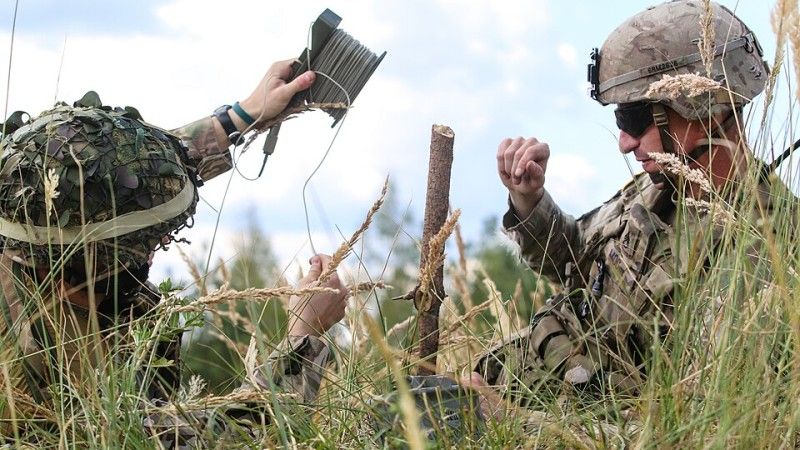
Photo. U.S. Army photo by Spc. Hubert Delany / Wikimedia Commons
The Eastern Flank is not simply shifting its geography. It is building distinct layers of dependency, and these layers may not share the same centre.
Observing NATO’s Eastern Flank has almost inevitably meant observing Poland. This has not merely been a matter of geography, but because Warsaw has progressively concentrated a combination of strategic depth, infrastructure, American presence, logistical capabilities, and, especially after 2022, a connectivity function toward Ukraine that remains difficult to replicate. Rzeszów has become the most visible symbol of this centrality, while Poland’s rearmament has transformed the country from a frontier state into one of the continent’s primary military hubs.
This centrality is not disappearing. On the contrary, while new capabilities emerge around Poland, Warsaw continues to increase its material weight. It is precisely this apparent contradiction that makes the ongoing transformation less straightforward. A network can expand without its centre losing relevance; it can distribute certain functions while keeping others strictly concentrated; it can even enhance the value of the node capable of connecting previously non-existent parts. Losing exclusivity, in other words, does not necessarily mean losing centrality.
Yet, an additional factor makes it difficult to view Poland as merely the eastern pillar of a future European industrial architecture organised by Germany. Warsaw has built a substantial part of its rearmament outside this framework, purchasing Abrams tanks, HIMARS, F-35s, and Apache helicopters on a massive scale from the United States, while simultaneously turning to South Korea for K2 tanks, K9 howitzers, FA-50 light fighters, and Chunmoo rocket launchers. This involves far more than simply procuring different weapon systems. Every platform entails training pipelines, ammunition supplies, maintenance cycles, spare parts, upgrades, industrial arrangements, and technological dependencies designed to last for decades.
Poland thus emerges as a compelling case within the very network it is expected to help organise: geographically European, strategically transatlantic, and industrially linked to Asia. This limits Berlin’s potential to serve as the sole technical hub of the Eastern Flank and introduces a structural challenge likely to accompany European rearmament for years: increased capability does not automatically translate into greater homogeneity. A portion of the eastern land force may expand across American, South Korean, and European ecosystems simultaneously, increasing available mass while escalating the complexity of maintaining interoperability.

While Poland complicates the relationship with Germany, Ukraine reflects the most profound potential shift. Throughout the opening years of the war, Kyiv evolved into a vast operational laboratory, generating operational experience, tactical adaptation, rapid innovation in unmanned systems and electronic warfare, and a volume of battlefield knowledge that European militaries could hardly acquire in peacetime. The relationship remained recognisable: the West supplied essential capabilities, while Ukraine absorbed them, adapted them to battlefield realities, and returned hard-won operational insight.
This dynamic is now beginning to change. Technology transfers, joint industrial ventures, localised assembly lines, and initiatives to onshore Western defence production within Ukrainian territory open the possibility of Kyiv transitioning from a consumer and producer of operational experience into an internal manufacturing pillar of the emerging European security architecture. This transition is not yet complete, and conflating a licensing deal or an assembly facility with a self-sustaining industrial base remains an analytical error. Understanding the critical threshold becomes essential.
A factory may operate on Ukrainian soil while remaining almost entirely dependent on external inputs. Semi-finished goods, microelectronics, propellants, specialised machine tools, intellectual property, underwriting capital, and critical components continue to cross borders even when the end product carries a domestic label. The geography of physical production reveals far less than the geography of strategic dependencies. Determining whether Ukraine is truly becoming a distinct hub requires identifying where the supply bottlenecks lie.
An even more demanding challenge follows: sustaining defence manufacturing during active conflict is fundamentally different from sustaining it in peacetime. Ukraine’s wartime economy operates under extraordinary conditions, driven by immediate defence needs, Western funding lines, special procurement vehicles, and the political imperative to sustain combat operations. The decisive milestone will not be the ribbon-cutting of a facility, but the simultaneous establishment of serial production, resilient supply chains, domestic maintenance depots, multi-year budgetary support, predictable procurement cycles, and eventual export capacity. Only then can a wartime contingency measure be distinguished from the emergence of an enduring European production hub.

A tangible constraint looms that may prove more decisive than manufacturing infrastructure itself. Building a broad defence-industrial base requires specialised engineers, technicians, maintenance personnel, precision welders, software developers, logistics specialists, and a workforce capable of managing increasingly sophisticated systems. Both Poland and Ukraine face major demographic headwinds, acutely compounded in Ukraine by wartime losses, casualties, and displacement. A paradox may emerge in which capital, contracts, and facilities compete for the single resource that cannot be accelerated on demand: the specialised human capital required to operate them.
A distinct dynamic is unfolding at the northern and southern edges of the Flank. The Nordic-Baltic region is establishing tighter integration across airspace and maritime surveillance, critical infrastructure resilience, counter-drone networks, and naval defence. Concurrently, in the Black Sea, trilateral cooperation among Romania, Bulgaria, and Turkey, alongside the growing logistical importance of Constanța and the Danube corridor, adds strategic weight to a southern axis long overshadowed by the Polish route.
Here too, looking for a single replacement hub misses the broader structural shift. Constanța does not need to displace Rzeszów to carry strategic value, nor do Rail Baltica and Via Baltica need to render Polish corridors obsolete. The real transformation occurs when the disruption of a single axis no longer disables the broader system, because parallel corridors exist through which personnel, matériel, energy, and combat power can continue to flow. A network gains resilience not by establishing an indispensable node, but by systematically reducing single points of failure.
This operational reality defines Germany’s unique position. Berlin commands the economic scale, industrial depth, transport infrastructure, and fiscal capacity to act as more than just another node, positioning itself to shape technical standards, fleet interoperability, lifecycle maintenance, and continental procurement. Yet this capacity faces clear limits: the network Germany seeks to coordinate does not originate solely within its borders, and as the Polish procurement posture demonstrates, several of its most critical components belong to separate technological ecosystems.
The European Union introduces an additional layer of institutional complexity. While Brussels commands no armed divisions and exercises no direct authority over national military chains, its regulatory instruments, common defence funds, co-financing incentives, and industrial strategies increasingly dictate which manufacturing initiatives achieve long-term viability and which remain fragmented national endeavours. The authority that allocates capital inevitably influences where industrial capacity survives. Financing, therefore, functions as its own form of strategic geography.
Yet even this layer may not represent the ultimate tier of command, because an intangible domain operates above factories, deep-water ports, rail networks, and armoured brigades. Orbital constellations, real-time intelligence feeds, tactical data links, integrated battle management systems, target acquisition architectures, and broader C4ISR networks form the nervous system without which modern weapons platforms lose their decisive edge. The centre of gravity for this layer rests neither in Warsaw nor in Berlin. It remains anchored in the United States and the broader transatlantic architecture of NATO.

This reframes the underlying question. Analysis often seeks a single command centre within an architecture that no longer relies on one. Washington retains primacy over intelligence, strategic command, and the nuclear umbrella; Germany and Brussels steer a growing share of European industrial frameworks and capital allocation; Poland maintains a dominant land-power footprint, logistics hub, and eastern connectivity; South Korea embeds itself deeply into Poland’s material ecosystem; Ukraine drives tactical innovation and moves steadily toward co-production, while Romania, the Baltic States, and the Nordic nations anchor critical regional functions. The Eastern Flank is therefore evolving neither toward a centralised hierarchy nor toward pure polycentrism. It is developing into a multi-layered architecture where distinct tiers of the same operational network depend on different command centres – centres whose strategic priorities do not always fully align.
This structural lens clarifies Russian strategic behaviour. Moscow’s declaratory posture does not always signal impending kinetic action, but tracking the nodes it singles out, delegitimises, or threatens helps identify the connections it views as most threatening. When Russian messaging expands beyond Ukrainian field formations to target Western-supplied strike systems, industrial joint ventures, technology-transfer agreements, shared intelligence architectures, and the sovereign states enabling those capabilities, the operational boundary of the conflict broadens.
Moscow faces growing difficulty in treating the Ukrainian battlefield as separate from the transnational network sustaining it. This does not mean it considers every Western capital an active combatant, nor that it possesses the means to halt the current industrial reorganisation. It does indicate that Russian threat perceptions now incorporate the systemic depth behind the frontline. As manufacturing, maintenance, and technical capacity shift eastward, the strategic footprint of the threat perceived by Russia shifts westward.
This creates a second operational paradox. Russian pressure may accelerate the geographic distribution of European defence assets, as operational redundancy prevents an adversary from neutralising the network via a few high-value targets. Simultaneously, that same external threat incentivises European states to centralise operational command, shared financing, integrated air defence, and technical standards to manage escalating risk. A network can thus become geographically dispersed while becoming functionally concentrated in its dependencies.

Evaluating the Eastern Flank requires moving beyond the question of who commands the region as a whole. The relevant question is who commands which functional layer of the network, and what happens when those centres diverge.
Who provides targeting and intelligence, who finances capital expenditure, who manufactures the hulls, who controls critical subsystem components, who sustains lifecycle maintenance, who guarantees munitions stockpiles, who secures strategic transit routes, who maintains the technical workforce, and which of these structural partnerships will endure once the immediate wartime urgency recedes?
The future European strategic hierarchy is taking shape along these seams, rather than in baseline troop deployments or headline equipment procurements.
The fundamental shift may be difficult to discern because while analysts continue to use the traditional terminology of the Eastern Flank, the architecture taking shape no longer functions as a peripheral flank – nor does it answer to a single, monolithic East.
Authors: Ireneusz Sebastian Nowiński, Generazione Ponte Foundation


