












- ANALIZA
- WIADOMOŚCI
The Russian paradox: an oil producer forced to import gasoline

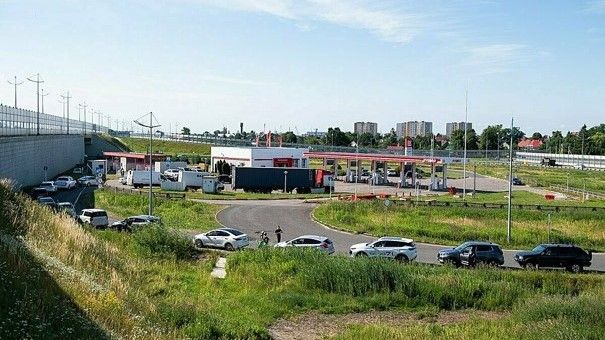
Photo. Александр Подгорчук / Wikimedia Commons
Ukraine is intensifying long-range strikes on Russian territory, while in the Sea of Azov it is targeting ships transporting gasoline. People are waiting in queues, and local authorities are forced to report shortages – in some regions, a sales ban was also introduced. With each passing day, Russians are feeling the consequences of the “special military operation” more and more.
Oil refineries as a main target of Ukrainian strikes
Recently, the Ukrainian Army has increased the frequency of its long-range strikes. It is worth mentioning the recent attacks on a refinery in Omsk, located approximately 2,500 kilometres from Ukraine. Consequently, production at this refinery has been halted. The same fate befell the NORSI refinery in Kstovo and the Saratov refinery, which are some of the largest gasoline producers in the Russian Federation. As the number and frequency of these operations grow, the Kremlin is struggling to repair the oil infrastructure. At the same time, constant raids are a significant obstacle to restoring previous production capacities.
Moreover, because of the drone attacks targeting not only refineries but also ships with gasoline, there is still an emergency on the Crimean Peninsula, as local authorities are struggling to get the blockade of Crimea under control, which is leading to a humanitarian crisis. Only last week Ukraine struck at least 36 ships coming to the peninsula, 32 of which were part of the shadow fleet that was supposed to supply the occupied region. For the Kremlin, the Crimean issues should be perceived as a political problem. The annexation of this region met with huge support among Russians, and now Vladimir Putin cannot secure it from constant Ukrainian attacks.
For the past few months, Ukraine has been using measures known as kinetic sanctions, which target first and foremost Russian energy infrastructure and its shadow fleet tankers being used for illegal transportation of oil outside the G7 sanctions regime. Ukraine says its attacks on Russian fuel facilities are designed to limit Russia’s ability to continue its war effort and force Moscow to start peace talks.
War is coming closer to home for many Russians – not only on the Crimean Peninsula. Undoubtedly, the gasoline shortages are growing and becoming more problematic not only for citizens but also for the Kremlin. According to Reuters, the state’s gasoline output covers only 65% of demand because of Kyiv’s attacks. There is something remarkable here: the Russian Federation, a fossil fuel giant, cannot provide its own citizens with the resources necessary for everyday life.
See also 

Consequences of war come to Russian citizens
Another problem for Putin and his government is the fact that Ukrainian attacks are more visible on the Internet. So, in this situation, no one can deny that the consequences of the war are becoming more noticeable. Especially since there is a dedicated website which shows where fuel is available and where it is not, providing clear evidence of how shortages are affecting the daily lives of citizens.
Many reports online show drivers queuing to refuel their vehicles for up to 18 hours. Interestingly, at some petrol stations, Cossacks were used to support police officers in maintaining public order. This situation is occurring in the Black Sea resort of Anapa.
Due to the fuel shortages in some areas, bus services and rubbish collection have been reduced. Moreover, as the summer harvest is approaching, the lack of gasoline is also worrying farmers.
The fuel crisis is evident in most regions of Russia. It is worth mentioning CNN’s research that analysed official statements from regional mayors and governors as well as national and local media reports. According to the report, more than 50 Russian regions have officially reported supply problems. At least three regions, including Irkutsk and the Transbaikal region in eastern Russia, have declared a state of heightened alert”, which is only one step below a state of emergency.
In these regions, social frustration is becoming more visible; for example, in Irkutsk, police fined four people, accusing them of reselling gasoline on the black market at inflated prices. Another incident involved a 20-year-old man who was accused of selling fuel at around four times the national average price. It is worth noting that, similar to the Crimean Peninsula, the local authorities in Irkutsk banned the sale of petrol in canisters to anyone except emergency services.

From oil exporter to gasoline importer – the Russian paradox
Because of Ukrainian strikes, which caused fuel shortages, Moscow is forced to boost imports of gasoline and diesel – the government announced an increase in imports this week from Belarus and Kazakhstan. Supplies of gasoline and diesel from Minsk to Russia hit a monthly record in June, with volumes reaching 6,000 tons of gasoline per day.
Gasoline production is currently 40,000 to 45,000 metric tons per day below what’s needed – a shortfall of around 35%. This gap is especially problematic in summer, when warmer weather leads to more driving and higher fuel demand.
Russian politicians are trying not to exaggerate the current situation, presenting it as challenging but not critical. Last week, Deputy Prime Minister Alexander Novak, during a televised government meeting, claimed that the fuel situation remained complex and that “it is clear that the current situation at filling stations is causing concern among the public.”
At the same meeting, Vladimir Putin highlighted that Ukraine was trying to damage Russia’s economy – “but most importantly, it seeks to create a sense of anxiety in society. We all understand that this goal is unattainable. The resilience of Russia’s power system is very high – among the highest in the world.” In a separate speech, he said that Russia is “currently seeing certain shortages, although they are not critical.” Following his statement on current fuel shortages, he also mentioned the need to significantly increase production of the air-defence systems, which shows how Russia is vulnerable to the Ukrainian offensive.

How the Kremlin is struggling with the fuel crisis
As a result of Kyiv’s drone offensive on oil refineries, the Kremlin is forced to implement new measures to stabilise the situation on the domestic market.
Faced with a very serious challenge and concerned about growing public anxiety over fuel shortages, on July 8, the Russian Federation announced a ban on diesel exports that will be valid until the end of the month. Additionally, last week it was declared that Russia had started imports of gasoline from India. For now, approximately 60,000 metric tons have been shipped from New Delhi. Russia, one of the world’s biggest oil producers, is struggling to refine enough fuel to meet domestic demand.
However, analysts mentioned that signs of a diesel export ban were also visible last month. According to Kpler data, Russia’s seaborne exports of diesel and gasoil already plunged in June, falling 39% from May to around 1.8 million metric tons – a 46% drop compared to the 3.35 million tons exported in June of last year. The decline has continued into July, with Russian diesel and gasoil exports averaging just 214,000 barrels per day between July 1 and 8, compared with 793,000 bpd for the entire month of July 2025, and 842,000 bpd in July 2021, before the war in Ukraine began.
Besides the diesel export ban, Putin mentioned that the government is planning to shorten scheduled refinery maintenance, increase imports from neighbouring countries and may be considering allowing lower-quality gasoline onto the market to increase supplies.
See also

A growing challenge for the Kremlin
According to the latest poll by the independent organisation Levada Center, Putin’s approval rating has dropped to around 74%, while the number of Russians who believe the country is heading in the right direction has fallen to 52%, down from 61% in May. Nevertheless, it remains unlikely that people will take to the streets.
The worsening economic situation should, however, be perceived as a major challenge for Vladimir Putin. When he came to power, he promised Russian society economic growth and the restoration of Russia’s great-power status. It seems that the lack of the first element is increasingly concerning Russians. According to Gallup, Russians are now more pessimistic about the state of their economy than at any point in the past 20 years, with 60% of respondents saying that economic conditions where they live are getting worse.
That said, there is little evidence that Russians will turn against Putin. On the contrary, he could feel more pressure to escalate attacks against Ukraine, but also increase hybrid threats and attacks against NATO countries, especially on NATO’s Eastern Flank. One point should be highlighted – Putin backed into a corner is not good news for the West.


