












- ANALIZA
- KOMENTARZ
- WIADOMOŚCI
The US is the biggest beneficiary of the EU’s energy decoupling from Russia

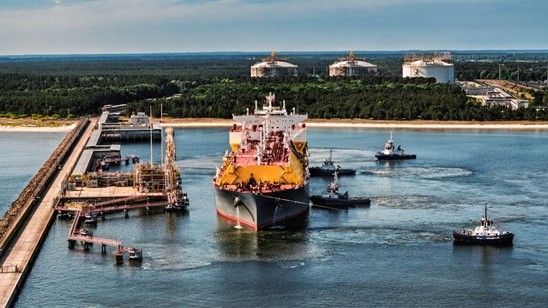
By redirecting its decoupling from Russian hydrocarbons toward the United States, Europe handed Washington a new source of lucrative leverage that is now increasingly exploited.
The EU’s decoupling from Russian hydrocarbons following Moscow’s 2022 aggression against Ukraine was, in itself, a strategic success. It largely broke Europe’s long-standing susceptibility to Russian energy blackmail and pressure, while cutting off a multi-billion-euro revenue stream for the Kremlin’s war machine.
Four years later, the EU’s dependence on Russian gas has fallen from 45% of total imports to 12%, while Russian oil imports have shrunk from 27% to just 2%. Last December, Member States agreed to phase out Russian gas “once and for all” by November 2027 and move towards phasing out Russian oil. Yet this elimination was not matched by real diversification, but by an almost complete redirection towards another supplier: the United States. That is the strategic mistake.
Europe's new energy dependency in numbers
The US has come to dominate EU LNG imports, nearly doubling its share from 29% in 2021 to 53% in 2025. At the same time, LNG’s share in total EU gas imports rose from less than a quarter to roughly half in 2025, following the collapse of Russian pipeline gas flows. The same dynamic is visible, though to a lesser extent, in petroleum imports, where Washington increased its share from 8% to 14%, becoming the EU’s largest supplier.

The situation is all the more concerning because the EU’s overall energy mix remains dominated by imported hydrocarbons, with petroleum accounting for 38% and gas for 19%. Holding the largest shares in both energy fuels gives Washington powerful leverage over the continent, especially at a time when its approach toward Europe is becoming increasingly transactional and aggressive.
From dependence to risky exposure
The EU has only awakened to this new dependency at the beginning of this year, when Washington threatened to annex Greenland. In late January, EU energy chief Dan Jørgensen said that the Union cannot risk “replacing one dependency with another”, while promising to find alternative suppliers to diversify away. Yet no concrete target has followed since, most likely because the immediate tensions over Greenland have gradually subsided.
But these tensions quickly returned this April over Trump’s threats to quit NATO or punish member states that refused to support the US in its war against Iran. In this context, the prospect of Washington leveraging its energy dominance over Europe can no longer be dismissed as hypothetical. Sooner or later, it could become just another instrument of pressure, used alongside Europe’s security and technological vulnerabilities to extract political concessions.

Unsurprisingly, Washington dismisses these concerns while seeking to preserve, and even deepen, Europe’s energy dependence. In response to Dan Jørgensen, Trump’s energy chief insisted that the United States would “never” weaponise energy exports and that the EU “can’t have a better partner”. Yet such reassurances are becoming increasingly difficult to square with Washington’s declining credibility and predictability, especially as the 2025 US National Security Strategy explicitly states that the United States may use its net energy exports to “project power”.
Obviously, US energy leverage over Europe is more constrained than the leverage Russia once held. Washington does not control private companies the way Moscow controlled its state giants, though it could still pressure them — formally or informally — to restrict exports. It is also true that pipelines locked Europe into Russian dependence much more tightly than LNG terminals, which can receive cargoes from different destinations if alternatives are available. Yet to harm Europe, this dependence does not necessarily need to be weaponised.
From monetisation to exploitation
Hydrocarbons offer the US not merely leverage, but an ideal, highly lucrative and structurally entrenched area to capitalise on its asymmetrical relationship with Europe, especially by leveraging other security and technological vulnerabilities. This is why Washington may be far more interested in further deepening this reliance than in torpedoing it.
In August 2025, both sides agreed on a framework agreement that many in Europe denounced as a capitulation and humiliation, caused by fears of abandonment by Washington and the threat of sweeping tariffs. It included the EU’s commitment to procure $750 billion in US LNG, oil, and nuclear energy products through 2028.
In that scenario, Europe would spend around $250 billion per year on US energy products — more than three times the $76 billion it imported in 2024, largely in hydrocarbons. According to IEEFA, the same $750 billion could instead finance 546 gigawatts of solar and wind capacity, equivalent to over 40% of the EU’s total installed electricity capacity.

This fits well with the US bid under Trump’s administration for American Energy Dominance, aimed at becoming a hydrocarbon hyperpower. A reinvigorated “Drill, baby, drill!” policy has fuelled major increases in both oil and gas production, with the country setting a new annual LNG export record in 2025. This also explains why the administration perceives the green transition, dismissed as a “climate cult”, as a potential European lever against US energy interests.
That said, the deal’s full realisation remains unrealistic due to both energy-market and political constraints. Even so, IEEFA estimates that the US could further expand its LNG dominance in Europe to as much as 80% of imports by 2030. If nothing changes, US hydrocarbon leverage over the continent will only grow — alongside the colossal sums of money that could instead be invested within Europe.
Perhaps such a relationship could be economically acceptable if US hydrocarbons at least provided Europe with a competitive advantage. In reality, they do the opposite. Today, the EU’s average natural gas price is roughly three times higher than in the US, while gasoline prices are currently about twice as high. As hydrocarbons still dominate the continent’s energy mix, these costs translate into some of the world’s highest energy prices, making global competition increasingly difficult. Europe is thus locked into a dependency that weakens its competitiveness, undermines its prospects of catching up with the US and China, and effectively finances the former.
Europe's hydrocarbon geography trap
Here we reach the core of the problem: Europe’s entrenched position as an energy importer. In 2024, the EU produced only 43% of its own energy, mainly from renewables and nuclear, while 57% was imported, mostly as oil and gas. The geography of hydrocarbons condemns Europe to dependence as long as they remain its dominant energy source.
Such a position will always leave Europe disadvantaged vis-à-vis energy exporters, both economically and strategically. Even when imports are not weaponised, Europe remains more exposed to supply shocks, with Bank of America recently finding that oil price shocks are twice as damaging for inflation and growth as in the US. Amid prolonged global instability — from Covid and Ukraine to Iran-related disruptions — and the growing weaponisation of energy, inaction will only make Europe suffer more.

Towards genuine diversification and a resilient energy transition
The words of EU energy chiefs suggest that Brussels is aware of the growing risks of dependence on US hydrocarbons. Jørgensen even argued that the EU should diversify towards “Canada for sure, Qatar, North African countries,” yet no concrete targets or measures followed.
This reflects a broader problem in EU legislation, which treats diversification merely as the elimination of Russian energy imports, even if the remaining supply comes from a single alternative source. This approach was understandable at the start of the war, when cutting Russia off was the priority, but it has become increasingly flawed and risky over time.
What the EU needs is therefore a genuine diversification and derisking, not merely finishing full decoupling from Russia but also steering its direction in a more distributed and resilient way. This could be achieved through supplier concentration thresholds, defining the maximum share any external supplier may hold. Such a limit should clearly remain below 50%, and preferably much lower, to ensure diversification across multiple providers while pricing in geopolitical risk.
Decoupling and diversification may change the sources and forms of exposure, but they cannot change Europe’s geography and thus cannot eliminate the underlying vulnerability. This makes a strong case for an energy transition towards a mix dominated by renewables and nuclear, which would better insulate Europe from external energy pressures and shocks.

However, even in “domesticating” energy production, Europe could repeat past mistakes, especially in green energy technology. China currently produces the vast majority of solar photovoltaics and batteries, allowing Beijing to shape the pace and price of the continent’s transition while capturing rents that could otherwise support Europe’s green industry.
What is worse, this dependency extends down to the critical minerals required for green technologies, where China’s dominance is even stronger. Europe will never achieve true energy autonomy unless it secures access to these technological and material capabilities, preferably through its own industrial and mining base. Similarly, in civil nuclear energy, European countries should remain cautious about nuclear fuel and reactor technologies, keeping supplies diversified while developing indigenous systems.
Europe faces a choice between energy servitude and true independence. The masters may change, but the chains will not be broken without genuine diversification and the internalisation of Europe’s energy mix.


