












- WAŻNE
- WIADOMOŚCI
What is happening in France? Macron waits as the streets burn

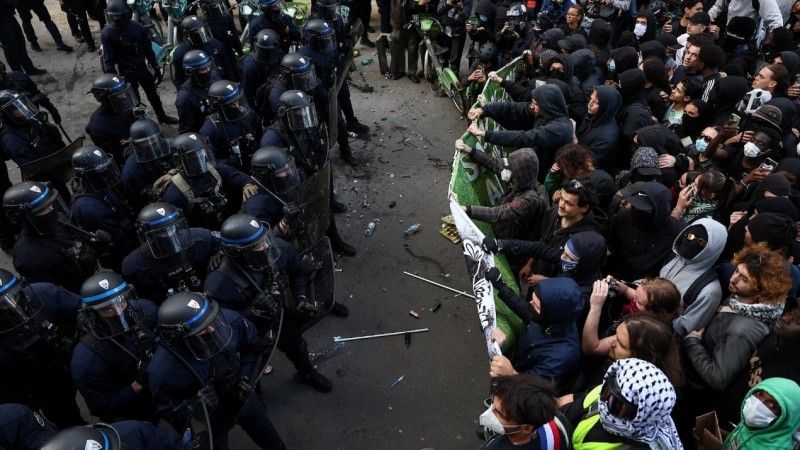
Photo. X/ Twitter
France is facing one of its most serious waves of domestic unrest in recent years. What began as demonstrations over education, public spending and living costs has escalated into violent clashes, arson, looting and attacks on state institutions. More than 500 police officers, gendarmes and firefighters have been injured, while at least 1,800 people have been arrested. President Emmanuel Macron faces mounting pressure to restore order as further nationwide protests are already being organised. The crisis is no longer simply about economic dissatisfaction. It is becoming a test of the French state’s ability to maintain control over its own territory.
Protests in France show no sign of ending, and the events of recent days, indeed recent weeks, demonstrate that the crisis has moved far beyond dissatisfaction with the economic situation or the education system. Initially, pupils, students and teachers took to the streets to demand greater investment in education, improved teaching conditions, more staff and an end to budget cuts.
There have also been peaceful demonstrations. However, the protests have increasingly attracted a much broader range of groups, from trade unions to radical political organisations. It must also be said that parts of the French left, particularly La France Insoumise, have actively encouraged the mobilisation and supported school blockades. Although its leadership has publicly rejected violence, its involvement has become an important element of the political confrontation.
France is no longer dealing merely with public dissatisfaction. It is facing a sustained battle over public order. The authorities are struggling to contain violent groups, while the security services are increasingly overstretched. Further nationwide demonstrations and strikes are already planned for 5 November, and there is little reason to expect the tensions to disappear in the coming weeks.
What has happened in recent days in Paris, Marseille, Lyon, Bordeaux and Limoges can hardly be described as ordinary demonstrations. Masked rioters have destroyed property, looted shops, set vehicles on fire, attacked police officers and firefighters, and vandalised public buildings. In Limoges, the historic 19th-century town hall was deliberately set ablaze. Much of the building was destroyed, including the collapse of its distinctive tower. Molotov cocktails, paving stones, pyrotechnics and improvised incendiary devices have been used during clashes.
According to figures released by the French Ministry of the Interior on 18 October, more than 500 police officers, gendarmes and firefighters have been injured, while at least 1,800 people have been arrested. These are no longer isolated incidents on the margins of demonstrations. France is experiencing a serious wave of violence that has exposed fundamental weaknesses in its internal security system — and, one might add, not for the first time.
Właśnie wróciłem z Francji 🇫🇷. Jestem bardzo zdziwiony, że państwo, które rozwija odstraszanie nuklearne i wojska w kosmosie jest wewnętrznie rozwalane i brakuje zdecydowanej reakcji. Protesty obejmują już największe miasta i niszczone są zabytki. Plan rządu to odpuścić...
— Aleksander Olech (@AleksanderOlech) October 17, 2026
In numerous locations, security forces have been overwhelmed, and the state has failed to protect even its own institutions and historical monuments. Some businesses have reinforced their premises with protective barriers, while shopkeepers have been forced to consider additional private security measures to prevent looting. When businesses must prepare for destruction before every major demonstration, serious questions have to be asked about the state’s ability to guarantee public safety.
It is also increasingly clear that French streets have become a battlefield not only of social dissatisfaction but also of political and identity-related tensions. Alongside slogans concerning education and the cost of living, Palestinian flags and symbols associated with radical political movements have appeared at demonstrations. The presence of such symbols does not, in itself, establish responsibility for the violence. Nevertheless, the protests have become a platform for political demands extending far beyond education reform or opposition to budgetary policies.
France is confronting overlapping social, political and intercultural tensions, while radical groups are exploiting demonstrations to challenge the authorities directly. What is particularly alarming is that the violence is no longer confined to particular districts of Paris. It has spread to other cities, targeting public institutions, historical monuments and commercial infrastructure. The scale of destruction demonstrates how quickly a crisis of public order can develop into a broader crisis of state authority. This is no longer merely a political crisis for the French government. It is a test of whether the French state can enforce its own laws, protect its citizens and maintain control over its territory.
President Emmanuel Macron now faces two radically different scenarios. The first would involve a decisive escalation of the state’s response: deploying substantial additional police and gendarmerie forces, reinforcing specialised units and, in the most extreme scenario, involving the armed forces in protecting critical infrastructure and public institutions. This would signal that the state intends to restore control through a much stronger security response. However, such a decision would carry enormous political and social risks, particularly if force were used on a scale that further intensified tensions.
The second scenario would involve limiting intervention, concentrating resources on protecting the most important facilities and waiting for the unrest to subside. The problem is that such an approach would not resolve any of the underlying causes of the crisis. Within weeks or months, France could find itself in exactly the same position. With another nationwide day of strikes and demonstrations already planned for 5 November, the authorities cannot assume that the current violence represents the final stage of the confrontation.
The situation also presents significant political challenges for Macron’s political camp. Marine Le Pen hardly needs an intensive presidential campaign to keep questions of security, public order and government effectiveness at the centre of the national debate. Each successive day of unrest provides further material for criticism of the current administration. The longer the crisis continues, the more difficult it becomes for the government to demonstrate that it remains capable of managing the country’s internal security.
The greatest danger for France is not another demonstration, another burning vehicle or even another night of violent clashes. It is the gradual normalisation of a situation in which parts of society no longer expect the state to guarantee security. A country can withstand protests, political confrontation and economic crises. What it cannot afford is the persistent erosion of its own authority. France is not facing a shortage of security institutions, personnel or equipment. It is facing a crisis of political decisions and the effective use of state power. Macron may choose confrontation, or he may choose to wait. But waiting is not a strategy, and every week without a credible response carries a price. The next demonstrations are approaching. The question is no longer whether France will face another test of public order, but whether its authorities will be better prepared when that test comes.


