


- WIADOMOŚCI
- OPINIA
- KOMENTARZ
- ANALIZA
Poland’s counter-terrorism system set for adaptation [OPINION]

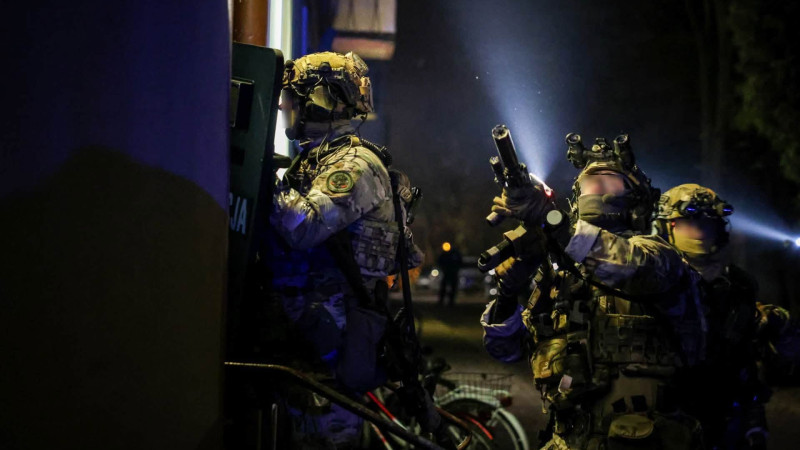
Photo. Policja Świętokrzyska
Much has already been said regarding the tragic act of terror that took place in Kraków. However, it is essential not merely to exploit the event’s emotional resonance, but to engage in rigorous analytical reflection to derive concrete lessons. Above all, this is necessitated by the state security architecture itself, which requires deliberate institutional change to ensure enhanced systemic adaptiveness.
The primary imperative is the candid recognition that Poland cannot be treated as an exception to broader European and global trajectories regarding terrorist threats and kinetic acts of terror. Fostering illusions of absolute invulnerability to such asymmetric risks compromises the state’s psychological posture and undermines tangible operational preparedness. Crucially, contemporary Poland and its society must move beyond fixating exclusively on specific perpetrators and incidents, and instead understand the structural magnitude of the prevailing challenges. The author therefore outlines several priority vectors that warrant strategic focus, evaluated through the prism of operational timelines and resource allocation.

A. Radicalization
We must explicitly acknowledge that radicalization processes will continue to manifest among disparate individuals within our society, who may subsequently form a recruitment pool for established terrorist entities, independently attempt to execute acts of terror, or incite third parties to violence. It is critical to recognize the multifaceted spectrum of radicalization: ranging from extreme political ideologies, religious tenets, and socio-economic grievances, to militant eco-radicalism. Consequently, defense planners must avoid the analytical fallacy of pursuing a monolithic radicalization profile, as was observed during the era of heightened Islamist terrorist threats in Europe and globally.
Crucially, radicalization frequently emerges as a secondary, highly eclectic phenomenon, shaped by idiosyncratic interpretations of political, ideological, or religious narratives. In the contemporary era of rapid information diffusion and cognitive-domain warfare, radicalization pathways can accelerate rapidly and take on a pronounced transnational character. Moreover, this environment enables unaligned actors to adopt specific ideological, political, or religious currents without seeking formal affiliation with organizational networks targeted by domestic or allied counter-terrorism intelligence. Restricting counter-terrorism architectures to a single predictive profile presents severe operational vulnerabilities.

B. Provenance of the Perpetrator(s)
The state security apparatus must systematically account for both homegrown terrorism and externally originated threat vectors. Comparative experiences in the United States and other Western nations demonstrate that security agencies must simultaneously prepare for domestic, anti-government operations analogous to the Oklahoma City bombing (Timothy McVeigh), as well as complex, externally orchestrated operations akin to 9/11. The Kraków attack naturally directs domestic debate toward the threat of homegrown terrorism—an analytical focus reinforced by the precedent of the 2016 attempted bombing of a municipal transit bus in Wrocław.
Nevertheless, our threat assessment matrix must not be prematurely narrowed. As a sovereign state, Poland constitutes an operational target due to systemic vectors including its active NATO posture, forward-deployed U.S. force presence, hosting of high-profile international forums, and tourism inbound from states facing severe terrorist threat levels. The analytical fallout from the Kraków incident must transcend the assailant’s native origin to preserve comprehensive scenario modeling. In particular, the analytical community must not pivot exclusively to lone-actor terrorism models at the expense of monitoring established foreign terrorist organizations or state-sponsored proxy and false-flag operations designed to advance hostile geopolitical agendas.
C. Psychological Disorders and Mental Health Pathology
Terrorist threat assessment cannot remain the exclusive preserve of anti-terrorism and counter-terrorism specialists; it demands engagement with broader public health vulnerabilities, particularly the fragile domain of psychiatric care. Crucial attention must be devoted to the susceptibility of psychiatrically vulnerable or distressed individuals to recruitment by extremist networks, the malignant influence of localized social circles, or the unassisted confluence of psychological disorder and ideological radicalization. This is further compounded by the proliferation of novel psychoactive substances (NPS), which induce volatile behavioral pathologies with severe security ramifications.
Fundamentally, a holistic counter-terrorism posture encompasses the accessibility of mental health clinics, familial resilience education, and community-level awareness capable of identifying acute behavioral anomalies that signal risks to public safety—manifesting as extremist radicalization, affiliation with violent milieus, or acute suicidality. Counter-terrorism is thus not merely a function of specialized security services, but relies heavily on the educational apparatus, public healthcare, and advanced empirical sociology and behavioral psychology. To genuinely optimize preventive frameworks, these intersections must be integrated into strategic decision-making, particularly in light of recent security incidents recorded in educational institutions nationwide.

D. Tactical Diffusion and Doctrinal Proliferation
Modern threat mitigation in Poland must account for the rapid proliferation and homogenization of tactical operational methods. This convergence is driven by the ubiquitous availability of open-source post-blast analyses, sophisticated extremist communication ecosystems, and tactical doctrine published directly by established terrorist organizations. Tactical methodologies demonstrate pronounced cross-pollination across disparate ideological, political, and religious orientations. A tactic pioneered or refined in the Middle East by entities such as Hamas, Hezbollah, Daesh, or Al-Qaeda can readily be adopted by extreme-right or militant left-wing formations. It is therefore structurally coherent that the perpetrator in Wrocław leveraged an improvised pressure-cooker device, drawing direct operational parallels to Tamerlan and Dzhokhar Tsarnaev in Boston.
Consequently, our national counter-terrorism apparatus must execute real-time monitoring and technical analysis of tactical evolutions across partner and allied nations. Counter-terrorism exercises must rigorously encompass the full operational spectrum—from CBRN containment to high-yield improvised explosive devices (IEDs) and vehicle-borne improvised explosive devices (VBIEDs). Active shooter scenarios and mass-casualty attacks within enclosed facilities and soft targets (including academic spaces) represent acute operational contingencies rather than theoretical constructs.

E. Notoriety, Contagion Effects, and Strategic Communication Deficits
While the scale and kinetic execution of the Kraków attack generated widespread public shock, the operational profile, methodology, and perpetrator typology should not have surprised the professional defense and intelligence community. This underscores the necessity for strategic preparation within the information domain. Strategic communications must preclude the unintentional lionization of the perpetrator or the generation of martyr mythologies that trigger behavioral contagion among latent copycats. Public dissemination of perpetrator-centric details must be strictly balanced against operational deterrence and crime-prevention imperatives. Official messaging must be calibrated to preempt cognitive destabilization, mass hysteria, and societal panic—factors that can swiftly degrade national tourism metrics and international standing.
Institutionalizing dedicated strategic communications cells remains vital across conventional, sub-threshold, and counter-terrorist domains; currently, these specialized capabilities remain underdeveloped across Polish state organs. Given that terrorism operates as psychological warfare mediated through the information space, public information protocols regarding the perpetrator’s image, manifesto, and profile must be systematically regulated. In France, extremist networks systematically operationalized the public profiles of deceased attackers to fuel radicalization pipelines. Furthermore, in Poland’s specific geostrategic theater, hostile state actors—namely the Russian Federation and Belarus—will predictably leverage domestic terrorist incidents to mount active measures, seed institutional distrust, and degrade societal resilience.

F. Dynamics of Legal and Illicit Arms Proliferation
A significant analytical risk in evaluating the Kraków attack is the temptation to restrict the operational review strictly to civilian firearms acquisition and personal protective equipment. Empirical observations of global terrorist tradecraft highlight exceptional tactical adaptability. The perpetrator in Kraków deployed a motor vehicle alongside an AR-15 platform weapon; however, the attack vector could have readily pivoted toward heavy vehicle ramming or bladed weapons. State response mechanisms must account for this inherent adaptability across both lone actors and organized cells. Imposing blunt prohibitions or disproportionate restrictions on specific categories of civilian firearms will not insulate the state from kinetic acts of terror.
Crucially, drawing from the post-conflict dynamics of the 1990s Western Balkans, the state must anticipate a significant influx of illicit weaponry, high-grade ordnance, and military ballistic protection diverted from the conflict zone in Ukraine. Reducing strategic analysis to domestic firearms ownership, shooting clubs, and sport shooting merely generates a false sense of institutional agency. A decisive majority of armed violent crimes rely exclusively on illicit supply chains. Moreover, on a European comparative scale, Polish society demonstrates remarkably low civilian firearm saturation rates. Analytical rigor dictates that policy responses must not be misdirected into simplistic, surrogate legislative debates.

Strategic Recommendations
The Polish counter-terrorism posture does not require disruptive structural upheaval, but rather institutional reinforcement and cross-domain prioritization. Conventional military modernization programs do not supersede asymmetric terrorist threats, nor does intense hostile intelligence pressure diminish the requirement for dedicated counter-terrorism divisions. Maintaining commensurate resource allocation along this operational vector is vital. Crucially, sustained capital must be directed toward multi-agency interoperability during joint response operations, recognizing that the initial kinetic burden invariably falls upon municipal and patrol police officers rather than Tier-1 tactical counter-terrorism units. This dynamic was demonstrated in Kraków, mirroring tactical realities observed during the 2015 Charlie Hebdo attack in Paris. Training curricula, physical procurement, and crisis command integration must directly empower frontline first responders.
Furthermore, under the Act on Anti-Terrorist Operations, the Internal Security Agency (ABW) serves as the designated national coordinator for this domain—a statutory mandate that demands sustained institutional, operational, and budgetary resourcing. While the ABW must provide centralized strategic direction, it cannot substitute for territorial policing assets or the wider security architecture; the enterprise functions as an integrated ecosystem spanning preventative anti-terrorism through kinetic counter-terrorism. The state must address structural bandwidth constraints within the ABW, recognizing its dual operational load across both counter-terrorism and counter-intelligence. Given Poland’s strategic environment and the Kraków attack, strengthening the agency’s institutional capacity is essential to its role as the operational core of national resilience.

A vital pillar remains the institutionalization of preventative security frameworks and public education. The historical „4U!” national public awareness campaign deployed by the ABW (in Polish – Uważaj, Uciekaj, Ukryj się, Udaremnij / Watch, Run, Hide, Fight), coupled with its modular e-learning platform, represented a methodologically sound framework for translating complex threats into actionable civic responses. However, sustained long-term execution and widespread civic penetration have remained inconsistent. Re-energizing and systematically scaling accessible, standardized educational programs across the broader populace is essential.
Finally, strategic counter-terrorism requires broad socio-political consensus to build cognitive resilience and insulate security agencies from partisan politicization. Society must be educated to accept that even the most resourced counter-terrorism architectures cannot provide absolute protection against hyper-dispersed, lone-actor threats. Nevertheless, major capital investments in strategic capabilities—such as integrated air and missile defense—must not cannibalize the core operating budgets of domestic counter-terrorism structures. Internal security disruptions can destabilize societal security as decisively as cruise missile incursions or autonomous loitering munitions.

Sovereign states along the eastern flank cannot construct false dichotomies between territorial defense and internal counter-terrorism; these domains are mutually dependent, requiring concurrent investments in physical force capabilities, cognitive resilience, and societal vigilance. Once operational friction subsides, the domestic media landscape must also internalize its institutional accountability, avoiding structural censorship while recognizing the long-term cognitive impact of strategic reporting.


