


- ANALIZA
- WIADOMOŚCI
Will NATO save the Baltic states in time? Russia wants to cut off Western support

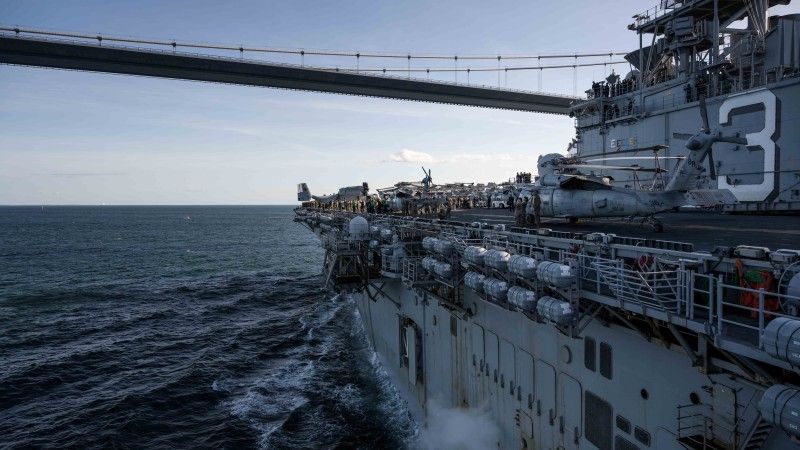
Russia does not need to defeat NATO on the battlefield. It only needs to break the Alliance from within. A potential act of aggression could begin in the Baltic Sea, with strikes against ports, critical infrastructure and transport routes. Before Western military columns reach the front, the fate of the Baltic states could already be decided. However, NATO’s greatest problem remains political: in the event of a real attack, would all member states immediately come to their assistance without any hesitation?
Whether and when this happens depends on three closely interconnected developments: the course of the war in Ukraine, NATO’s internal cohesion and changes in the Western political landscape. At this stage, the key factor deterring Moscow is the determination of the Allies to continue arming Kyiv. The announcement of a massive military assistance package fundamentally changes the Russian Federation’s calculations. Moscow faces the scenario it has feared most: a prolonged confrontation with a militarily strong Ukraine that is gaining the capabilities to strike Russia on its own territory.
The Kremlin knows perfectly well that NATO does not have to be defeated on the battlefield. It is enough to break it from within. That is why any decision to launch an attack would be preceded by attempts to paralyse the Alliance’s structures. The growing wave of sabotage and provocations in the air is nothing more than a test of NATO’s cohesion. At a moment when the West should respond with a strong, united political position, deep cracks could begin to appear in the facade of unity.
Examples of countries such as Slovakia show that, when the moment of truth comes, some capitals may choose to bury their heads in the sand. These divisions are directly fuelled by elections and political developments in the West. Russia is observing public sentiment and can see that support for Ukraine is weakening, while some countries want to return to talks with Moscow. This is reflected in the growing strength of the far right in France and the announcement of Putin’s participation in the G20 summit.
Why would Putin risk a direct confrontation with the world’s most powerful military alliance when he can paralyse it from within? The Kremlin will continue its strategy of hybrid warfare, ranging from provocations in the air and at sea, through migration pressure, to cyberattacks and disinformation operations. The objective of these activities is not territorial conquest, but permanent destabilisation, testing the Alliance’s political cohesion and examining the limits of NATO’s crisis-response procedures.

Belarus and the Kaliningrad region
The clearest warning signal would be large-scale troop movements and the deployment of heavy military equipment to Belarus. We have already seen this pattern when Russia was preparing its attack on Ukraine. First, Moscow concentrated personnel, brought in tanks and only then launched its offensive. If Russia begins doing the same again, it will be an unmistakable indication of an approaching threat.
The second extremely important location is the Kaliningrad region. Until now, Russia has been removing military equipment from the area and sending it to the war in Ukraine. However, if this changes and the Russians begin massively reinforcing the region again, it will be a clear warning signal. Another indication would be the resumption of regular military exercises in Kaliningrad, which we have not seen for years. Instead of reducing the military presence in the exclave, Russia would begin creating a real and direct threat there. Increased military activity in the Kaliningrad region would also provide Moscow with an ideal opportunity to conduct intelligence operations and test the defences of Poland and Lithuania.
The Baltic Sea is becoming a geopolitical cauldron
The Baltic Sea is becoming a geopolitical cauldron in which two completely different visions of security are confronting each other. On one side are the Baltic states, increasingly concerned and demanding a tougher approach. On the other are traditionally more cautious countries such as Finland and Sweden. But only up to a point. There are two locations where any violation would immediately place Helsinki and Stockholm on the highest level of alert: the Finnish border and the strategically important Swedish island of Gotland.
If Russia begins concentrating its forces in these areas, the situation will become clear. The Kremlin will no longer be merely issuing threats. It will begin blocking and securing maritime transport routes. This would be a crucial first step towards moving military forces efficiently and safely into the area of a potential conflict.
Everyone is focusing on a possible attack against the Suwałki Gap, but they are forgetting about the enormous logistical problem. To hold such territory, Russia would have to establish a secure supply route for fuel and ammunition from Belarus all the way to the Baltic Sea. We have already seen near Kyiv how Russian tanks became stuck in enormous traffic jams because they ran out of fuel. The Suwałki Gap would be a logistical nightmare. In Ukraine, drones have proved extremely effective at destroying Russian transport vehicles on the roads. Russian fuel trucks would be equally easy targets in this area.
Another crucial, although frequently overlooked, threat concerns the Black Sea region. Potential aggression against Moldova or Romania would force Türkiye to act, while its loyalty to NATO during a crisis remains an uncertainty for the West. The situation is further complicated by Russia’s extensive support from its Asian partners: joint armaments projects with China, military cooperation with Iran and assistance from Central Asian countries supplying the Kremlin with electronic components essential for missile production.
When Russian transport aircraft flying between Moscow and Algeria pass above our heads, through Polish airspace, nobody should have any illusions. The Kremlin’s logistical machinery is operating at full capacity. Russia is concentrating forces, replenishing supplies and testing NATO’s vigilance on the doorstep of the Baltic states. This is precisely why Lithuania, Latvia and Estonia have become the litmus test of our defence. It is there, as well as in Belarus and the Kaliningrad region, that our readiness is being determined. If the Baltic states fail to maintain iron discipline and raise the alarm first in response to aerial provocations, we could wake up to find the Russian army ready to strike.

The Russian fleet could paralyse the Baltic Sea
The West is quick to point out the weaknesses of Russian aviation and shortages in its artillery, but it is making a dangerous mistake in one area: underestimating the Russian fleet. The Russian Navy remains a powerful force that must be taken seriously. Of course, a considerable proportion of its vessels are technological relics. However, confusing outdated equipment with a lack of firepower is a trap. Russia still has the ability to strike at sea, particularly beneath the surface, and can effectively paralyse key shipping routes.
Russia also continues to invest enormous sums in icebreakers, making it exceptionally strong in the High North and the Arctic. This dominance also influences its plans for the Baltic Sea. Western experts emphasise that if Russia decides to attack, it could begin in the Baltic in order to establish a secure operational area and push NATO forces back.
The Russian plan would involve rapidly shelling the coastlines of Finland and Sweden and occupying smaller Swedish islands. At the same time, Russian forces would attack the coastlines of Lithuania, Latvia and Estonia, while also conducting operations towards Iceland to block assistance from the West. Russia would use the Baltic Sea to destroy coastal infrastructure in countries expected to support one another. By attacking ports and critical infrastructure, Russian forces would neutralise coastal defences.
The destruction of ports would mean a complete blockade. Neither food nor, most importantly, shipments of weapons and ammunition from Allied countries would reach the states under attack. In this way, Russia would effectively cut off the Baltic states, Finland and Sweden from maritime assistance, leaving them without crucial support. Razing Baltic ports to the ground would give Putin a double victory. It would not only deprive the targeted countries of assistance, but also create a powerful shield around Russia. By neutralising the coastline, the Kremlin would protect itself against retaliation, including incoming long-range missiles and counterattacks by Allied fleets.
At that point, NATO’s plan to send reinforcements by sea would collapse. The West would be forced to do what it fears most: move hundreds of thousands of soldiers and enormous quantities of heavy military equipment overland. Transporting tanks and ammunition from bases in Germany, France or Italy through a congested Europe vulnerable to sabotage would take many weeks, if not months. This is precisely the Kremlin’s Baltic trap: before Western military columns reach the front, the fate of the Baltic states could already be decided.

Russia's shadow fleet
The West looks at Russia’s shadow fleet as a floating collection of technological relics: rusting tankers purchased through fictitious African companies, barely capable of remaining afloat. This is a mistake, because these vessels are not there to transport oil. They are there to spy. The Kremlin sends them into the Baltic Sea as bait. Every suspicious vessel appearing in our waters represents an enormous test for NATO.
The Russians are examining how our radars respond, how quickly coastal units are mobilised and which procedures NATO countries activate. In this way, an apparently useless wreck sailing under an exotic flag becomes a digital spy. It collects invaluable information about our systems, which Russia could exploit during the first hour of a real offensive strike.
NATO has better equipment. Politics remains the problem
Although Russia is successfully observing and testing Alliance procedures, NATO’s land and maritime defences are already operating at full capacity. The accession of Sweden and Finland has significantly changed the military situation, while close military cooperation between Poland and Sweden now provides a crucial foundation for security across the Baltic Sea region.
Developments are taking place in Europe that would have been almost unimaginable until recently. French soldiers are already stationed near Finland’s border, while a French aircraft carrier has entered a Swedish port, sending a clear deterrent signal to the Kremlin. Although NATO still needs to strengthen its naval forces in the Baltic Sea, it is compensating through activities on land and substantial Polish investments in modernising its submarine fleet.
As NATO, we have better equipment and greater capabilities. However, our greatest problem remains political. Would all member states immediately come to our assistance in the event of a real attack, without any hesitation? This is precisely why countries such as Poland, Finland and Estonia do not want one-off assurances. We need regular, clear political signals from the entire Alliance that continuously demonstrate our absolute unity and readiness for collective defence.
Estonia and Finland are preparing for war
Only 2 per cent fail to report for military service. That is the proportion of Estonian conscripts who currently avoid reporting for duty. In a country where military service is compulsory, these figures are an extraordinary achievement and evidence of social resilience that is unique in Europe. Faced with a real threat, Estonian society does not panic. Instead, it integrates itself into the country’s defence system with iron discipline. For Estonians, conscription is a fundamental element of deterring an adversary. They have chosen full readiness, transforming a legal obligation into a national consensus on defending their own country.
Finland is preparing to expand the powers of its military intelligence. The new regulations are intended not only to increase the scope of intelligence activities beyond national borders, but also to enable offensive operations against an adversary. Helsinki is strengthening its state capabilities precisely where the risk of confrontation with Moscow is currently greatest. Estonia and Finland are jointly developing a system of so-called total defence, in which, when war comes, it is not only the army that fights, but the whole of society. This is a modern shield built on extensive civil defence, secure shelters and, above all, an unbreakable national consensus on defending one’s own country.
The Finnish and Estonian defence models assume that, during a crisis, the country’s entire infrastructure serves the armed forces. Finland maintains, among other things, special and regularly updated registers of lorries, tractors and agricultural machinery owned by private companies and farmers. If war breaks out, this equipment can be immediately mobilised to construct field fortifications and provide logistical support at the front.
Estonia has adopted the proven Finnish model and introduced its Higher National Defence Courses, regular training programmes attended by politicians, chief executives of major banks and media organisations, doctors and school headteachers. The objective? When the moment of crisis comes, key civilian decision-makers must know exactly how to cooperate with the military, making the state resistant to decision-making paralysis and chaos.
See also 

Russia is already operating on our territory
Putin does not need to storm our borders. His people are already here, hidden behind the facades of embassies and the so-called Russian Houses scattered across Europe. These locations are not innocent libraries or language schools. In reality, they provide ideal cover for spies and centres of sabotage.
Worse still, Russia recruits citizens of other countries to carry out its dirty work, including assassination attempts and sabotage, in order to conceal its involvement. The good news is that the West is finally responding. Awareness is increasing, and European intelligence and security services are becoming increasingly effective at identifying agents and disrupting the Kremlin’s plans before they can be implemented.
NATO has the strength. We must act together
We must not forget that NATO remains the most powerful military alliance in the world. We have better equipment, greater capabilities and increasingly strong military cooperation. The accession of Finland and Sweden has fundamentally changed the security situation in the Baltic Sea, while Poland, together with the Nordic and Baltic states, is building one of the Alliance’s most important defence regions. Added to this are the presence of American, French, British and other Allied troops, joint exercises and enormous investments in weapons and military infrastructure.
Russia can provoke us, test our response procedures and attempt to divide NATO from within, but it cannot change the fact that together we possess significantly greater military and economic potential. That is why we must continue strengthening our own capabilities, developing cooperation and regularly demonstrating our readiness for collective defence. We do not need further declarations without substance, but concrete actions that continuously demonstrate our unity.
NATO’s greatest strength is not simply the number of tanks, aircraft or warships. It is the fact that none of our countries has to defend itself alone. And it is precisely this unity that Russia fears most.


