


- WIADOMOŚCI
A naval vessel being built in Gdańsk — but not for the Polish Navy

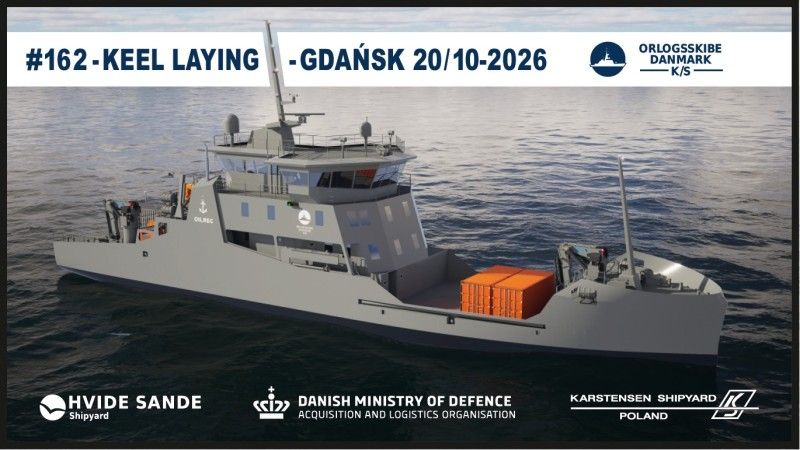
Photo. Karstensen Shipyard Poland
A keel-laying ceremony for a 60-metre multipurpose naval vessel took place at Karstensen Shipyard Poland in Gdańsk. Three more such ceremonies will be held there in the near future: two for sister ships and one for a larger, 72-metre vessel.
In March 2025, the Danish government approved a programme to modernise the fleets of its Navy and Home Guard, a formation responsible for territorial defence in the broad sense. The plan includes the construction of four multipurpose environmental protection vessels that will also serve as minelayers, and a vessel carrying uncrewed systems for underwater monitoring, for the Navy. Further 21 smaller vessels will be built for the Home Guard. The entire programme is expected to cost approximately DKK 4 billion (around USD 615 million). It precedes another programme, currently only at the planning stage, to build large frigates for the Navy.
The entire programme now under way will be delivered by the Danish shipbuilding industry through facilities in Denmark and Poland. Karstensen Shipyard Poland has operated in Poland since July 2018. It was initially based in Gdynia, in a hall leased from the Polish company Vistal Offshore. At the same time, the shipyard sought its own site for long-term operations and consequently acquired Synergia 99. That company owns part of the former Lenin Gdańsk Shipyard located outside Ostrów Island. This investment gave the Danish shipyard in Gdańsk a large hull construction hall and longitudinal slipways B-1, B-3 and B-5. The first two remain operational and regularly host spectacular launches. Until now, Karstensen Shipyard Poland has focused on building partially outfitted fishing vessel hulls for its parent company, Karstensens Skibsværft in Skagen.
On 2nd October 2025, the Danske Flådestøtteskibe consortium, since renamed Orlogsskibe Danmark, was selected to build the four multipurpose vessels. Its members are the Danish design office OSK Design and two Danish shipyards: Karstensens Skibsværft and Hvide Sande Shipyard. OSK Design developed designs for multipurpose vessels measuring 60 and 72 metres in length. The order covers three 60-metre vessels and one larger, 72-metre vessel, at a cost of approximately DKK 1.9 billion.

Photo. OSK Design
The hulls and superstructures of all four vessels will be built in Gdańsk. Following launch, the three smaller vessels will be towed to Hvide Sande Shipyard for outfitting. The larger vessel will be towed to the parent yard, Karstensens Skibsværft, for the same purpose. All four vessels are scheduled to enter service between 2028 and 2030.

Photo. OSK Design

Photo. OSK Design
Both types will be equipped for environmental protection, including pollution response, such as cleaning up fuel or chemical spills, as well as minelaying, training, patrol and surveillance duties. Their working decks will have space for containers carrying specialist equipment or for mines. They will have cargo-handling cranes at the stern, while the larger vessel will carry a gun forward. Responsibility for marine environmental tasks in Danish waters lies with the Ministry of Civil Protection and Emergency Management. However, the Navy manages and operates the vessels assigned to these tasks, while the Ministry of Defence Acquisition and Logistics Organisation (FMI) procures them.

Photo. Karstensen Shipyard Poland
Construction of the first vessel in Gdańsk, under hull number NB 162, began with the first steel cutting on 10 June 2026. The keel-laying ceremony took place on 20 October 2026 on slipway B-1, formerly part of the Lenin Gdańsk Shipyard and now owned by Karstensen Shipyard Poland.

Photo. Jarosław Ciślak/Defence24

Photo. Jarosław Ciślak/Defence24

Photo. Jarosław Ciślak/Defence24

Photo. Jarosław Ciślak/Defence24
The distinctive form of the keel-laying ceremony itself deserves attention. It differs considerably from Polish ceremonies, which involve welding a commemorative medal into the ship’s bottom structure. The Danes placed two commemorative medals in a specially prepared wooden board, which was then positioned beneath the hull’s bottom plating. Wedges driven beneath the board pressed the medals against the steel plate. This tradition derives directly from the procedure used when hulls were still made of wood and the designs on medals or coins left impressions in the ship’s wooden keel. Today, the medals remain at the shipyard until the launch, after which they are handed over to the shipowner. They are subsequently placed in a commemorative display case in a position of honour aboard the vessel.

Photo. Jarosław Ciślak/Defence24

Photo. Jarosław Ciślak/Defence24

Photo. Jarosław Ciślak/Defence24

Photo. Jarosław Ciślak/Defence24
The construction of naval vessels at Karstensen Shipyard Poland in Gdańsk is a first for the company. However, Karstensens Skibsværft in Skagen has already delivered three patrol vessels to the Royal Danish Navy. Their hulls and superstructures were also built in Poland. The patrol vessels Knud Rasmussen (P 570) and Ejnar Mikkelsen (P 571) were built by Stal-Rem in Gdańsk, now part of the Remontowa Group, and delivered to the customer in 2008 following outfitting. The patrol vessel Lauge Koch (P 572), meanwhile, was built at the Crist shipyard in Gdynia and entered service in 2016 after being outfitted in Denmark.
The construction of another four hulls and superstructures in Poland is undoubtedly an important development. We will follow their progress with interest and report further milestones. The keel of the larger, 72-metre vessel will be laid in Gdańsk shortly.

Photo. Jarosław Ciślak/Defence24


