












- WIADOMOŚCI
- ANALIZA
End of the problems? Deliveries of upgraded Jaguars begin


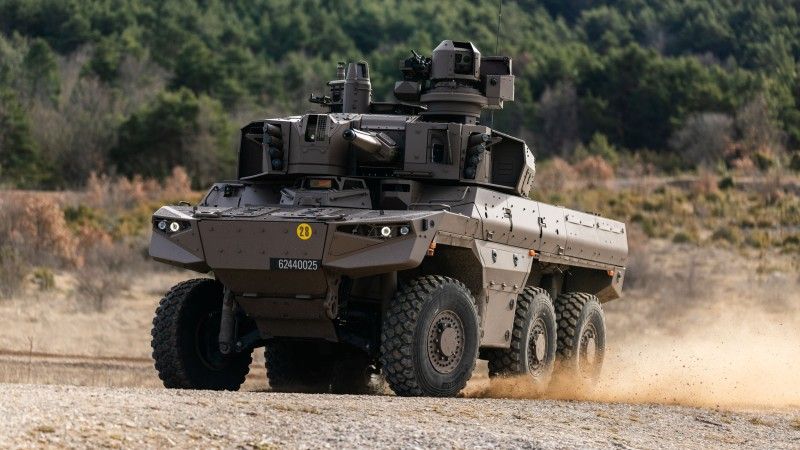
Photo. KNDS France / X
The French Army has received the first EBRC Jaguar armoured reconnaissance and combat vehicles in the new R3 standard. The configuration is intended to deliver the full set of capabilities originally planned for the platform, including the complete employment of Akeron MP anti-tank guided missiles. Twenty-one R3 vehicles had been delivered by 4 September 2026, while previously delivered Jaguars are to be upgraded to the same standard by the end of 2027.
France has already received more than 100 Jaguars in the earlier R1 and R2 configurations. Production has accelerated as the programme expands both domestically and abroad. The French Army ultimately plans to operate 300 Jaguars, with the current schedule pointing to this number being reached by 2033. Belgium has ordered 60 vehicles, while Luxembourg ordered 38 Jaguars and an additional 16 Griffons in December 2025 for the joint Belgian-Luxembourg reconnaissance battalion.
Problems and growing pains
The introduction of the Jaguar has not been trouble-free. Reported issues included difficulties in accurately engaging moving targets, electronics reliability, insufficient electrical power available to the crew, problems with the air-conditioning system, required modifications to the chassis and limitations in the employment of the Akeron MP missile.
Some of these problems were addressed during the transition to the R2 configuration, but several important capabilities were still not fully mature. This contributed to criticism of the vehicle, particularly as discussions emerged in France about the need for a platform offering heavier and cheaper direct fire against fortifications and armoured targets.
This is also the context in which the Fenris fire-support vehicle was presented at Eurosatory 2026. It should not, however, be described as a formal French Army response to the Jaguar’s problems. Fenris remains an industrial initiative developed by John Cockerill Defense and Arquus. It uses the Jaguar architecture but replaces its turret with the unmanned Cockerill 3105 armed with a 105 mm gun.
The companies behind Fenris point directly to lessons from the war in Ukraine and the requirement for a highly mobile vehicle capable of destroying fortifications and armoured targets with direct fire. The two vehicles could therefore answer different requirements. Jaguar remains focused on reconnaissance, networked combat and precision engagement with Akeron MP, while Fenris is intended to provide heavier direct fire without requiring an expensive anti-tank missile for every hardened target.

R3 enters service
The R3 standard is more important than another routine upgrade. France’s Direction générale de l’armement and the Army declared the configuration “bonne de guerre” on 8 April 2026, effectively recognising it as meeting the requirements of a combat-ready configuration. The French Army formally approved it for service on 20 July.
According to the DGA, R3 incorporates the complete package of technical and combat capabilities originally planned for the Jaguar. Before qualification, testing covered reliability, electromagnetic compatibility, engagement of moving targets and the employment of Akeron MP in different configurations. This does not necessarily mean that every minor problem with electronics, air-conditioning or other subsystems has disappeared, but it does mean that capabilities which had previously remained incomplete have now been formally validated.
The most important change is the full employment of Akeron MP. The missile has a range of more than 4 km, a tandem anti-armour warhead and a dual-mode TV/IR seeker. During trials, the DGA tested engagements against moving targets, vehicle-on-the-move versus moving-target scenarios, firing beyond direct line of sight and retargeting the missile after launch through its fibre-optic data link.
Akeron MP can be used in both lock-on-before-launch and lock-on-after-launch modes. This is particularly important for the Jaguar because the vehicle is not intended to fight a main battle tank in a direct gun duel at short range. Its sensors and missile armament are supposed to allow the crew to detect heavy or high-value targets and engage them from beyond the effective range of its 40 mm cannon.
The delivery of 21 R3 vehicles also means that the French fleet has now grown to more than 130 Jaguars. More importantly, all previously delivered vehicles are to be progressively brought up to the R3 standard by the end of 2027. For Belgium and Luxembourg, this is equally relevant: they are entering the programme after many of the platform’s initial growing pains have already been identified, tested and addressed.

EBRC Jaguar
The EBRC Jaguar (Engin Blindé de Reconnaissance et de Combat) is a French wheeled reconnaissance and combat vehicle developed by Nexter Systems, Thales and Arquus. It is intended to replace the AMX-10 RC, ERC 90 Sagaie and VAB Mephisto in French service while operating alongside the VBMR Griffon.
Its main armament is the CTA International CT40 automatic cannon using 40 mm telescoped ammunition, supported by a 7.62 mm coaxial machine gun and a launcher for Akeron MP missiles. A remotely operated weapon station with another 7.62 mm machine gun can also be fitted on the turret. The baseline protection corresponds to STANAG 4569 Level 4, while a 500 hp engine gives the approximately 25-tonne vehicle a maximum speed of around 90 km/h and an operational range of more than 800 km.
The key point is that R3 should not be seen simply as an attempt to repair an unsuccessful vehicle. It is the first standard in which France formally declares that the Jaguar has reached the complete combat configuration originally planned for the programme. The next test will therefore be practical: whether the upgraded fleet can finally deliver those capabilities reliably in everyday service.


