












- WIADOMOŚCI
- ANALIZA
France wants to defend Europe, but it must rebuild its armed forces

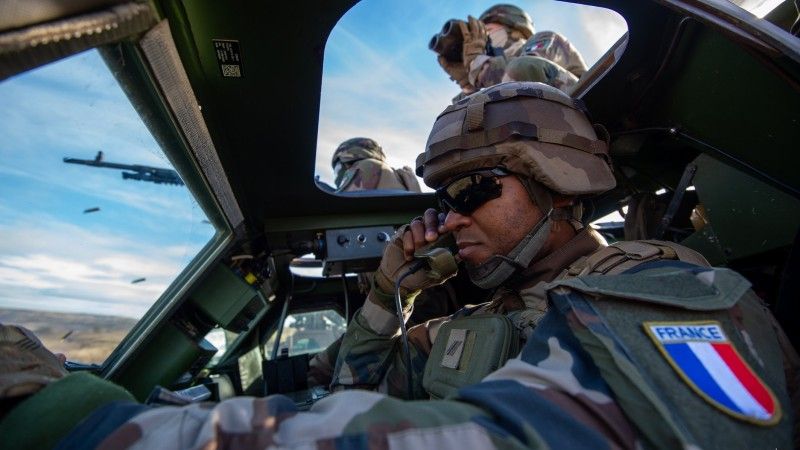
France is increasingly positioning itself as a country that should assume greater responsibility for Europe’s security. A new document from the French Haut-Commissariat à la Stratégie et au Plan, however, shows the scale of the challenge. The current military model is comprehensive, but in a prolonged high-intensity war, it would quickly encounter significant limitations. Paris needs more personnel, larger weapons stocks, a stronger domestic defence industry and greater investment in drones, robotics and artificial intelligence.
The document, France 2035–2050. Préparer la Nation et défendre l’Europe face aux menaces de demain, is not a plan for the coming months, but for the next decade and beyond. It sets two horizons: 2035, when the effects of current reforms should already be visible, and 2050, which is used to test the resilience of the French model against much more serious crises. The title itself is revealing. France is no longer speaking only about defending its own territory, but about preparing the state and defending Europe.
There is, however, one fundamental political problem. The first round of the French presidential election will take place on 18 April 2027, and Emmanuel Macron cannot run for a third consecutive term. In practice, almost the entire implementation of the 2027–2050 vision will therefore fall to future presidents and governments. The document may define the direction, but implementing it will require long-term political and budgetary continuity – something that does not currently appear guaranteed in Paris.
In the French assessment – correctly – Russia will remain the most important direct military threat to Europe regardless of how the war in Ukraine ends. At the same time, Paris assumes that a growing share of the burden for European security will gradually shift from the United States to European countries. Future EU enlargement to include Ukraine and the Western Balkans could further change the way Europe views competition with Russia. Interestingly, whether intentionally or not, Türkiye is absent from this discussion. It is worth recalling that relations between Paris and Ankara have long been difficult.
The proposed concept also includes the French model of deterrence. France wants to remain capable of independent action, retain nuclear weapons, maintain a full spectrum of conventional forces and preserve its own defence industry, while connecting these capabilities more closely to European security. The Forward Deterrence doctrine is intended to give France a greater role in the nuclear domain, supported by intelligence, long-range strike, missile defence, electronic warfare, cyber capabilities, space assets and autonomous drones. Poland, Finland and Sweden are already among the countries participating in this broader framework.
The report devotes considerable attention to hybrid activities. Its authors note that the number of operations in Europe officially attributed to Russia rose from fewer than ten in 2022 to nearly fifty in 2024. These figures are already somewhat dated – the document was published in September 2026 – but they still show the trend. The French expect confrontation to expand further into cyberspace, information, the economy and technology. Cognitive warfare is given particular importance. Its purpose is no longer only to spread false information, but to influence the way societies understand and assess reality.

The greatest change, however, is expected on the battlefield itself. Dronisation, robotics, artificial intelligence and digitalisation will become as important as traditional combat platforms. France plans to develop drone swarms, remotely operated munitions, advanced cyber defence and military space systems. This matters because the current French model is broad and includes virtually every major type of military capability, but, crucially, not in quantities sufficient to sustain a prolonged war.
The same problem concerns personnel. After the Cold War, the French model was built around approximately 300,000 military personnel. The emerging model sets a target of around 355,000 personnel, including 80,000 reservists. Updated assumptions go even further: by 2035, the defence establishment is expected to reach approximately 380,000 people, including 210,000 active-duty military personnel, 65,000 civilians and 105,000 reservists, in addition to around 50,000 participants in national service.
This is a major challenge because France must not only recruit more people into the armed forces, but also compete with the private sector for specialists in IT, cybersecurity and artificial intelligence. In some critical parts of the defence industry, 10–15 per cent of positions are already unfilled. In wartime, it is therefore not enough to possess Rafales, submarines or artillery. France will also need programmers, engineers, technicians, autonomous-system operators and personnel capable of sustaining production for years. This is a challenge for every European country that is currently increasing defence investment.

The most difficult issue, however, will be investment. The current LPM – France’s military programming framework – provides €413 billion over seven years, while its 2026 update added another €36 billion through 2030. France plans to reach 2.5 per cent of GDP on defence by 2030. If the current trajectory is maintained, annual defence spending could reach approximately €104 billion in 2035, equivalent to 2.9 per cent of GDP. If France reaches the 3.5 per cent target, annual expenditure would rise to around €125 billion.
This is where the fundamental gap between ambition and capability becomes visible. Europe is increasing defence spending, but very unevenly. Some countries are already above 3 per cent of GDP, while others are only now approaching 2 per cent. France itself acknowledges that maintaining its position as one of Europe’s leading military powers will require levels of expenditure comparable to those seen during the Cold War.
France wants to be one of the countries responsible for defending Europe, and it has solid foundations for doing so: nuclear weapons, a strong domestic defence industry, Rafale fighters, a capable navy, space assets and the ability to operate across several theatres, supported by an extensive network of overseas military bases.
The report nevertheless shows that the current model would not be sufficient for a long war against an opponent with comparable capabilities. Nor is there any certainty that Paris will ultimately choose to enter such a level of competition. In any case, France must invest in its armed forces – and intends to do so. This is the most important conclusion of the report.
The 2035 and 2050 vision provides a framework that now has to be treated seriously. The main objectives have been identified and the debate has reached the political level. That in itself deserves recognition and should lead to concrete conclusions. The next step is implementation.


