












- WIADOMOŚCI
- ANALIZA
Starlink station fire in Poland. Possible slowdown in Ukraine

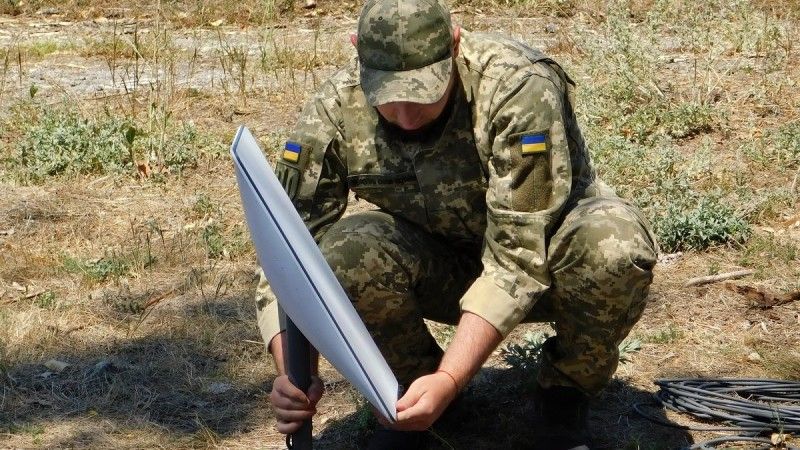
Photo. Armed Forces of Ukraine/militarnyi.com
A fire at the Starlink ground station in Wola Krobowska, central Poland, is being investigated as a possible act of arson. The incident matters far beyond the damaged equipment. The facility is part of strategic telecommunications infrastructure supporting internet connectivity across Central and Eastern Europe, including Ukraine. Poland’s Internal Security Agency and the Central Bureau of Investigation Police have been informed, while Deputy Prime Minister Krzysztof Gawkowski has said that there are indications the incident could be another element of hybrid warfare. That assessment still requires evidence, but the location and function of the facility make the case particularly sensitive.
The fire broke out on the evening of 23 September. The emergency call reached the fire service in Grójec at around 21:00, and three fire crews were deployed. Nobody was injured. According to the preliminary findings, the power distribution unit and a backup generator were damaged. Investigators are considering deliberate ignition of the electrical infrastructure, although an electrical fault has not yet been excluded. Police prevention units and officers from the regional police headquarters also worked at the site.
The target itself is important. The Wola Krobowska facility contains around a dozen dome-shaped antennas, approximately two metres in diameter, connecting the Starlink satellite constellation with terrestrial telecommunications infrastructure. Together with a similar installation near Kaunas in Lithuania, it supports connectivity across a significant part of Central and Eastern Europe, including Ukraine. The Polish facility is operated by Exatel, a state-owned telecommunications company.
Ukraine is a crucial part of this story. Russian attacks have repeatedly damaged Ukrainian energy and telecommunications infrastructure, while power outages and physical destruction make stable terrestrial internet access more difficult in parts of the country. Starlink therefore remains much more than an alternative civilian internet provider. It supports connectivity where conventional networks are damaged or unavailable and remains important for Ukrainian military and state communications.

At the same time, damage to one ground station would not cut Ukraine off from Starlink. The network is distributed and traffic can be redirected through other gateways. However, losing one of the regional nodes can reduce available capacity, increase latency and temporarily slow connections in parts of the network. This distinction matters. In a war, the purpose of sabotage does not always have to be a complete blackout. Slowing communications, reducing redundancy and forcing traffic onto fewer nodes can already create both civilian and military problems.
This is why the possible hybrid dimension cannot be ignored. A state does not need to destroy satellites in orbit to disrupt satellite communications. Ground stations, power systems, generators, fibre connections and other telecommunications nodes remain physical infrastructure and are much easier to reach. If an adversary identifies these points correctly, a relatively limited act of sabotage can create disruption, force security services to react and test how resilient the wider system really is.

The civilian dimension is equally important. Exatel is part of Poland’s telecommunications infrastructure and carries internet traffic through the country, including connectivity supporting Ukraine. Disruption to such infrastructure could therefore affect much more than ordinary internet access. Modern banking, payment systems, logistics, public administration and parts of critical infrastructure all depend on permanent connectivity.
Poland has spent years discussing the protection of military installations, railways and energy infrastructure. Strategic internet infrastructure must now be treated in exactly the same way. The war in Ukraine has shown that communications are not simply a civilian service. They are part of national resilience and, during war, part of the battlefield. If the Wola Krobowska fire proves to have been deliberate, the key question will not only be who set the fire, but whether someone was testing how easily one of the region’s important communications nodes could be disrupted.


