












- ANALIZA
- OPINIA
- KOMENTARZ
- WIADOMOŚCI
Shift in the paradigm: Poland in the new US Strategy

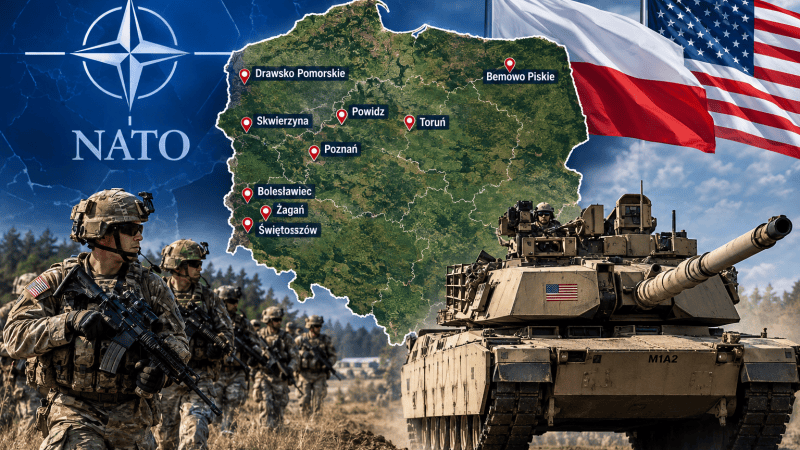
Photo. Graphics generated using the ChatGPT model
The potential expansion of the US military presence in Poland is a major topic of political debate in the country. However, beneath the emotion lie practical issues that underscore the importance of ongoing discussions between Warsaw and Washington and the potential repercussions for the region’s security. It is therefore worth looking into the arcana of these complex decision-making processes.
The decision regarding the potential placement of a new US base or bases in Poland is tied to several layers of an intricate decision-making process. Equally important, this process involves both the American and, to a large extent, the Polish side, taking into account the internal legal and political specifics of both nations. Above all, this layer of strategic decisions requires concrete stances from the most senior decision-makers in both countries—those responsible not only for defence policy itself, but also for diplomacy and finance.
Allied presence as a sovereign decision of Poland and the US
In this context, announcements by the American president may be particularly significant. In the US system, the president serves not merely as the commander-in-chief in a general sense, but holds the specific constitutional role of Commander in Chief. Furthermore, let us emphasise that the Polish side is the host nation, which must inherently desire to have this type of allied infrastructure on its territory. Russian and pro-Russian propaganda attempts to define such actions as being imposed by the authorities in Washington, but the reality is quite the opposite. Within NATO, Poland has the right to make decisions independently and then negotiates with the US on that basis.
See also 

To put it plainly, any allied presence is based on Poland’s sovereign decisions—unlike the Cold War era, when the USSR imposed its military presence on Warsaw Pact members. This must be reiterated, especially since the aforementioned Russian and pro-Russian narratives are highly visible in Polish social media as well. It can be safely assumed that as talks progress, increasingly broader attacks in the information-cognitive domain will become a reality, alongside attempts to inspire anti-American and/or pro-Russian circles.
Breaking Cold War patterns
Returning to the strategic level, the appearance of a significant US military facility (or facilities) on our territory would mark another qualitative shift in post–Cold War thinking. Above all, it would clearly signal that deterrence and defence requirements have shifted far from 20th-century standards. During that era, the network of bases, military infrastructure, and supporting elements was built to secure Western Europe, primarily the former West Germany. Today, the same Soviet-minded and Russian-executed threat endangers Europe from Norway, Finland, and Sweden, through Lithuania, Latvia, Estonia, and Poland, down to Romania and Bulgaria. By shifting part of its assets to this region of Europe, the US would signal such a strategic vision and, above all, a desire to maintain continuity within it.

This last aspect—continuity—is decisive. As an ally, the US has repeatedly demonstrated since 2014 its willingness to support the security of Poland and other countries in the region through practical deployments of forces and assets—ranging from ad hoc measures taken after the first Russian aggression against Ukraine to more systematic processes. In Poland’s case, this was particularly evident with the establishment of US Army Garrison Poland, headquartered at Camp Kościuszko alongside a dozen other installations across the country, as well as the transition from the Mission Command Element (MCE) to the forward-deployed command component of the reactivated US Army V Corps.
Furthermore, the Americans established a crucial logistics hub on our territory—APS-2 in Powidz—enabling rapid reinforcement of the theatre with the forces of an entire heavy land forces brigade (an Armored Brigade Combat Team) or providing the capacity to replenish equipment losses. In recent years, the Naval Support Facility Redzikowo near Słupsk also achieved operational capability under the scope of US Navy activities in Europe. Nor should we overlook that the US serves as the framework nation for NATO’s enhanced Forward Presence (eFP) battle group in Poland, which has been operating since 2017. New installations would thus serve as an accentuation of these processes.
Russia may receive a clear message
We must also note that finalising such negotiations at the strategic level would signal a paradigm shift in relations with Russia. The Americans would show they do not intend to yield unilaterally to Russian pressure over the rules of operation in Central and Eastern Europe imposed by the Kremlin. It should be stressed that the US has already undertaken visible transformations in this regard, departing from agreements such as the INF or Open Skies treaties. In both cases, the Russians used these treaties to unilaterally blackmail the US and the West while ostentatiously violating them themselves.
Many more such examples could be cited, which should motivate us to recognise that deploying a permanent presence of the US Army—and perhaps other branches of our ally’s armed forces—would complement this new approach toward Russia. This approach demands rejecting all principles established during the Yeltsin era or the first phase of Vladimir Putin’s own rule.

Other important topics surrounding the possible arrival of a permanent US base (or bases) in Poland include announced reductions in other European countries. This naturally generates considerable controversy, given the White House’s current communication style. However, we must honestly admit that American administrations have long signalled that NATO’s European allies must take on more responsibility. Although this process was disrupted by the 2022 Russian invasion of Ukraine, we must recognise that there is no turning back, regardless of who holds power in the White House and Congress.
Above all, the Americans wish to increase their posture in the Indo-Pacific direction due to China’s policy. Furthermore, the US military has been assigned new tasks in the Western Hemisphere, which had also been signalled at least since the last presidential campaign won by Donald Trump. Meanwhile, the stance of countries like Spain regarding American requests to use bases for operations in the Middle East merely accelerates processes that were already underway and reinforces strong emotional narratives that mask the true background of these actions.
Avoiding easy diagnoses
In this context, we can be glad that the US is not withdrawing entirely from Europe or abandoning its responsibilities toward NATO and the European theatre, but is rather transforming them. One must continuously contend with popular visions of the collapse of transatlantic relations, which are also prevalent in the Polish media. Such views provide a sense of dramatic flair to the claims being made—often framed as massive “geopolitical” shifts—yet they overlook NATO’s transition toward balancing capabilities between its two components: the American side and the European-Canadian side. This shift aims to eliminate, or at least partially reduce, the sole reliance on American capabilities, ranging from conventional to non-conventional forces.
It is worth recalling that many European countries currently voicing public concern over reductions in the American presence—and drawing comparisons to Poland in the process—have long advocated for the need to achieve strategic autonomy in security and defence. Poland and many nations in our region, by contrast, saw the need to balance and strengthen their own defence capabilities alongside allied actions and the bilateral dimension of strategic relations with the US.

These transformations are tailored to the new NATO posture, which explains the vital role of activities in Poland, Romania, and Bulgaria, as well as in the Nordic and Arctic spaces. Poland and other countries in the region are not betraying anyone, as emotional commentary sometimes claims. Rather, we are strengthening NATO’s capabilities by retaining a portion of American assets where they are most needed and required—especially since in our region, regardless of NATO’s ISTAR capabilities and intelligence capacity, one must also account for a degree of surprise potential from the Russian side, primarily regarding actions bordering on war or below its threshold. Hence, bringing the assets of our key ally closer to the actual flashpoint becomes crucial, not to mention its role in deterring Russia.
Would this be a success for NATO?
If this leads to the expansion of permanent bases, we can talk all the more about a success for NATO rather than a collapse of allied relations. Furthermore, emotional assessments of Donald Trump and his administration must be separated from an evaluation of transformations within the US military presence system, particularly regarding bases and infrastructure in Poland. The call to understand that decision-making processes in American defence policy consist of many components remains unchanged.
These components are internally diverse, reflecting the interests of the Department of War, the departments of the individual US armed services, geographic combatant commands, and so forth. Moreover, the US Congress plays a paramount role in shaping military finances. Reducing this entire mechanism strictly to Trump is a dangerous simplification or an outright analytical error, even when emphasising the role of the commander-in-chief.

From an operational standpoint, developing the military infrastructure network in Poland could also enhance our ability to respond to a real crisis in our region—always keeping allied actions in mind, rather than exclusively American ones. We return once again to the fact that the existing network of installations in Western European countries was tailored to Cold War standards. Since the end of the Cold War, force-projection speed in a crisis area must be taken into account; it is no coincidence that debate continues across Europe over how to improve military mobility.
Furthermore, in recent years, highly dispersed American infrastructure has generated costs heavily highlighted not only by circles around the Pentagon, but also by parts of the expert community. The US defence budget is impressive, but it also needs rationalisation to account for modernisation needs, procurement, and competition with China.
Smaller, compact bases
Smaller, more compact bases integrated into the new European security architecture could be far more financially sustainable for the Americans. A broader discussion is underway on base design and vulnerability to strikes, particularly saturation attacks. The question arises whether we will serve as a testing ground for smaller, more dispersed facilities, given American challenges with traditional 20th-century bases, such as those in the Middle East (targeted by Iran). At the same time, host nations might be more open to integrating these facilities into American missions in other areas of responsibility led by US CENTCOM, especially given the political and ideological anti-Americanism in a number of Western European countries. We often forget that the American model for basing and military installations assumes their integration into the global dimension of US policy.

It may sound trivial, but the US is a global power, and military decisions inherently reflect this reality. Recent political decisions in 2026 by Spain and other nations suggest that leaders there may have overlooked this fact—demanding, on one hand, that the US limit itself strictly to the European dimension, effectively imposing restrictions on what is, after all, a key global power (alongside China).
What will influence the decisions of the US and Poland?
Regarding the possible location of additional American installations in Poland, the sites generating the most interest are currently located in Lower Silesia and Greater Poland. We must not forget, however, that this involves broader operational planning for the European theatre, not just a narrow perspective centred on our country. We must therefore move past the simple framework of viewing this strictly through a Polish-American lens. As for concrete decisions, they will be made based on an analysis of multiple factors, with the decisive ones likely relating to the following aspects:
Connectivity: Road, bridge, and rail hubs, as well as proximity to military airfields and commercial airports. Distance and transport links to seaports must also be considered, as these are critical to American force projection plans both inside and outside Europe. Both Polish regions offer well-recognised advantages that Americans understand because of the presence of US Army forces and the institutional knowledge of US Army Garrison Poland. Once again, this is likely evaluated in light of American and allied objectives extending from the Nordic region down to Romania.
Expandability and Adaptability: The capacity to modify and expand installations according to evolving needs in the coming years. Frankly speaking, this means selecting a site that guarantees high potential for future utility, including training purposes. This growth potential requires both sides—the US and the host nation—to recognise their respective specific needs so as not to weaken or overburden one another. American soldiers on Polish territory must not disrupt our plans to develop military capability; instead, the forces should mutually reinforce each other. Here, for instance, we must consider the capacity of Poland’s existing military training grounds, which must accommodate the quantitative expansion of the Polish Armed Forces, allied activities (including those involving US units), and ongoing European training missions for Ukrainian forces.

Civil-Military Relations Support: Support for permanently deployed personnel, including their families. Soldiers, civilian employees, and their families must be assured of the standards characteristic of American overseas presence, including interaction with Polish urban centres. Note, for example, how prominent the housing issues of US military personnel in Poznań became. Yet many more potential friction points could arise, given experiences with other bases and installations worldwide. In selecting a location, the US and Poland must look beyond purely military matters to address social, community, and broader civilian considerations.
Security Considerations: Today, these encompass the necessity of accounting for potential Russian actions (including during wartime), as well as threat vectors related to terrorism. In the case of the latter, due to American actions in the Middle East, non-state actors operating cells within Europe must also be factored in. Counterintelligence requirements represent another aspect defining the site or sites. Any allied infrastructure—and American infrastructure in particular—heightens intelligence interest from Russia, Belarus, and China.

Financial Matters: With particular emphasis on the role of host nation support. Military affairs, especially regarding a permanent presence, must be closely tied to an appropriate assessment of expenditure, which also affects decisions on site selection and the use of existing infrastructure.
Worth fighting for
In conclusion, new US military bases and installations in Poland naturally require political consensus in both nations. At the same time, they are deeply linked to a range of factors involving strategic planning on a scale broader than Europe alone, as well as operational planning within the European theatre and Poland itself. Their development will by no means contradict the principles of allied relations within NATO; rather, it will adapt to new US capabilities and the post–Cold War reality on our continent. Poland therefore has a key role to play in its relationship with the US—one that will also yield supporting benefits for other nations in our region.


