












- WIADOMOŚCI
- WYWIADY
European defence giant eyes long-term cooperation in Poland [INTERVIEW]

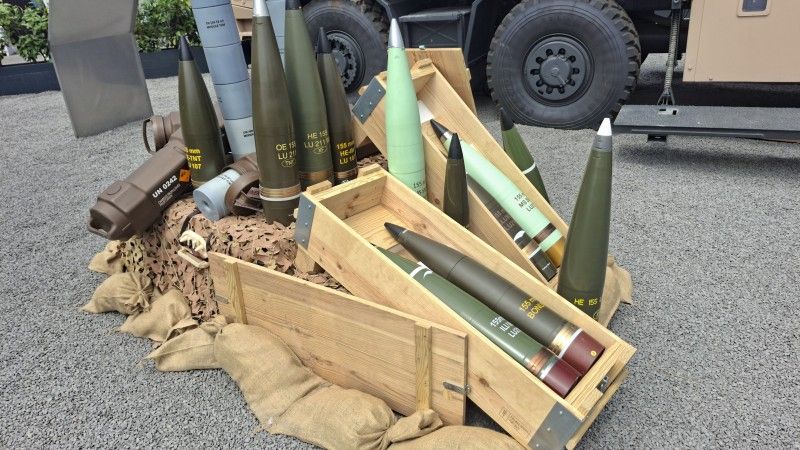
KNDS, a European defence sector giant, is prioritising a strategic partnership with the Polish industry. Dominique Guillet, Vice President of KNDS Weaponry and Ammunition, in a conversation with Jędrzej Graf, details the technology transfer process for the modern 155 mm LU211P ammunition and plans for building sovereign production capabilities in Poland. Learn the behind-the-scenes details of the agreement with the Niewiadów company and the vision for systems integration intended to define the future of artillery and air defence on NATO’s eastern flank.
Jędrzej Graf: KNDS is developing technologies for 155 mm artillery ammunition. This area remains crucial, especially considering the lessons learned from the conflict in Ukraine. What new technologies have you implemented in your 155 mm ammunition product line?
Dominique Guillet, Executive Vice President for Weapons and Ammunition, KNDS: First of all, we are very pleased to be at Eurosatory this year to present our innovations and new products to our customers and visitors. This includes our high-end products that are well known globally, such as the LU 211. As an innovative company, we are proposing a wide range of solutions.
Primarily, we are focusing on extended-range 155 mm ammunition. Range is becoming increasingly critical for modern armies. We are also developing solutions for drones, ranging from medium to long-range capabilities, as displayed at our booth. This has become one of our new specialties over the last two to three years.
Returning to the 155 mm caliber, our main innovative solutions concern smart and precision ammunition. We would also like to highlight our new Extended Range Systems, featuring the LU 220, which will be presented to the press at the end of this week. This is a major solution and a priority topic for us. Another key area is precision-guided munitions, such as Katana. Armies require both conventional high-explosive shells and precision-guided solutions; with Katana, decimetric accuracy (tens of meters CEP) is now achievable.

A key challenge is the production capacity for ammunition within Europe, given the current shortages. What efforts is your company making to increase its production output?
Our company specialises mainly in long-range and extended-range ammunition. Since the start of the war, we decided to implement increments to increase our production capacity across Western Europe—specifically in France, Belgium, and Italy. This involves increasing the capacity for shell production, filling operations, as well as the production of propellants, modular charges, and fuzes.
We have now quadrupled our production capacity in Western Europe. Furthermore, we are very open to partnerships in Eastern Europe. We are close to signing agreements with several partners in that region because extended-range products are in high demand. We do not focus mainly on low-end solutions like the M107; that is not our core business. However, many other European companies are increasing their capacity to produce that type of ammunition and we can support them there.
You mentioned the artillery market. In Poland, the situation is very dynamic, with new companies like Niewiadów and offerings from the WB Group. What is your strategy for potential partnerships and cooperation on the Polish market? What kind of technology transfer could be offered to NATO countries like Poland?
The Polish market is important both for the military and for us as a company. This is why we have worked with various Polish firms over the last four to five years. Historically, KNDS—including the former Nexter and KMW—has produced equipment for Poland, and we intend to develop our activities in the country further.
We are currently in discussions with different entities in Poland, including Niewiadów and PGZ. We also maintain a good relationship with the Polish Armament Agency, offering our solutions, particularly in the field of extended-range ammunition.
See also 

What are the key advantages of extended-range ammunition, especially in the context of the challenges seen in Ukraine, such as high operating tempos and the need for consistent access to munitions?
Our LU 211 solution with base bleed offers a range of up to 40 kilometers. It is a highly efficient design that is easy to produce, and we have already delivered significant quantities to many countries. It is compatible with various systems, including the Caesar, K9, Krab, PzH 2000, and RCH 155.
Our technology is ready for transfer. We are prepared to explore different solutions and are in close discussions with Polish actors regarding the transfer of technology and production. This could cover various industrial processes, including forging, filling, and the manufacture of modular charges.
During Eurosatory 2026, KNDS and Niewiadów signed an agreement on cooperation in the production of ammunition, including the LU211. Could you tell us more about the agreement?
We are also very pleased to have signed an agreement with Niewiadów, which establishes the framework for a long-term industrial partnership in Poland. The objective is to rapidly develop sovereign production capabilities for advanced ammunition systems and strengthen the resilience of the European defence industrial base.
The primary focus of this cooperation is the local production of our proven long-range 155 mm LU211P ammunition, together with Modular Charge Systems (MCS) and other key components of the ammunition system, including combustible cartridge cases. This is an important step because, like I said earlier, LU211 family has already demonstrated its operational value with a range of artillery systems and is increasingly in demand among European armed forces. The agreement also creates the possibility of extending the cooperation to other product lines, including long-range 105 mm ammunition and our latest generation of 120 mm tank ammunition, while leveraging shared industrial infrastructure in Poland.
For KNDS, this partnership reflects our commitment to developing long-term industrial cooperation with Poland. It will support the requirements of the Polish Armed Forces while also contributing to the supply of KNDS customers, ensuring greater production capacity, security of supply, and operational readiness for European and Allied nations.
See also
So what will be the next steps in cooperation with Niewiadów?
The signing of this strategic agreement is an important milestone, but it is only the beginning of the practical implementation. Over the coming months, our priority will be to move forward with the technology transfer and the establishment of production capabilities in Poland. We have already completed the initial assessment of Niewiadów’s production and organisational capabilities.
The next phase will focus on the detailed transfer of technology, particularly for the LU211P projectile and the Modular Charge System (MCS). This includes licensing and know-how related to projectile manufacturing and the production of modular charges at the LAP level. At the same time, we will work closely with Niewiadów to prepare the necessary infrastructure and production lines. Our teams will provide technical and personnel support throughout this process. We expect that qualification testing of the localised solutions on the Polish Krab and K9 Thunder systems will begin within the next few months.
I would like to highlight that the partnership is designed not only to serve the Polish Ministry of National Defence, but also to create a sustainable production base that can support both Polish requirements and the broader needs of KNDS customers. We see this as a long-term industrial cooperation that will strengthen European ammunition production capacity.
Let us move beyond artillery for a while. Counter-UAV capabilities are also important. From our perspective, Poland’s 1,000 km border with Ukraine, Belarus, and Russia makes this threat very realistic. What solutions are you currently offering to potential clients in this field?
For counter-UAV operations, we offer the RAPIDFire system, which is a very effective solution with a 40 mm gun. We also offer 30 mm systems (30 x 113 mm) with airburst ammunition. We are proposing these to various customers, including Poland. We are keen to cooperate with Polish industrial actors because sovereignty is key for many nations, especially Poland. This is why we are talking to partners like Niewiadów to envision cooperation in both 155 mm artillery and counter-UAV systems.
I would like to highlight that there are no formal limitations for the technology transfer of Counter-UAS systems and we are open to cooperation. However, the Polish Army may have already selected certain solutions. Therefore, we need to discuss with Polish companies how we can enhance those solutions using our know-how—for instance, improving range or the ability to intercept targets at altitudes of 3 to 4 km.

I believe the Polish Ministry of Defence is currently building a layered system by integrating solutions from various companies. I understand that the discussion regarding industrial cooperation is also viewed positively by your government, which helps foster these bilateral relations.
As you can see at our booth, the DNA of KNDS is to provide mission-oriented solutions. This involves organising and ensuring interaction between different systems, weapons, ammunition, UAVs, and fire-control systems. The most important factor for modern armies is the architecture that allows these systems to work together seamlessly—including ammunition, after-sales service, and maintenance.
KNDS is a pioneer in proposing this type of „system of systems” architecture. We are open to working with Polish companies to ensure full interoperability. Today, many countries purchase systems from various suppliers; KNDS is capable of integrating these disparate elements—such as munitions from KNDS, platforms from PGZ, and drones from other manufacturers—into a cohesive architecture. In wartime, the speed of decision-making is vital, which requires different systems to interact almost instantaneously.
I would like to have another question regarding 120 mm tank ammunition. What is your current offering in this field?
As you may know, we are now offering the 120 SHARD round. This is a well-known ammunition that has already been tested in Northern Europe against modern threats. We are open to discussing the transfer of technology to Poland for this ammunition. It is compatible with various platforms, including the K2 and the Abrams, those tanks work within standard NATO interface. As well as Leopard 2, as it is the KNDS portfolio.
And we are open to transfer of technology of SHARD, both with PGZ, and with other partners.

I understandthat in general you are open to working with multiple partners in Poland to find the best solutions.
Yes, we are open to partnerships with the Polish industry; this is a priority for us. To sign a partnership, you need at least two parties, but I highlight that we can cooperate with multiple partners, both state-owned like PGZ and private.
I would like to add that we are open to discussion with many potential partners, but sometimes it is necessary to move quickly and finalise agreements. Time is of the essence, and we must take decisive action for the future of Europe. We have strong ambitions for Poland, and we intend to be a long-term partner there.
Thank you very much for the conversation.


