


- ANALIZA
- WIADOMOŚCI
France and UAE revive Rafale F5 cooperation after €3.5 billion dispute

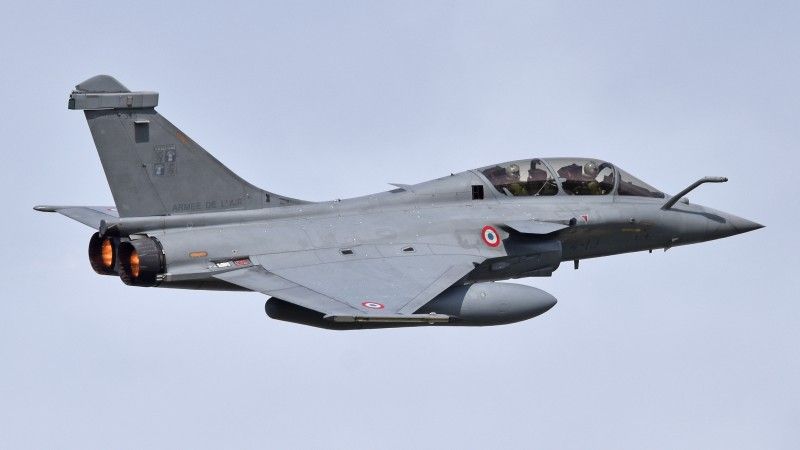
France and the United Arab Emirates have agreed to resume cooperation on the Rafale F5 fighter programme, months after negotiations collapsed over financing and access to sensitive military technologies. During President Emmanuel Macron’s visit to Abu Dhabi on 20 October, both countries signed a new intergovernmental agreement covering the future Rafale standard, defence industrial cooperation and technological development. For Paris, this represents an important opportunity to restore a partnership that had previously left France facing the prospect of financing the F5 programme alone.
The new agreement marks a significant change compared with the situation earlier this year. As Defence24.com reported in April, the UAE had withdrawn from negotiations after France refused to provide access to sensitive technologies, particularly advanced optronics. Abu Dhabi had initially been prepared to contribute up to €3.5 billion to a programme estimated at approximately €5 billion. The disagreement exposed the limits of one of France’s most important defence partnerships, despite years of extensive military and industrial cooperation.
The latest arrangements cover cooperation on the Rafale F5 standard within both countries’ fighter aircraft programmes, including technical and financial specifications for future industrial cooperation. However, the agreement does not yet establish whether the UAE will restore its previously discussed €3.5 billion contribution or receive access to the technologies that caused the original dispute. This distinction is important because France has already continued development through its own defence industry, while Dassault Aviation previously confirmed that no foreign country was participating in the F5’s co-development.

From a broader strategic perspective, the agreement carries significant implications. France maintains a permanent military presence in the UAE and considers Abu Dhabi one of its most important partners on the Arabian Peninsula. The Emirates ordered 80 Rafale F4 fighter jets in 2021 as part of a wider defence package worth approximately €16.6 billion, including helicopters, weapons and support. Deliveries are expected to begin at the end of 2026. The future F5 standard could therefore become another important element of a relationship already built around French combat aircraft, military infrastructure and long-term defence cooperation.
The Emirati position has also evolved considerably. Abu Dhabi is investing heavily in its domestic defence industry, particularly through EDGE Group, which brings together more than 35 companies specialising in advanced weapons, unmanned systems, cyber capabilities and electronic warfare. During his visit, Macron toured EDGE’s industrial facilities and discussed further cooperation with Emirati officials. The group has already developed partnerships with French companies and signed an agreement with France’s Directorate General of Armaments. For the UAE, participation in advanced defence programmes is increasingly linked to technological access, industrial development and reducing dependence on foreign suppliers.
The Rafale F5 itself represents a major technological shift rather than a simple modernisation of the existing aircraft. The standard is expected to introduce a new RBE2-XG radar, upgraded electronic warfare capabilities, more resilient communications and improvements to the M88 engine. It will also operate alongside a future unmanned combat aircraft capable of conducting reconnaissance, electronic warfare and strike missions. Another central element is the integration of the ASN4G hypersonic nuclear missile, which will support the modernisation of France’s airborne nuclear deterrent. The F5 standard is expected to be qualified around 2033, with export availability envisaged from approximately 2035.

France has also demonstrated the importance of its Gulf partnerships during the recent conflict involving Iran. French military forces helped protect the UAE and other regional partners against Iranian aerial threats, including drones and missiles. The latest agreements therefore extend beyond fighter aircraft and include military interoperability, industrial resilience, artificial intelligence and space technologies. Paris and Abu Dhabi are also expanding cooperation in energy, with new agreements involving ADNOC, Schneider Electric and Technip Energies. France is seeking to strengthen its strategic position in the Gulf while simultaneously securing important energy and industrial partnerships.
Financially, the renewed relationship is particularly important for Paris. France faces considerable pressure on its defence budget, while simultaneously developing the Rafale F5, preparing a future combat aircraft following the collapse of the Franco-German FCAS fighter project and modernising its nuclear forces. Additional Emirati participation could reduce some of these financial pressures and create new opportunities for French defence companies. However, the previous negotiations demonstrated that Abu Dhabi expects substantial industrial benefits in return for its financial involvement, while Paris remains determined to retain control over its most sensitive military technologies.
The agreement signed in Abu Dhabi represents a significant political and industrial step after the breakdown of negotiations in 2025. France has succeeded in bringing the UAE back into discussions about the future of the Rafale F5, while Abu Dhabi has secured a new framework for cooperation on advanced combat aviation. The next stage will determine whether this framework produces substantial financing, technology-sharing arrangements and concrete industrial projects. For Paris, restoring Emirati participation could have consequences extending far beyond the Rafale programme, particularly as France seeks to finance its next generation of combat aircraft and preserve its military position in the Gulf.

It is worth noting that India also wants to participate in the new French programme, but was denied access due to the sensitivity of French technologies. Paris needs funding but does not want to share…


