


- ANALIZA
- WIADOMOŚCI
Rafale exposes J-16 weakness. But China tested more than a fighter

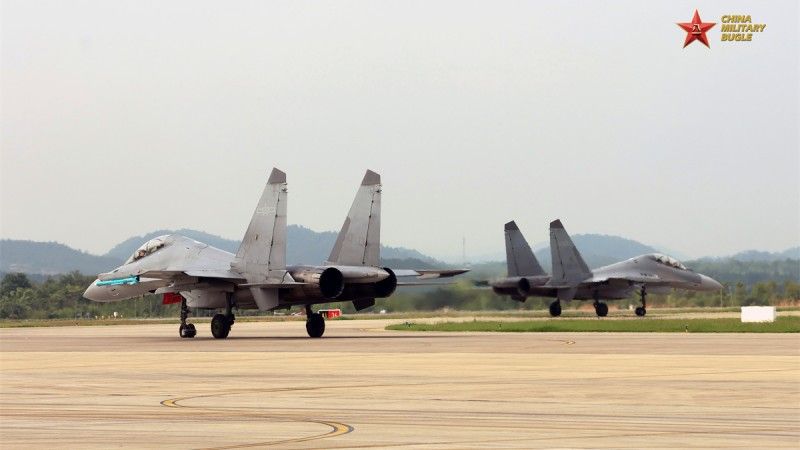
Photo. eng.chinamil.com.cn/ Luo Shiwei
Chinese J-16 fighters trained against Egyptian Rafales during Eagles of Civilization 2026, and the most important new element is no longer just the fact that the two aircraft met in the air. According to recent reports, Chinese pilots themselves acknowledged that the Rafale had an advantage over the J-16 in close air combat. This matters because it breaks the earlier information narrative suggesting that the Chinese fighter had dominated the French aircraft. But the real meaning of the exercise is broader: China did not send only fighters to Egypt. It deployed an entire airpower package and tested how the People’s Liberation Army Air Force can operate far from Asia against Western-built combat aircraft.
The encounter between the J-16 and Rafale was important from the beginning. It was one of the rare publicly confirmed cases of direct training between a Chinese heavy multirole fighter and a Western-built 4.5-generation aircraft used by a foreign air force. The Chinese and Egyptian sides conducted medium- and close-range air combat drills on 23 August as part of the second edition of Eagles of Civilization. The exercise was expected to move from basic one-on-one and two-on-two engagements towards more complex operations involving larger formations.
The new information changes the political and military interpretation of the exercise. Chinese pilots reportedly admitted that the Rafale was superior in close combat, especially in manoeuvrability and dogfight performance. This is not surprising from a technical point of view. The Rafale is smaller, lighter and built around a delta-canard configuration that gives it strong nose-pointing ability, high instantaneous turn performance and good control at demanding angles of attack. In a close-range fight, these features matter.
🇫🇷🇪🇬🇨🇳 Egypte: Selon l’évaluation des pilotes de l’armée de l’air chinoise, le Rafale est supérieur aux J-16 en combat aérien rapproché (dogfight) pendant l'exercice "Eagles of Civilization 2026": "Ses capacités en combat rapproché sont effectivement supérieures, tout comme sa maniabilité. D’une part, on ne peut pas se permettre de sous-estimer cet écart en matière de performances au combat rapproché".
— Restitutor Orientis 🇱🇮 (@restitutorII) October 11, 2026
The J-16 is a different aircraft and should not be assessed as a Rafale equivalent. It is a heavy Flanker-derived platform built around range, payload, radar size, weapons carriage and integration into a wider air-combat system. Its strengths are visible in beyond-visual-range scenarios, strike missions and operations conducted with airborne early warning, electronic warfare and tanker support. But in classic close-in manoeuvring combat, the Rafale showed why it remains one of the most dangerous European combat aircraft.
Rafale won the close fight
The key point is precision. The Rafale’s advantage in close air combat does not mean that the Rafale automatically defeats the J-16 in every scenario. It means that in the part of the exercise where manoeuvrability, energy management and pilot handling matter most, the French aircraft demonstrated superiority. That is already important enough, because it undercuts the earlier Chinese media narrative that presented the J-16 as clearly dominant.
There is still no official kill ratio, no full telemetry, no detailed rules of engagement and no public information on fuel states, weapons simulation, starting positions, sensor restrictions or the use of supporting aircraft. Without those details, nobody can honestly describe the full result of the exercise. Earlier claims that the J-16 had decisively beaten the Rafale were not supported by official evidence. The same standard must apply now, even if the latest information is much more favourable to the French aircraft.

The correct conclusion is therefore not social media triumphalism, but operational clarity. The Rafale performed better in close air combat. The J-16 remains a dangerous platform when used in the role for which it was designed: as a heavy fighter integrated with a wider Chinese system of reconnaissance, command, electronic warfare and long-range weapons. That is exactly why China did not bring only J-16s to Egypt.
Beijing deployed a system, not only an aircraft
The strategic significance of Eagles of Civilization 2026 is that China sent an entire airpower package. The deployment included not only J-16 fighters, but also airborne early warning, electronic warfare, tankers and transport aircraft. The presence of the KJ-500, the Y-9LG electronic-warfare aircraft and YY-20A tankers changes the meaning of the exercise.
This was not only a test of whether the J-16 could turn better or worse than a Rafale. It was a test of whether the People’s Liberation Army Air Force can move a complex air package more than 6,000 kilometres from China, sustain it in Africa and train against Western-built systems in a politically valuable environment. For Beijing, that may be more important than the outcome of individual engagements.
See also 

The Y-9LG is especially important. Its presence means that China could observe the electromagnetic environment created during operations involving Rafales. This does not prove that Egypt handed over sensitive data or that China obtained the technical parameters of the SPECTRA self-defence system. But every realistic exercise involving a Western combat aircraft creates opportunities to observe procedures, emissions, communications, radar behaviour and pilot reactions. For China, that information has value even if the Rafale won the dogfight.
The Indian angle is obvious
The Indian dimension cannot be ignored. India operates Rafale aircraft, and for China the opportunity to train against Egyptian Rafales is valuable. It gives Chinese pilots and analysts exposure to the aircraft’s aerodynamic behaviour, visual profile, manoeuvring style and tactical employment. Even if the Egyptian configuration is not the Indian one, the platform itself matters.
At the same time, Egypt’s Rafales are not India’s Rafales. The Indian aircraft have country-specific modifications, different weapons integration, different electronic-warfare arrangements, different procedures and a different training environment. Eagles of Civilization is not a rehearsal for war against the Indian Air Force. It is, however, a rare opportunity for the PLAAF to build familiarity with an aircraft type that would matter in any future Asian airpower calculation.
This is why the exercise should be read on two levels. At the tactical level, the Rafale showed superiority in close air combat. At the operational level, China demonstrated that it can deploy fighters, tankers, airborne early warning and electronic-warfare platforms far beyond its own region. Both conclusions are important. Ignoring the Rafale’s advantage would be wrong. Reducing the entire exercise to a dogfight would also be wrong.
The real lesson from Egypt is that the Rafale remains a highly capable and dangerous fighter in close combat, while China is learning how to fight Western-built aircraft as part of a much larger system. France can point to the Rafale’s performance and China can point to distance, scale and expeditionary deployment. These are two different messages because one concerns the aircraft, and the other concerns the system that Beijing is building around it. All in all, both countries will need the next versions of their flagship jets.


