- ANALIZA
- WIADOMOŚCI
Italy’s Leonardo sets up Ukraine subsidiary and prepares Michelangelo Dome component for testing

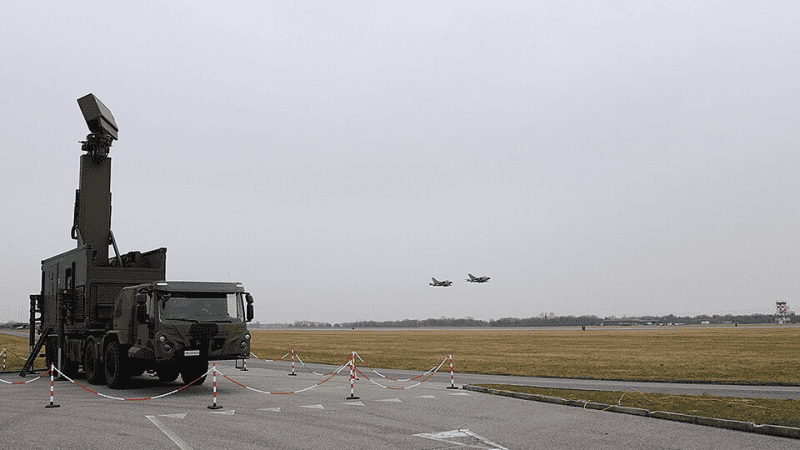
Photo. Italian Air Force, CC BY 2.5
The Italian Leonardo has established a wholly owned subsidiary in Kyiv, expanding its direct presence in Ukraine’s defence technology sector. Separately, the group has confirmed that an initial capability linked to its Michelangelo Dome architecture is scheduled for demonstration in Ukraine before the end of 2026.
Leonardo Ukraine was registered on 20 May 2026 and first appeared in the group’s half-year financial report published at the end of July.
According to the Ukrainian business register, the company’s activities include scientific and engineering research, communications and navigation equipment, software development, IT services, and the maintenance of electronic and optical systems. Leonardo has confirmed that the legal process required to begin operations has been completed.
The group is not entirely new to Ukraine. Its 2025 accounts already listed a 49% interest in Elsacom Ukraine. The newly created company is nevertheless different: it gives Leonardo a wholly owned local structure through which it can employ personnel, conclude agreements and develop its activities in the country.
Interest in Ukrainian drone technology
Leonardo CEO Lorenzo Mariani has indicated that cooperation with Ukraine’s drone industry is being considered. Speaking at the Farnborough International Airshow in July, he pointed to the operational experience accumulated by Ukrainian companies during the war.
For Leonardo, the attraction extends beyond individual drone designs. Ukrainian manufacturers work within a development cycle in which equipment is deployed, evaluated and modified using feedback from frontline units. This is particularly relevant in areas such as electronic warfare resistance, autonomous navigation and the mass production of relatively inexpensive unmanned systems.
The Kyiv subsidiary could provide Leonardo with closer access to this industrial environment. No Ukrainian partners, production facilities or joint programmes have yet been announced.

Michelangelo trial confirmed
Leonardo is also moving ahead with plans to demonstrate an initial element of the so-called “Michelangelo Dome” in Ukraine.
Unveiled in November 2025, Michelangelo Dome is an air and missile defence project that can be compared with Iron Dome and Patriot, although it is intended to work on a much broader level. While those systems use their own radars and interceptors against specific aerial threats, Michelangelo is designed to coordinate many different defence assets.
Rather than being a missile battery, it is a digital architecture connecting radars, satellites, command systems, cyber and electronic warfare capabilities, guns and missiles supplied by different manufacturers. The network would combine information from these systems, create a common picture of the threat and help commanders choose the most suitable response. Put simply, Michelangelo is intended to connect multiple layers into a wider defence network covering the air, land, maritime and space domains.
Its MC5 integration layer is being designed to connect both new and legacy equipment, including systems supplied by other manufacturers. Information from multiple sensors would be fused into a common operational picture, allowing the architecture to identify a threat and support the selection of an appropriate response.
This approach is particularly relevant to Ukraine, whose air-defence network combines Soviet-designed equipment, Western missile systems, locally developed sensors, electronic warfare assets and counter-drone weapons.
In March, Leonardo’s then-CEO Roberto Cingolani said that the first Michelangelo component intended for Ukraine was already under construction. He expected delivery and testing in a real environment before the end of 2026.
The timetable appears to have survived the subsequent change in Leonardo’s leadership. During the group’s half-year results presentation on 31 July, Mariani reiterated plans to demonstrate an initial “dead-zone protection” capability in Ukraine by the end of the year.
This element is intended primarily to counter mass attacks by low-cost drones. Leonardo has previously described a layered solution combining surveillance sensors, command systems and comparatively inexpensive effectors, including gun-based systems.
See also 

Separate but aligned projects
Leonardo has not disclosed the exact configuration of the Michelangelo Dome equipment being developed for Ukraine. The company has nevertheless confirmed that its first component is under construction, with delivery expected before the end of 2026, and that it will be tested in Ukraine in what Leonardo described as a real environment.
The Ukrainian programme is linked to the Dead Zone trial, which focuses on the innermost layer of protection against drones and other low-flying threats. Leonardo has not said whether the equipment will take part in actual combat operations. Nor should the announcement be interpreted as the deployment of the complete Michelangelo Dome, whose wider command, space and international integration capabilities will be introduced gradually over the coming years.
The group has also not stated that Leonardo Ukraine will manage or support the trial. Establishing a local subsidiary and testing Michelangelo remain formally separate developments.
They are, however, strategically aligned. A permanent structure in Kyiv could make it easier to cooperate with Ukrainian engineers, collect operational feedback and study the integration of systems already used by the Ukrainian Armed Forces.
For now, Leonardo Ukraine remains a small company on paper, while Michelangelo Dome is still under development. The planned demonstration will show whether the group can translate its multi-domain concept into a practical capability suited to Ukraine’s rapidly changing threat environment.