












- WIADOMOŚCI
- KOMENTARZ
They will strike where it really hurts. Premiere of new missiles in France

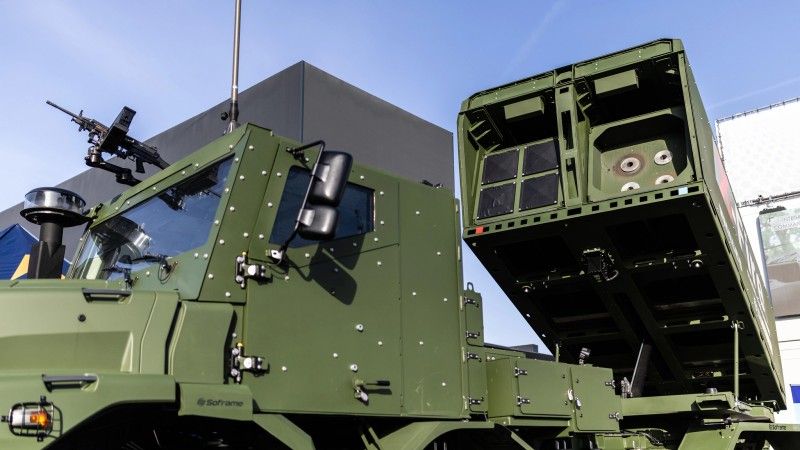
Photo. Adrien Daste / Thales
Alongside the expansion of its naval and airborne nuclear arsenal, France is investing in conventional deterrence capabilities. Part of this effort consists of land-based ballistic missiles.
At the Eurosatory 2026 defense industry exhibition in Paris, the European company ArianeGroup is presenting an updated development roadmap for conventional surface-to-surface ballistic missiles. The new weapon system is being developed jointly with Thales and Soframe for the Missile ballistique terrestre (MBT) program conducted on behalf of the French Armed Forces (French: Forces armées françaises). The B-Strike family comprises two effectors with ranges of 1,000 and 2,500 km. An ArianeGroup representative told an AeroTime journalist that the company is self-financing the project and is ready to build a demonstrator.
MBT is one of many missile programs being conducted by France’s Directorate General of Armaments (French: Direction générale de l’armement). The intention to procure conventional missiles with a range of 2,500 km was included in the recently updated Military Programming Law for 2024–2030 (French: Loi de programmation militaire 2024–2030). The fielding of such a system is expected by the end of the 2030s, with initial operational capability to be achieved in 2035–2036. The B-Strike family is therefore more than just an eye-catching exhibit at Eurosatory.
See also 
B-Strike 1000 and 2500
The short-range ballistic missile designated B-Strike 1000 is an operational-level weapon with a range of about 1,000 km. The single-stage missile carries a conventional warhead, which separates from the first stage before reaching its apogee, or maximum altitude, 120 km above the ground. In the terminal phase of flight, the warhead reaches hypersonic speed — above Mach 5 — while retaining the ability to maneuver in order to complicate interception by enemy air-defense systems. According to ArianeGroup, the circular error probable (CEP) is to be less than 10 m. The manufacturer states that the system will be resistant to satellite navigation signal jamming.
Photo. MBDA
JThe launcher is to be the X-Fire system unveiled in recent weeks. Thales and Soframe proposed this solution to the French Army (French: Armée de terre) under the Frappe longue portée – terrestre (FLP-T) program. For this project, ArianeGroup and Thales developed the FLP-T 150 guided rocket. The winner of that procurement was the rival MBDA-Safran consortium, which offered the military the Thundart system. However, ArianeGroup, Thales, and Soframe are not giving up, counting on the purchase of X-Fire with ballistic armament. The launcher module is to accommodate two transport-launch containers, each holding one B-Strike 1000 missile.

Photo. Thales
Interestingly, the consortium has reached an agreement with South Korea’s Hanwha Aerospace to integrate the CGR-080 guided rocket with the X-Fire launcher. The effector used in the K239 Chunmoo launcher — including the Homar-K system fielded by the Polish Armed Forces — will be produced in Poland by the special-purpose company Hanwha WB Advanced System. It can be assumed that integration of the Korean munition was proposed in order to shorten the timeline for introducing X-Fire into service, as well as to guarantee the Armée de terre deliveries of proven effectors before production begins of the target FLP-T 150 effector.
The larger B-Strike 2500 missile is a conventional strategic-level weapon. The size of the two-stage missile will require the use of a launcher significantly larger than X-Fire. The weapon module has been placed on a semi-trailer towed by a tractor unit. As noted by Etienne Marcuz, an analyst at the Paris-based FRS think tank, in the future the B-Strike 2500 will be capable of lofting hypersonic glide vehicles (HGVs) to an altitude of 150 km. It is difficult here not to recall the V-MAX demonstrator built by ArianeGroup. In 2023, the vehicle was flight-tested at the state missile test center in picturesque Biscarrosse in western France.
— Etienne Marcuz (@Etienne_Marcuz) June 15, 2026
As Marcuz noted, the B-Strike 1000 is intended to reach its target in less than 10 minutes. In the case of the B-Strike 2500, flight time will be around 15 minutes. France is a nuclear power, but its armed forces would certainly benefit from fielding conventional strike assets of this class. One need only cite the growing effectiveness of Ukraine’s „kinetic sanctions” against Russia, particularly its oil and defense sectors. Polish military authorities are also expressing interest in acquiring similar weapons.
It is worth emphasizing that ArianeGroup has extensive experience in designing ballistic weapons. The company manufactures the M51 intercontinental missiles launched from Le Triomphant-class strategic submarines. In September of last year, ArianeGroup received a contract to develop and produce the new M51.4 version. Since the retirement of the land-based Pluton and Hadès systems, France’s nuclear deterrent has relied on missiles carried by submarines and multirole combat aircraft.
The European dimension
The aforementioned Military Programming Law emphasized the intention to cooperate with Germany and the United Kingdom in the field of ballistic weapons. Two of France’s closest European partners have themselves launched the Deep Precision Strike project, aimed at jointly developing effectors of various types — not necessarily ballistic — with ranges exceeding 2,000 km. Meanwhile, in February and April, the Hartpunkt portal reported that Paris had begun enticing Berlin with the prospect of launching production of ballistic weapons for the Bundeswehr in Germany.

Photo. Destinus
Incidentally, ArianeGroup is jointly owned by Safran and Airbus on a 50:50 basis. In this respect, ArianeGroup itself is a venture with substantial German industrial participation. Moreover, France, Germany, and the United Kingdom are all members of the European Long-Range Strike Approach (ELSA) project. However, as demonstrated by the fate of Franco-German defense programs in recent years, neither political calculations, nor shared interests, nor complementary industrial capabilities are any guarantee of success for such projects.


