- WIADOMOŚCI
TUGA: A Polish radar for drone detection

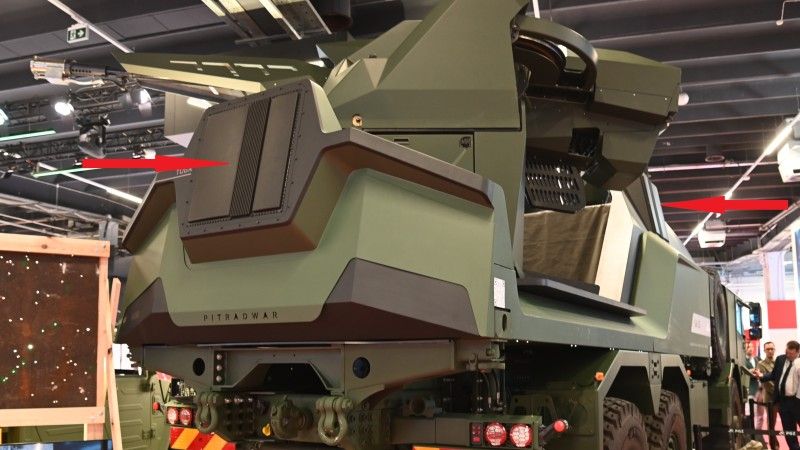
Photo. M.Dura
TUGA is not only a radar capable of effectively detecting mini- and microdrones, but also a surveillance system that offers a low probability of detection, thereby enhancing operator safety.
The threat posed by drones has become so significant that dedicated systems must be developed to counter unmanned aerial vehicles with small radar cross-sections that fly more slowly than missiles and aircraft, operate primarily at low altitudes, and are relatively inexpensive. Such counter-drone systems should incorporate both suitable effectors and sensors capable of detecting UAVs in all weather conditions, with the required probability of detection and accuracy.
The new TUGA radar offered by the well-known Polish company PIT-RADWAR S.A., a member of the Polish Armaments Group, directly addresses these requirements. Developed in Poland, the radar incorporates features designed to ensure both the necessary effectiveness and user safety.
This was achieved through several solutions, most notably:
- an active electronically scanned array (AESA), using distributed high-power amplifiers based on gallium nitride technology;
- and a distinctive operating mode employing frequency-modulated continuous-wave (FMCW) technology.

Photo. PIT-RADWAR S.A.
Thanks to its AESA (more precisely, a pair of transmit and receive antennas) and the associated signal-processing system, TUGA is classified as a 4D radar. It can determine four parameters of an aerial target: bearing, range, altitude, and Doppler, or radial, velocity. Operating in the X band (8–12 GHz), the radar has been designed with particular emphasis on improving its ability to track and classify aerial objects with small radar cross-sections, including mini- and microdrones.

Photo. PIT-RADWAR S.A.
TUGA can operate in sector-surveillance mode with a stationary antenna, covering a 90-degree sector in a “stop-and-stare” configuration. It can also provide omnidirectional surveillance through:
- the use of several antennas positioned around the perimeter of a platform, such as a vehicle or vessel;
- or the installation of a single antenna on a rotating mechanism.
Because the TUGA antenna is compact, measuring 640 × 640 × 150 mm, and lightweight, it can also be incorporated into a multisensor surveillance head equipped, for example, with cameras for identifying detected objects. PIT-RADWAR S.A. presented such a solution at MSPO in Kielce in 2024, including for the 35 mm SA-35 self-propelled gun.

Photo. M.Dura
Radars designed to detect small drones usually have a relatively short range, often no more than 5 km. They must therefore be deployed close to the line of contact. Because they must operate actively by emitting radar signals, they are exposed to detection by enemy reconnaissance systems and destruction by artillery or drone attacks. To mitigate this risk, the TUGA radar uses a frequency-modulated continuous-wave signal.
This solution reduces the signal’s peak power, making the radar more difficult for enemy reconnaissance equipment to detect. TUGA is therefore categorized as a low-observable radar and classified as an LPI, or low-probability-of-intercept, radar. By comparison, a pulse radar with a similar range can often be detected in unobstructed space from a distance 100 times greater than an FMCW radar.
The use of a continuous wave changes the radar’s mode of operation. In a conventional pulse radar, range is determined by measuring the time taken for a transmitted pulse to return to the receiver after being reflected by the target. A single antenna can therefore be used because the transmitter and receiver operate alternately. An FMCW radar, which transmits continuously, uses two antennas: a transmitting antenna that emits the signal and a receiving antenna that collects the signal reflected by the target. Comparing the difference in frequency between the signal being transmitted at a given moment and the signal being received makes it possible to determine the distance to the target with very high accuracy.
TUGA is a modular and easily configurable system. Weighing less than 50 kg, it can be deployed in a transportable configuration on a dedicated tripod, integrated into vehicles with several antennas positioned along their sides, or installed aboard vessels after being adapted for operation in demanding environmental conditions in the TUGA-M configuration.

Photo. M.Dura
It should also be noted that TUGA can detect larger aircraft. The radar has a maximum instrumented range of 50 km and a minimum range of 50 m. Its ability to detect specific objects depends heavily on factors including their size and the materials from which they are made. In the case of micro-class drones with a radar cross-section of 0.01 square meters, TUGA’s ability to detect them at ranges of at least 5 km has been confirmed.
These capabilities allow the TUGA radar to be used both in conventional air-defense systems—following full integration with an identification friend-or-foe system—and in specialized counter-drone systems such as SAN batteries. It could also serve as a valuable addition to the multisensor network being developed under the East Shield program.
Sponsored article
Published in partnership with PIT-RADWAR