












- WYWIADY
- WIADOMOŚCI
Poland's dominance in the Baltic Sea. Billions invested in new wind power capacity

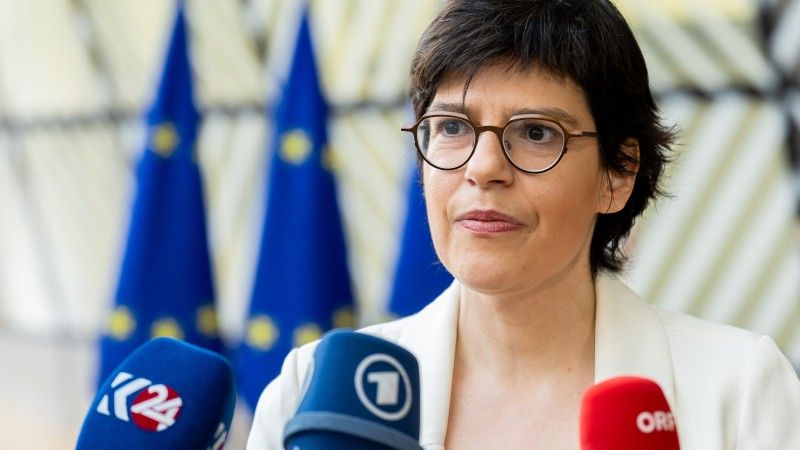
Photo. Belgian Presidency of the Council of the EU 2024 / flickr / @belgium24.eu / CC BY 2.0 https://creativecommons.org/licenses/by/2.0/deed.en
Poland plans to build 11 GW of offshore wind farms by 2040 and is consistently implementing its plan, as evidenced by recent auctions for example. Of the 45 billion euros that the European wind sector has invested in new wind capacity set to come online in the coming years, Poland accounts for one-third. Most of this is in offshore wind farms. Tinne Van der Straeten, CEO of WindEurope, discusses this topic further in an interview with Energetyka24.
Tinne Van der Straeten, Belgium’s former Minister of Energy from 2020 to 2025, was recently appointed CEO of WindEurope, thereby resigning from her seat in the Belgian Parliament. She oversaw Belgium’s energy sector during, among other things, the energy crisis triggered by Russia’s invasion of Ukraine. She assumed her new role on February 2nd. Now, it is crucial to phase out fossil fuels and accelerate the development of wind energy in Europe so that the EU can achieve its 2030 energy security and climate goals.
How do you feel about your new role? Did you think that that’s what you would be doing? And what are your plans for the incoming years?
I am very glad to be here at WindEurope. I have been working on renewable energy policy for a long time and I truly believe that an energy system that is based on renewable energy has numerous benefits. It is affordable, clean, it can be scaled. And specifically – it is home grown, so it can make us more independent from fossil fuels and from the volatility that comes with it as well. This exact moment gives evidence to that. We see gas and oil prices rising right now because of situation in Iran and the closure of the Strait of Hormuz. So it is absolutely urgent turn to a clean, affordable and home-grown energy sources, such as wind energy. They help us take back control of our energy generation and ensure competitive electricity prices for Europe’s businesses and households.
WindEurope recently published its yearly report on the state of the wind energy sector in the EU and its future. What is your opinion about last year in terms of wind energy development in European Union?
In terms of wind energy development, Europe performed really well in 2025. We saw 19 gigawatts of wind installations that came online.
90% of these installations were onshore wind. At the same time, we also see that the European wind industry invested 45 billion euros in wind projects of a total of 20 gigawatts of wind power that will go online in the coming years.
These are really good numbers. They prove that the wind industry is here and up to the task, ready to deliver. That we can indeed build wind farms, that there is the business case for investment and that we can operate within the existing regulatory framework. And that costs of renewable energy will come down if we have a scale and also if we have a right pace.
But they also show us what’s at stake. If European policymakers interfere with the EU electricity market rules now they put our progress at acute risk.
Capital flows need clarity, so if we want to see these projects be realizeds in the incoming years we cannot backpedal on the existing market rules today. So the whole discussion that was suggested after the informal retreat by the European Union in February that maybe we should review some of the market rules is absolutely and totally wrong route to go to.
What about offshore?
Offshore wind needs to step up its game. But at the North Sea Summit in Hamburg, there was a new commitment signed and many promising words were spoken. What is more, we see a new offshore leader coming to the market and that is Poland.
When I mentioned 45 billion euros that were invested in new wind energy capacity in 2025 – I mean final investment decisions – Poland accounted alone for 15.5 billion euros. So one third of the wind capacities that will be installed in the next few years were financed by Poland, and almost all of that was offshore wind.
This of course came after the successful auctions that Poland had. This proves that regulatory stability leads to successful auctions and to final investment decisions, ensuring that the project will be completed in the near future. Observing what is happeningin the North Sea and Baltic Sea, I am confident about the future of offshore wind in Europe.
What are the main obstacles to the development of wind farms in EU? What do we need to make the sector thrive?
We need to accelerate the process of wind farm development, we need to increase capacities to become more independent. I see three main issues holding us back.
The first one is – of course – the grids. We need efficient grids that are up to the task to manage all these new capacities that will soon come online.
The other one is – permits. Specifically, onshore wind faced difficulties obtaining permits. Regarding these two problems – the grids and the permits – there has been created a whole framework on fast permitting in European legislation during the previous crisis. Germany is a good example of the implementation of these regulations to national legislation. This was an important driver of new wind capacities in this country. They have great results because they worked within an existing framework. This is also the area where Poland needs to step up their game as the permitting process takes a long time in Poland – five to six years. It’s up to national government to work within this framework.
In Belgium – even though it’s a small and densely populated country – we managed to develop onshore wind sector. Onshore wind is very competitive, as well as quick and easy to build. If your permitting process is efficient you could achieve a lot more.
The third very important issue is electrification. We need demand to increase. Let’s look at the low hanging fruit first. There are a lot of industrial processes that are ready to be electrified with existing technologies – low or mid temperature processes for example. If we do this it means we become less dependent on other energy sources and we drive a demand for new wind capacities where they are needed. It goes hand in hand.
In your opinion, is the wind energy the one that can support energy security in long term?
Yes, absolutely. Wind is electricity that we can „make at home”. We can turn our sea basins into huge power plants. We can use the space we have to build onshore wind turbines that are located close to the to cities so we can electrify these cities.
It is home grown, it is scalable, it is competitive. It is something that we do ourselves so we can cut our dependencies on fossil fuels that will in any case come from abroad. Wind energy – in the short and in the long term – it is absolutely the way to go.
What about manufacturing of the wind turbines? In Poland, a common criticism is that the turbines, parts or technology aren’t locally sourced – not really home grown – but come from places like China.
The supply chain is globally diversified of course. But at the same time the turbines are manufactured in Europe, there is a strong value chain at home as well. The jobs, the brains and the data are here at home. We have a strong footprint of 440,000 Europeans working in wind and it’s something that we need to keep.
So we should not confuse a globally diversified supply chain with a strong anchor in Europe. It’s the technology that is built here and that’s operated here from European control centers. So it is a „home grown” and European anchored technology.
What is your opinion about wind energy role in Poland? Should it be one of the main energy sources or should it be something else?
Absolutely, renewable energy in any case and with no regrets is an energy source for every country. As WindEurope we conducted a study on the cost of various energy systems. We compared several scenarios: the renewable-based scenario, nuclear-based scenario, hydrogen-based scenario and the scenario where you do not change anything, with no specific direction business as usual in general. Out of these scenarios, the renewable one turned out as the cheapest – even when accounting for additional grids and storage investment. It was not only about energy generation nor adding wind and solar capacities.
I would recommend that Poland goes with this scenario as well. And you can really make it. Poland is one of the European top investors in offshore wind capacities, it is becoming a leader in the Baltic Sea basin. It is also a big country so you can step up and increase onshore wind capacity. There is absolutely no reason not to do it as it will be beneficial both for Polish citizens and for the companies and industries.
How do you see Poland’s role in European offshore sector?
Poland is an emerging leader in the offshore sector and it can also support other countries with turbine manufacturing. This is what we have seen in Belgium, first you build wind turbines in your country and then supply chain is following, creating jobs and increasing manufacturing capacity. And manufacturing capacity is actually already present in Poland – there are offshore wind clasters in Gdańsk and Szczecin – so it is really happening and will only further develop.
There is a chance that Poland will become an engine for regional collaboration. We have seen that in the North Sea basin countries that are developing offshore wind they meet each other at a regional level as North Seas Energy Cooperation. Something similar could be happening in future around Baltic Sea and it might be Poland’s role to start this. That could be supported on the European level as well to strengthen collaboration in the Baltic Sea region.
What lessons could Poland learn from Belgium’s energy transition?
It is an interesting question because our countries are very different. Belgium is a smaller country in terms of territory, very densely populated but strategically located. What we have in common is of course – the sea. We also both have energy-intensive industry present.
First thing is that despite we are densely populated country we managed to develop onshore wind sector. This is also achievable for Poland but in my opinion, I would suggest revising the distance rule for the onshore wind and maybe looking at a country like Belgium. If we managed to do this in a country with such a high population density then it can probably be achieved in Poland as well (385 inhabitants per km2 vs 120 inhabitants per km2).
Second, regional collaboration. I remember the Vilnius conference of the Baltic states I attended in 2024 during the Belgian presidency in the EU. One of the topics was Baltic cooperation, following the example of cooperation in the North Sea region. In order to have such regional collaboration you need to have an engine. Someone who says: „okay, I’m willing to take the lead” – traditionally it is a country that is already a regional leader. And today I think it is fair to say that Poland is leading regarding offshore wind development.
The third thing is the supply chain. In Belgium we have benefited greatly from an early and ambitious renewable energy policy, particulary in the area of offshore wind power. We observed that the supply chain has followed like in the port of Ostend. The companies are also operating in smaller cities – like ZF Wind Power that is producing gearboxes and power trains for wind turbines in Lommel. There are a lot of consulting companies, offering for example, safety certificates required for working in the offshore sector. We have Jan de Nul that installes offshore wind worldwide as well and some companies that were former shipbuilders, like Equans, and turned into Offshore High-Voltage Substations (OHVS) manufacturers.
Not only the policy has to be ambitious, but also it needs to be consistent. Then it allows to organize auctions for high-capacity projects, adding significant numbers of gigawatts, with risked limited by using CFD (Contract for Difference) as Poland has recently done. That will ensure that the supply chain comes along. Continuation of organizing auctions will only reinforce that. These would be my takeaways from Belgium.
How widespread is the problem of disinformation about renewable energy in other European countries? As in Poland it is an enormous problem.
I think it is fair to say that we are witnessing a polarization around energy almost everywhere across Europe. Some countries become targets of disinformation and misinformation more than others. For example Latvia – it is a major victim of disinformation and misinformation. But we also see an increase in anti wind narratives and false claims in Spain, Poland and elsewhere.
It’s really important that we keep being engaged: on the one hand, correcting the disinformation and misinformation, revealing its true nature and confronting it with the hard facts. On the other hand, we have to keep engaging in dialogue with local communities, showing how wind farms can benefit them, so that they are involved in the process.

Disinformation and misinformation are the issues we are working on a lot as WindEurope. We are preparing a report on that specific problem that we will share at our annual event in Madrid on 21/23 April.


