- WIADOMOŚCI
- KOMENTARZ
Mass shooting in Poland. Far-right or far-left? The political battle begins

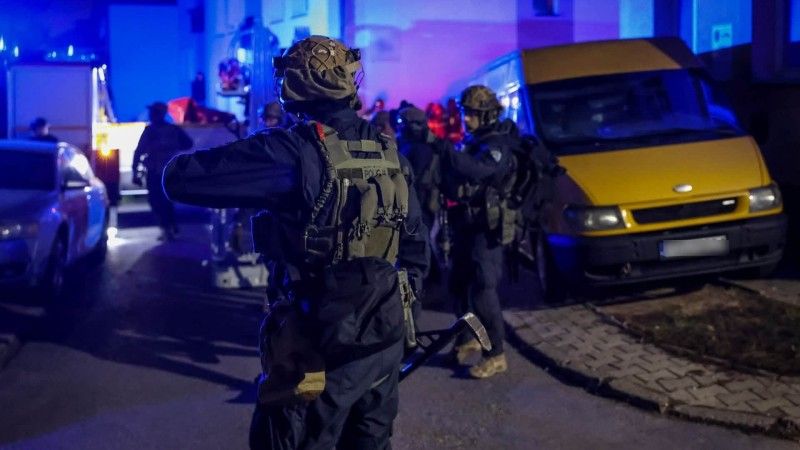
Photo. Policja Świętokrzyska/Facebook
Six people were killed and 15 others injured in the mass shooting in Kraków on 7 November. Three additional victims, members of the attacker’s family, were found dead at their home in Ostrowiec Świętokrzyski. Two police officers were wounded during the intervention, while the attacker remains in hospital. Polish prosecutors have opened a terrorism investigation, but the motive has not yet been fully established. Meanwhile, another debate has already begun in Poland: was the attacker a far-right or far-left extremist? Once again, media outlets and politicians are competing to establish the political background of a perpetrator before investigators have completed their work.
The attacker, a 24-year-old Polish citizen, opened fire on civilians in Kraków’s Main Market Square on Saturday afternoon. Among the six people killed was a British national, while citizens of Portugal, Germany, Austria, Russia and the United Kingdom were among the injured. The gunman was shot and detained by police. Investigators also recovered numerous firearms and ammunition, while the discovery of three bodies at his family home has further complicated the investigation.
Far-right or far-left? The race to assign blame
Interestingly, the political debate began almost immediately. Initially, reports suggested that the perpetrator had far-right views. Interior Minister Marcin Kierwiński indicated that preliminary findings pointed towards fascination with far-right ideologies. However, subsequent unofficial reports questioned whether the attacker had any actual links to far-right organisations. At the same time, claims began circulating online suggesting that he might instead have held far-left views. These claims remain unverified, but the political argument has already gained momentum.
This is precisely the problem. Instead of waiting for investigators to establish the facts, there is an immediate attempt to place the attacker on one side of the political spectrum. Far-right or far-left? Which political camp should be blamed? Who can use the tragedy against their opponents? And all this while the investigation is still underway and the families of the victims are mourning their loved ones.
Unfortunately, this is not exclusively a Polish phenomenon. We have witnessed similar debates in France and Germany, where terrorist attacks, mass killings and other serious incidents have repeatedly triggered arguments about the political or ideological background of perpetrators. Instead of concentrating on what happened and why, public discussion quickly turns into another confrontation between political camps.
Politicians are responsible for national security
What is particularly concerning is that politicians themselves frequently fuel these disputes. Of course, we could simply ignore another political argument or another series of accusations on social media. However, there is one fundamental problem: these same politicians are responsible for the most important decisions concerning national security. They decide how security services operate, how threats are addressed, how much funding is allocated to defence and which military capabilities and weapons systems are purchased.
Therefore, their words cannot be treated as just another political exchange. When politicians rush to assign ideological responsibility before an investigation has been completed, they can influence public perceptions and the direction of the entire debate. And the consequences of political decisions concerning security are considerably more serious than another argument between the government and the opposition.
Poland has now joined this debate, which has already become familiar in other European countries. First, the attacker was associated with the far right; later, allegations of far-left sympathies began to circulate. Neither version should be treated as a final conclusion without verified evidence. The most important point is that the investigation must establish the motive, rather than politicians or commentators attempting to do so through competing public accusations.
Nine people have lost their lives in the two incidents under investigation, including six in Kraków. Others remain injured, including police officers who intervened to stop the attacker. Nevertheless, the discussion about political responsibility has already begun, even before all the circumstances have been established.
In my assessment, politicians should be particularly careful when commenting on such tragedies. They are not merely participants in public debate. They are responsible for the security of the state and its citizens. And if every mass shooting or terrorist attack becomes another opportunity to fight over the far right and far left, we risk allowing political confrontation to take priority over establishing the facts. Perhaps the most important question is not which political side can be blamed first, but why we are so determined to find someone to blame before the investigation has even finished.