












- WIADOMOŚCI
- ANALIZA
Merchant ships targeted by drones and missiles. Türkiye develops new defences
 Add as preferred on Google
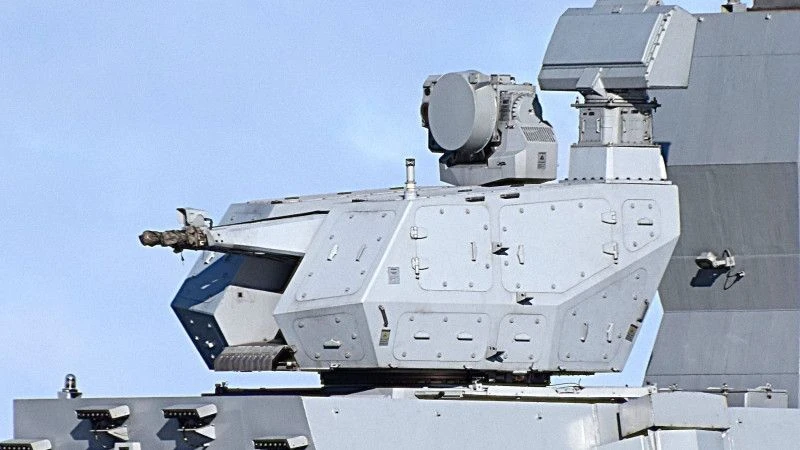
Photo. Andrzej Nitka/Defence24.pl
Merchant vessels are increasingly exposed to attacks by state and non-state actors during armed conflicts. The threats vary across regions, from attacks and confrontations involving shipping in the Strait of Hormuz to missile and drone strikes in the Black Sea and more recent security incidents off the coast of Libya. With naval forces unable to protect every commercial vessel, Türkiye is developing autonomous, containerised air defence systems that could provide merchant ships with protection against missiles and drones.
At Euronaval 2026 in Paris, Turkish defence manufacturer ASELSAN presented a concept for protecting merchant ships using its own weapon systems, including an autonomous version of the GÖKDENİZ close-in weapon system and a containerised version of the GÖKSUR VLS surface-to-air missile launcher.

The concept aims to extend the use of proven military weapons beyond warships, allowing them to be deployed on commercial vessels and other maritime platforms without requiring permanent modifications to their structures.
Merchant vessels transiting dangerous maritime areas, offshore installations and other important elements of maritime infrastructure face growing security risks. However, the limited number of available warships makes continuous naval protection impractical, particularly across several distant regions simultaneously. Moreover, emerging threats are evolving faster than new warships can be built or existing vessels modernised.
ASELSAN’s proposed solution relies on autonomous, containerised versions of its existing gun-based and missile-based defence systems. Each incorporates independent power generation, sensors and fire-control equipment, allowing it to operate without extensive integration into the host vessel. The modules can be installed, removed and transferred between platforms as security requirements change. This approach could provide additional protection for commercial shipping along high-risk maritime routes while reducing dependence on dedicated naval escorts.
GÖKDENİZ
GÖKDENİZ is a Turkish naval close-in weapon system (CIWS) developed by ASELSAN as a maritime version of the KORKUT self-propelled anti-aircraft system originally designed for land forces. Its primary mission is to defend against anti-ship missiles, unmanned aerial vehicles and other airborne threats. It can also engage aircraft, helicopters, surface vessels, floating mines and coastal targets.
The system is armed with twin 35 mm Oerlikon automatic cannons manufactured under licence by the Turkish company MKE. Its combined rate of fire reaches 1,100 rounds per minute, with an effective engagement range of approximately 4 km.
The guns use ASELSAN’s 35×228 mm ATOM programmable airburst ammunition, as well as more conventional high-explosive incendiary tracer (HEI-T) rounds. Thanks to an automatic ammunition-feeding mechanism, the system can accommodate both programmable and conventional ammunition simultaneously, selecting the most suitable type for a particular target.
GÖKDENİZ also integrates ASELSAN-manufactured electro-optical sensors and radar systems, enabling it to operate in all weather conditions.

GÖKSUR VLS
GÖKSUR VLS is a point-defence missile system developed by ASELSAN to protect maritime platforms. Its primary purpose is to provide 360-degree air defence for various types of vessels, with a declared effective range of up to 15 km.
According to the manufacturer, the system is particularly effective against anti-ship and cruise missiles flying just above the sea surface. Its modular design allows individual vertical launch system (VLS) units to be combined into different configurations, with installations possible both above and below a vessel’s deck.
GÖKSUR VLS employs GÖKSUR IIR missiles developed by TÜBİTAK SAGE. These are naval adaptations of the BOZDOĞAN short-range air-to-air missile.
The missile can reach approximately Mach 4 and is powered by a rocket motor equipped with thrust-vector control, which, according to the manufacturer, provides excellent manoeuvrability. Its infrared seeker enables it to track targets even under electronic jamming conditions or in adverse weather.
For maritime applications, the missile has been equipped with a two-way data link, allowing information to be exchanged during flight. It has also been adapted for vertical launch, including the installation of folding rear fins.

The first successful test of the vertical launch system took place on 16 February 2025 aboard the corvette Beykoz (F 503), formerly a French A69-class aviso.
The autonomous versions of GÖKDENİZ and GÖKSUR VLS demonstrate how existing military technologies could be adapted to meet the growing security requirements of commercial shipping. Their combination would provide layered protection, with the missile system engaging threats at greater distances and the gun-based system providing a final defensive layer against incoming missiles, drones and other targets.
However, equipping civilian vessels with military-grade weapons also raises important questions concerning international maritime law, authorisation to use force, crew responsibilities and the practical integration of such systems into commercial operations. Their wider adoption will ultimately depend on whether the security benefits justify the financial, legal and operational challenges.


