












- ANALIZA
- WIADOMOŚCI
Akeron missiles in a van. What really happened in Italy?


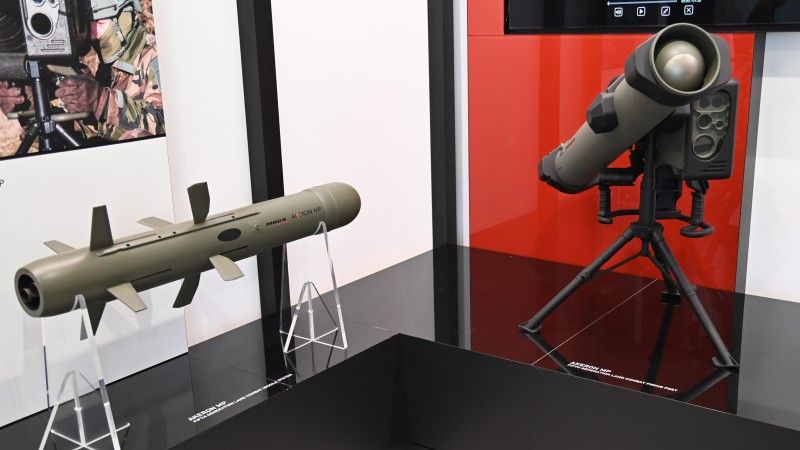
Italian authorities detained a 46-year-old French citizen after Akeron MP anti-tank missiles were found in his van following his arrival in Bari by ferry from Patras. At first sight, the case looked like an attempted illegal transport of combat weapons. The more details emerge, however, the less obvious this interpretation becomes. There is confirmed cooperation between MBDA and a Greek company testing Akeron missiles in Crete, while the final technical assessment of the seized missiles has still not been completed.
According to Italian media, the detention took place in June, although the case became public only recently. A van with French registration plates was inspected by the Guardia di Finanza after leaving the Superfast II ferry arriving from Patras. Five specialised containers designed for transporting anti-tank systems were found inside. One was empty and another contained an inert training missile. Three others contained Akeron MP missiles.
The blue tape changed everything
One of the most unusual elements of the case concerns the markings. Blue bands are normally associated with training or inert ammunition. Italian military personnel found, however, that the blue markings were removable tape. After it was taken off, yellow and black markings associated with high-energy ammunition were reportedly visible underneath. This became one of the main reasons why the three missiles were initially treated as military weapons.
This is not yet the final technical conclusion. Bari prosecutor Lanfranco Marazia ordered an additional assessment intended to determine the actual configuration and combat capability of the missiles. The defence presents the opposite version and maintains that the items were inert and had no offensive capability. MBDA has also reportedly provided Italian investigators with technical documentation supporting this position.
This distinction is fundamental. Investigators now have to establish whether the Italian military correctly interpreted the external markings and configuration of the missiles, or whether the seized items were special test examples whose appearance partly corresponded to combat missiles.

A NATO facility in Crete
The explanation provided by the detained driver, Régis Claude Albert Normand, has become more interesting as further information has emerged. Normand claims that he was carrying out a legitimate transport connected with MBDA and that the missiles were linked to activities in Greece.
Cooperation between MBDA and Greek company ALTUS-LSA is publicly documented. The companies are working on the integration of Akeron MP with the ATLAS 8 Heavy Lifter unmanned aircraft. More importantly, on 2 June 2026, only days before Normand was detained, MBDA and ALTUS conducted trials of the KERVEROS system at the NATO Missile Firing Installation in Crete. Inert Akeron MP missiles were used during those tests.
The defence has stated that the transport was intended for a „NATO base in Greece”. Public information does not allow us to state that the missiles seized in Bari were exactly those used during the NAMFI trials. The chronology is nevertheless striking. MBDA and ALTUS test inert Akeron missiles in Crete; several days later a driver linked to a transport carried out for MBDA returns from Greece with Akerons; and his lawyer points to a NATO installation as the destination of the earlier shipment.
This does not prove that the transport was legal. It does, however, make the version concerning a technical and testing mission considerably more credible and requires investigators to verify it before treating the case as an ordinary attempt to smuggle weapons.
Who actually organised the transport?
There is another element that may prove equally important. Normand eventually stated that he was acting as a subcontractor for Kaltrucks France, a company involved, among other things, in specialised military transport. He himself was working for NACI Transport, a company owned by his wife.
French company records show that NACI Transport was established in December 2023 and is formally involved in freight forwarding and transport organisation. The company advertises express deliveries, pallet transport, agricultural machinery and vehicles. It does not present itself publicly as a specialised military transport company.
According to Italian media, Normand also admitted that this was the first transport of this type that he had carried out. If his account concerning an official MBDA assignment is confirmed, investigators will have to reconstruct the entire chain: MBDA – specialised transport contractor – subcontractor – driver.
This creates a third possibility between two much simpler explanations. The case may not be either a fully legal transport or deliberate arms smuggling. The original order could have been legitimate, while problems emerged later during subcontracting, preparation of documentation, cargo marking or execution of the shipment.

The documents may decide the case
Italian investigators have questioned the documentation presented by the driver. Three international consignment notes were considered too general to clearly identify the cargo, while doubts were also raised about dates, stamps and the credibility of some documents.
The defence responds that the shipment had been authorised by the French Ministry of Defence and that MBDA submitted additional legal and technical documentation. There are therefore two competing versions: Italian investigators point to missing or questionable documents, while the defence argues that the transport formed part of an authorised operation.
The legal issue itself is also more complicated than simply asking whether Italy issued a transit permit. Under EU rules governing transfers of defence-related products between Member States, a separate authorisation from every country through which a shipment passes is not automatically required once the relevant intra-EU transfer authorisation has been granted. National provisions concerning public security and the safety of transport can still apply.
The investigation must therefore establish what authorisations were actually required for this specific France–Greece–France operation and whether the documents carried by Normand correctly reflected the nature of the cargo.
Smuggling or a badly organised military transport?
Akeron MP is one of MBDA’s modern anti-tank guided missiles, previously known as MMP. It can engage tanks, armoured vehicles and fortified positions and can operate both in fire-and-forget mode and with the operator remaining involved after launch.
But the technical characteristics of the weapon are no longer the most interesting aspect of the Bari case. Three questions are now much more important: were the seized missiles actually combat-capable, was the shipment connected with the MBDA–ALTUS trials in Crete, and was the entire transport chain properly authorised and documented?
At this stage, none of these questions has been conclusively answered. The Italian investigation began with what looked like three combat missiles hidden under misleading blue markings. It may still end as a case of illegal arms transport. But it may also reveal something different: an authorised defence-industry operation in which subcontracting, documentation and the physical handling of military equipment went seriously wrong.


