


- WIADOMOŚCI
- ANALIZA
Donald Trump and the new Congress: how will oil and gas markets change
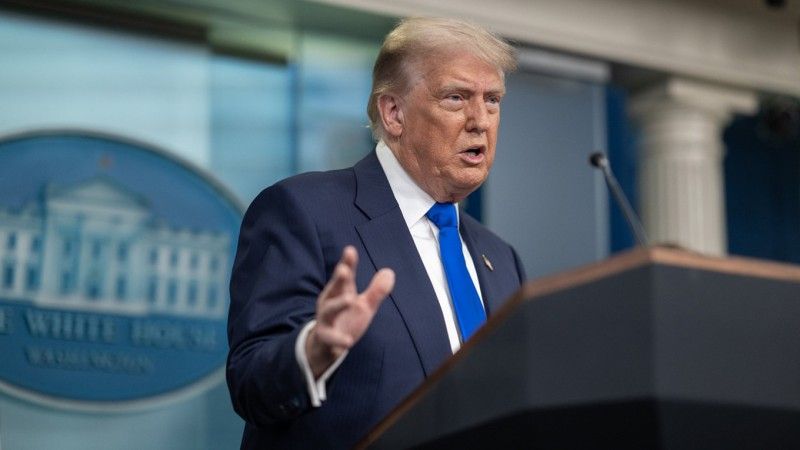
Will the energy security map change after the midterm elections? After 4 November, an opportunity for discussions regarding gas and oil is emerging within the US authorities.
The results of the Congressional elections on 3 November 2026 bring a new dimension to the debate on American energy policy. According to the election results published on 4 November, the Democrats have secured a majority in both the House of Representatives and the Senate. Although vote counting continues in some districts, the direction of political change is already clear: President Donald Trump’s administration will have to negotiate with a Congress that will soon be controlled by the opposition. Ultimately, this could alter geopolitical scenarios in the energy sector, particularly in the gas and oil markets. The new majority, taking their seats in January 2027, will gain legislative, budgetary, and oversight instruments allowing them to increase pressure on the administration. This does not, of course, mean a diametric and automatic shift in US foreign policy, but it may hinder the implementation of some of the current administration’s plans and force a broader debate—not only on their impact within the United States of America itself but also on the consequences for allies.
What to expect from the new Congress?
In the area of gas, the future of sanctions against Russia and the potential return to supplies via the sidelined Nord Stream pipeline take on particular importance. Even before the elections, Reuters indicated that Democratic control over Congress would make it more difficult to ease American restrictions related to the reactivation of the pipelines. In the case of oil, the political focal point remains the conflict with Iran and the security of transport through the Strait of Hormuz. The Democrats’ existing positions suggest that the new Congress will demand more information regarding the costs of military actions and, likely due to fuel prices, stronger emphasis on diplomatic solutions. Whether this proves effective is difficult to assess at this moment, as its success will depend on cooperation with the President and the development of the situation in the region itself. It must be added that actions taken by Iran will also have a significant impact, particularly whether they will seek a truce and under what conditions.

At present, it is difficult to judge to what extent the result of the US midterms will mean a geopolitical change in the conditions under which American energy decisions are made, as President Trump prefers governing by decree. In the US, governing through “decrees” allows the president to act without passing a new act through Congress every time, but importantly, only within the limits of existing powers. This primarily concerns executive orders. These do not grant the president unlimited legislative power. In assessing such a legal state in the context of agreements with Russia and Iran, it is now necessary to observe more closely what Congress itself will want to know. It is the relationship between the White House and the new majority that may co-determine the durability of sanctions, the terms of negotiations, and the credibility of commitments to European partners. Therefore, from 4 November, the dispute over the security of supplies through the Strait of Hormuz, the possibility of restarting the Nord Stream pipelines, and broader American energy policy can no longer be identified solely with the position of the White House.
Statements from leading Democrats indicate opposition to actions that, in their view, increase the leverage of Iran and Russia. For Europe, and particularly for Poland, this is an important signal regarding the future of transatlantic cooperation. Poland should utilise its good relations with every American political force to demonstrate, for instance, what threats specific decisions in the energy sector may cause.
The Strait of Hormuz and the Nord Stream pipelines are separated by geography, legal conditions, and the nature of their infrastructure. However, they are linked by the question of the political consequences of controlling the flow of raw materials. Whoever can restrict supplies gains an instrument of influence over prices, enterprises, and government decisions. It is from this perspective that the positions of Democratic Party representatives should be read. This does not mean that the Democrats have presented a single, detailed programme covering both issues. However, one could venture the thesis that they have accurately sensed the problems and the fatigue regarding the conflict with Iran.

Public statements and legislative initiatives reveal a direction aimed at restoring safe navigation in the Persian Gulf—though they note this will not be an easy process—and counteracting the rebuilding of Russian energy influence in Europe.
Hormuz: opening the strait requires lasting conditions
Let us look at the facts that occurred even before the midterm elections. Democratic senators assessed the conflict with Iran primarily through the prism of its results. Senator Chuck Schumer argued that the Trump administration’s actions increased Tehran’s ability to use the strait as a tool of pressure. In his assessment, temporary and conditional permission for navigation leaves Iran with a significant negotiating advantage. This is a criticism regarding the effectiveness of the American strategy, rather than an opposition to the restoration of transport itself. More detailed questions were posed by Senator Chris Coons. In a statement on 14 June 2026, he cautiously welcomed the announcement of an agreement, demanding the disclosure of its contents. He asked whether the strait would truly be available to all commercial vessels, whether Iran would retain control over transit, and what economic and sanction concessions Washington envisages. From the perspective of the energy market, these are fundamental questions. A political declaration alone does not yet provide a basis for planning regular supplies. Shipowners, insurers, and commodity recipients need predictable transport conditions. If the possibility of a tanker passing through depends on the next round of negotiations, risk remains part of the economic calculation.

Senator Martin Heinrich, meanwhile, drew attention to the administration’s preparation for the consequences of the conflict. He demanded explanations as to whether the impact of closing the strait on the energy market and the costs borne by American households had been properly assessed before actions commenced. An important problem is evident in this line of reasoning: the ability to conduct military operations should go hand in hand with the ability to predict their economic consequences. The cost of an operation also includes supply disruptions and uncertainty, which influence business decisions long after a ceasefire is announced—something American voters also felt at the fuel pumps.
Nord Stream: an American investor does not solve the dependency problem
In the case of Nord Stream, the position of some Democrats has been recorded exceptionally clearly. In a cross-party draft resolution presented on 6 November 2025, opposition was expressed to the restoration of the Nord Stream I and II projects, regardless of the country of origin of the persons or entities involved. This is a significant entry for assessing ideas to introduce American capital into this infrastructure. A clear conclusion can be drawn from it: for the authors of the initiative, a change in the ownership structure does not remove the strategic problem of the return of Russian gas. An American investor could participate in transmission revenues, but the raw material would still originate from Russia. An assessment of security would therefore require an answer to the question of who controls extraction, sales conditions, and the ability to restrict supplies.
This direction was confirmed by Senator Jeanne Shaheen, working with Republican Senator Jim Risch on the SHADOW Fleet Sanctions Act. According to a communication from 29 January 2026, the project passed through the Senate Foreign Relations Committee and envisaged the expansion of sanctions concerning both pipelines. This was a stage of legislative work which shows, however, that opposition to their reactivation also has an institutional dimension. Importantly, such a view among Democrats is nothing new; it should be noted that as early as May 2021, the then Democratic Chairman of the Foreign Relations Committee, Bob Menendez, criticised the Joe Biden administration for waiving sanctions against Nord Stream 2 AG and its chief executive.

Therefore, the statements of Democrats cannot be treated as a guarantee of Washington’s future decisions. Support for a specific policy direction must be translated into lasting solutions and cooperation with American partners, also with the support of other European countries. Arguments from EU countries should consistently point out what economic and security consequences the restoration of dependence on Russian supplies would bring. Both disputes lead to a similar reflection. Short-term price benefits should therefore be evaluated alongside the costs of a future crisis.
History, as a good teacher, continues to prove that for European countries, regardless of even the best relations with allies, the most important thing remains the preservation of the ability to choose. The more real supply alternatives and efficiently functioning connections between states exist, the less room there is for concerns about the potential use of energy resource supplies for geopolitical pressure. It is precisely this capacity that we should protect when assessing both the agreements regarding Hormuz and subsequent proposals for a return to Nord Stream.


