- ANALIZA
- WIADOMOŚCI
- KOMENTARZ
New power in Hungary. How much will actually change?

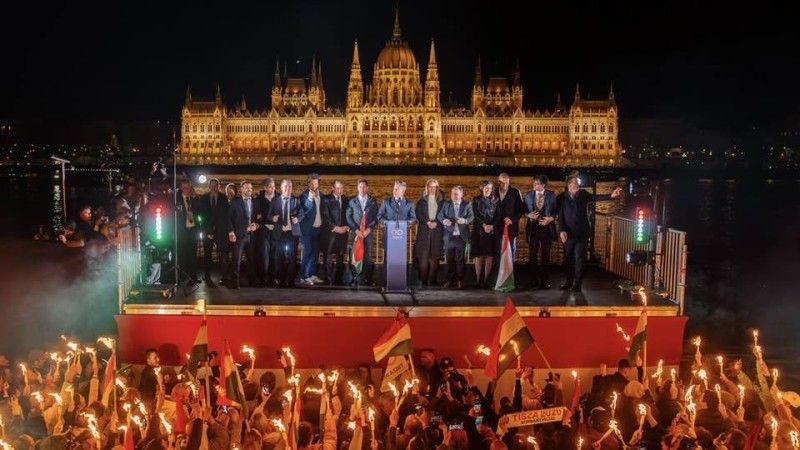
Peter Magyar overwhelmingly defeated his political opponent. Hungary witnessed a record voter turnout in the parliamentary elections, reaching nearly 80 percent. Some are speaking of a “return of Hungary to Europe,” suggesting a complete reversal in the country’s political direction. However, the election winner will likely surprise us more than once in the coming months.
After all votes were counted, the National Election Office (NVI) announced the final results, according to which Peter Magyar’s TISZA party won 141 seats in the 199-member National Assembly. The party secured a constitutional majority, giving it the ability to implement large-scale reforms. What can we expect from the new Hungarian government, and should we anticipate changes in the region?
See also 

Smooth election process
The transfer of power in Hungary took place without larger incidents. The Organisation for Security and Co-operation in Europe (OSCE) mission positively assessed the electoral process in most of the polling stations it observed. However, it noted that the ruling Fidesz party had abused its power, disrupted the campaign, and treated public media with bias.
The victory of the TISZA party was not contested by Viktor Orbán. After most votes were counted, the Fidesz leader stated that “the election result is painful for us but clear: we were not given the mandate to govern.” The former prime minister had ruled the country continuously since 2010.
Reactions in the West
The change of power is significant not only for Hungary itself. It is likely to affect EU policy and the situation in Ukraine. Beyond the usual congratulations extended to Peter Magyar, many politicians and media outlets highlighted the potential implications of the new government in Budapest.
The British broadcaster Sky News commented that “the end of Prime Minister Viktor Orbán’s 16-year rule has serious consequences for Hungary, the European Union, Ukraine, and the world.” It described the outcome as a “major defeat” for Vladimir Putin, Donald Trump, and right-wing populism. The report added that “Orbán’s loss could also mean the eventual release of EU funds for Hungary, which were frozen because, according to Brussels, Orbán’s government failed to meet democratic standards.”
The Guardian noted that the election served as a kind of test for the MAGA ideology. The global right had drawn inspiration from Viktor Orbán’s policies, and he had enjoyed support from, among others, Italian Prime Minister Giorgia Meloni and Israeli Prime Minister Benjamin Netanyahu.
The reaction of the U.S. administration was ambiguous. Vice President J.D. Vance expressed disappointment over the former prime minister’s defeat. He defended the American side’s previous support for Orbán, explaining it as an act of pursuing national interests. “It was the right thing to do to stand by someone who has stood by us for a very long time,” he said. Vance added that he regretted Orbán’s loss but was confident that the United States would maintain good cooperation with the next government in Budapest.
Meanwhile, U.S. President Donald Trump appeared unconcerned about the change of power in Hungary. In an interview with ABC News, he indicated that he looked forward to working with Peter Magyar’s cabinet. “I think this new guy will do well; he’s a good man,” Trump said. It seems the American president is putting on a brave face. Fidesz’s defeat represented not only the loss of a Eurosceptic ally for his administration but also the collapse of a political model currently promoted by Washington.
See also

During Orbán’s rule in recent years, Slovak-Hungarian relations had grown closer. Orbán’s ally, Slovak Prime Minister Robert Fico, congratulated Magyar on his victory and declared his readiness for “intensive cooperation.” He emphasised the importance of fair treatment of national minorities in both countries and the need to resume oil transport through the Russian Druzhba pipeline. Fico also praised his past cooperation with Orbán, noting that “his determination to protect sovereignty and national interests has been and will always be a great example for me.” This statement should be seen as a general endorsement of the former prime minister’s confrontations with the European Union.
Following Magyar’s victory, Czech Prime Minister Andrej Babiš sent him a congratulatory letter inviting him to visit Prague. He also welcomed Magyar’s remarks about reviving meetings of the Visegrád Group (comprising the Czech Republic, Hungary, Slovakia, and Poland). Recently, cooperation within the group had stalled, mainly due to differing government policies. It is worth noting that Babiš, like the U.S. administration, supported Viktor Orbán during the campaign.
See also

Germany, for its part, hopes for the swift activation of the EU loan for Ukraine. According to a German government spokesperson, the change of power increases the likelihood of releasing the €90 billion loan. Berlin is also eagerly awaiting the formation of the new government in Budapest. The European Commission expects a positive decision on the matter by April 22.
A particularly important statement came from European Commission President Ursula von der Leyen, who argued that the momentum from Hungary’s parliamentary elections should be used to replace unanimity in EU foreign policy with qualified majority voting. Until now, EU foreign policy decisions required unanimity and could be blocked by a single member state—as Hungary had done in the past regarding sanctions against the Russian Federation. Von der Leyen also announced that the Commission would cooperate with the new Hungarian government on issues related to the frozen EU funds. These funds had been suspended due to legal changes introduced by Orbán’s government. One of Peter Magyar’s campaign pledges was to unfreeze them. Access to the funds will depend on reforms ensuring, among other things, judicial independence and anti-corruption measures.
Peter Magyar’s first decisions
Even before the official formation of his government, Peter Magyar began making political moves. One of his first steps will be to suspend news programming on state media. Broadcasting will resume only after ensuring objective reporting. Before the election, the International Press Institute (IPI) had pointed out that Hungary’s media regulatory system was the most politicised in the European Union. After 16 years of Viktor Orbán’s rule, the authorities directly or indirectly controlled about 80 percent of the media market.
While Magyar cannot be accused of being anti-EU, the situation is less clear regarding Ukraine. According to the French dailyLe Monde, Peter Magyar is “maneuvering” on this issue. The opposition leader reportedly remained “ambiguous” about Ukraine to avoid alienating a public that is “skeptical about supporting Kyiv.” Despite his victory, Magyar has not changed his rhetoric.
On April 20, Peter Magyar appealed to Ukrainian President Volodymyr Zelensky to reopen the damaged Druzhba oil pipeline as soon as possible. “If the Druzhba pipeline on the Ukrainian side is ready for oil transport, it should be reopened as promised. We also expect Russia to resume deliveries in accordance with the agreements.” The incoming prime minister emphasied that lifting Hungary’s blockade of the EU loan for Ukraine would depend on the pipeline’s reactivation.

Summary with expert commentary
For this article, I reached out to Ilona Gizińska, a research fellow at the Centre for Eastern Studies (OSW) specialising in Hungary, to ask about the new Hungarian government and what we can expect from it.
Patryk Jagnieża (Defence24.com): What is the new Hungarian government’s stance toward the Russian Federation? Can we expect future sanctions packages to be blocked?
Ilona Gizińska (OSW): The Magyar government will likely adjust its approach toward Moscow, moving away from the political closeness characteristic of Orbán’s cabinet toward a more distanced, pro-European pragmatism. This would mean limiting overtly pro-Russian rhetoric and abandoning the use of vetoes as a constant tool in EU policy, while maintaining working relations with Russia in structurally necessary areas—primarily the energy sector. Consequently, systemic blocking of EU sanctions packages is unlikely, though a selective approach should be expected: acceptance of political and financial sanctions while seeking to soften measures affecting raw material imports. This direction will be shaped by Hungary’s high dependence on Russian energy and its limited capacity for rapid diversification.
See also
What is the new government’s stance toward countries with Hungarian minorities, particularly Ukraine?
The new government will likely maintain strategic continuity in its policy toward countries with Hungarian minorities, treating their protection as a cross-party national priority. In relations with Ukraine, this would mean moving away from the confrontational rhetoric typical of Orbán’s rule and attempting to de-escalate tensions through bilateral dialogue, while maintaining a firm stance on linguistic, educational, and institutional issues concerning Hungarians in Zakarpattia. Greater predictability and readiness for compromise can be expected at the EU and NATO levels, without instrumental blocking of initiatives toward Ukraine. However, Budapest’s support will remain conditional on Kyiv’s progress in minority rights. As a result, the new government’s policy will be more cooperative in style, though its core interests will remain largely unchanged.

What about the previously blocked €90 billion EU loan for Ukraine? Can we expect future aid packages to be blocked?
Regarding the €90 billion EU loan for Ukraine, Péter Magyar has signaled a departure from blocking it. The declared approach envisions allowing the instrument to be adopted at the EU level while using an opt-out mechanism—meaning Hungary would not participate financially but would not obstruct the decision of other member states. This makes the release of funds politically far more likely than before. In a broader sense, systemic blocking of future aid packages should not be expected. The new government will likely adopt a more predictable and cooperative approach, limiting the use of vetoes as leverage.
Is there a realistic chance for Hungary to find alternative energy sources? What is the actual share of Russian energy in Hungary’s energy mix?
There is a realistic possibility for Hungary to diversify its energy sources, though the process will take time. The starting point is a high dependence on Russian supplies: in recent years, natural gas imports from Russia accounted for about 70–85 percent, crude oil largely still arrives via the Druzhba pipeline, and the nuclear sector relies on cooperation with Russia (the Paks II project). The TISZA party’s political messaging envisions full diversification by around 2035, indicating an evolutionary rather than abrupt approach. This caution stems largely from the need to review and potentially renegotiate long-term energy contracts with Russia, which limit the flexibility of supply diversification.
See also

We can therefore expect a significant shift in Hungary’s foreign policy compared to the previous government. For now, Peter Magyar can be described as a pro-European pragmatist. We should no longer see Hungary using its veto power to block EU policy for political leverage. The government in Budapest will continue to act in the interests of Hungarian minorities, making their protection a condition for good relations with neighboring states. In the event of tensions, the new leadership is likely to pursue de-escalation. Relations with the Russian Federation are more nuanced, primarily due to Hungary’s ongoing dependence on Russian energy supplies and cooperation in the nuclear sector. Hungary has the potential to diversify its energy sources, but this will be a gradual process. With the change in government and possible energy sector reforms, Russia may attempt to pressure Hungary—for example, by halting energy exports to the country. Should that occur, Budapest must be prepared for a mobilisation similar to what Europe experienced at the onset of Russia’s invasion of Ukraine in February 2022.