












- WIADOMOŚCI
- KOMENTARZ
Trump’s Europe: allies, clients, or rivals?

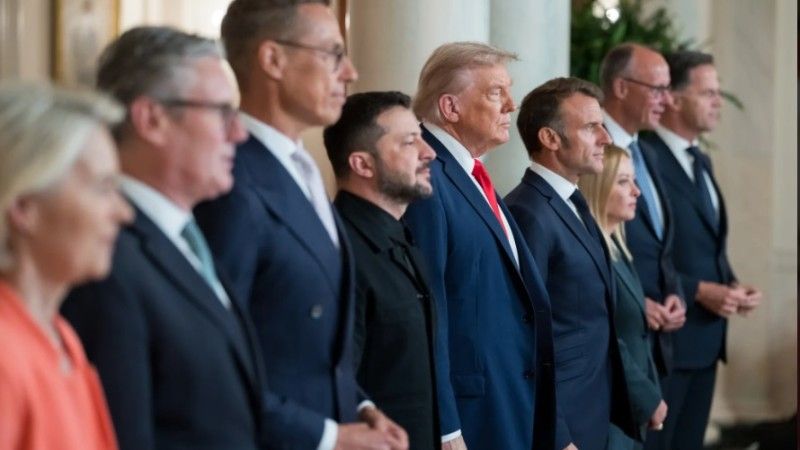
How does Donald Trump view Europe, and what are the main implications for the continent?
To say that Donald Trump isn’t a fan of the European Union is an understatement. The American president has changed the dynamics of transatlantic relations, and even in his National Security Strategy Europe is described more as a rival than an ally.
It once seemed that transatlantic relations were written in stone as the foundation of the world order after World War II. But looking at the first year of Donald Trump’s second term, there are not many certainties about international relations left. What „used to be” is no longer valid. The first glimpse of the new approach of the incoming administration was a controversial speech by J.D. Vance at the Munich Security Conference. Europe was framed as an old, slow democracy, sacrificing democracy and free speech at the altar of regulations and bureaucracy. European leaders believed they were better prepared this time for Trump’s unconventional, transactional presidency. They began with flattery, including a personal letter from the King of England, a golden carriage, and even calling him „Daddy” by the NATO Secretary General. Trump was delighted, sometimes impressed, but he did not change his approach toward Europe - or, especially, the European Union. Why?
First of all, Donald Trump is pursuing an America First foreign policy. Every action on the international stage is reviewed through the lens of American interests. He also views international relations as a zero-sum game. Given that Donald Trump hates losing, it is clear that the United States cannot be the side of a relationship that fails to take full advantage of its power.
Second, in his second term Trump is surrounded by isolationists such as J.D. Vance. They prefer focusing on domestic politics rather than international affairs. Moreover, they do not see the U.S. as a global policeman, but rather as a paid security guard that focuses only on issues vital to American interests - of course, for appropriate remuneration. In their view, the U.S. must cease being the sole superpower in order to remain the key game-maker in world politics and to prepare for an economic confrontation with China that will define the new world order. There is little room for engagement with Europe in this vision.
Seeking freedom – the American way
In addition, the president’s inner circle consists of tech moguls, including his on-and-off political ally Elon Musk. To them, the European „bureaucratic regime” is an oppressive one. Self-proclaimed apostles of free speech use their platforms and reach to question the very existence of the EU, often echoing Russian narratives. They often amplify far-right and Eurosceptic views that encourage Europeans to pursue further EU exits. Their business objectives are incorporated into national interests, and the American administration regularly speaks out against EU regulations and decisions. When the European Commission fined X €120 million for breaching transparency obligations under the Digital Services Act (DSA), Secretary of State Marco Rubio called it „an attack on (…) the American people by foreign governments.” Anti-EU sentiment flooded X and was amplified by Elon Musk - the ruler of the algorithms - who also blocked the European Commission from running ads on his platform.
One of the main accusations against the EU is that it is undemocratic. In Elon Musk’s opinion, even the European Parliament is not a truly democratic institution, as its members are not elected in single-member districts. Apologists of total democracy point to the American benchmark, where many more offices than in Europe are elected - such as judges, sheriffs, and school board members. This highlights a key difference in the understanding of freedom between the U.S. and Europe.
In America - „the land of the free” - freedom is seen more as a laissez-faire approach to individual actions: a freedom to. In Europe, a continent marked by totalitarian regimes, freedom is understood as a freedom from: autocrats, food additives, hate speech. These differing views on freedom are fundamentally incompatible.
For Donald Trump - a businessman at heart - „freedom to act” is an invitation to rearrange and renegotiate. International law and European treaties are merely temporary agreements that can be changed at any time. That is why he prefers dealing with European countries individually rather than with the EU as a whole. As a seasoned negotiator, he is well aware that the position of any single European country is weaker than that of the entire bloc. In his National Security Strategy, he stresses that he will support „patriotic” parties across the continent. In this way, he seeks to create an alternative bloc of European countries closer to Washington than to Brussels, all in service of the America First agenda. Donald Trump wants to use ideological proximity with selected European leaders to turn them into American advocates in Europe and to demonstrate that supporting the American approach to European politics can pay off domestically.
The new European dilemma: Washington or Brussels?
For years, most European countries relied on two pillars of security: the U.S. and Europe. Now it seems they may be forced to choose between them. This will almost certainly become part of domestic political debates in many European states and may even spark serious discussions about leaving the EU or halting European integration altogether.
In a widely publicized POLITICO interview following the publication of the National Security Strategy, Donald Trump said he wanted a strong Europe - and that the leader who wanted a weak Europe was Vladimir Putin.
What is important is that a strong Europe does not mean - in Trumpian terms - a strong EU. On the contrary, it means a strong alliance between the U.S. and selected European partners, who would eventually become clients rather than equals. In his bestselling book The Art of the Deal, Donald Trump emphasizes the importance of strengthening one’s negotiating position. Shaping a new Europe according to the American vision is precisely that. The U.S. holds overwhelming advantages when negotiating with individual European countries - advantages that are far less pronounced when dealing with the EU as a whole.


