












- ANALIZA
- WIADOMOŚCI
When the pressure is on, Rubio holds the line. Vance doesn't

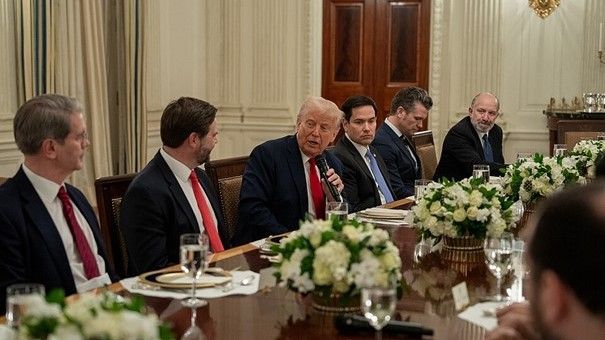
A week of dueling messaging on Iran and Israel exposed more than a policy gap inside the Trump administration; it exposed a difference in temperament that says a lot about how each man is likely to be judged going forward.
This week, Vice President JD Vance and Secretary of State Marco Rubio were both sent abroad to defend the same fragile achievement: the preliminary U.S.-Iran framework signed on June 17. They were given the same brief and faced the same kind of hostile questioning. What they did with that pressure could not have been more different and the gap between their reactions is worth examining on its own terms, separate from whether one agrees with either man’s underlying foreign policy.
Two trips, two postures
However, the vice president’s visit to Switzerland for talks with Iranian officials and his expression of optimism regarding the diplomatic front were less controversial than his statements while back in Washington. While in the White House, he criticised Israeli friends and indicated that the strikes by Israel on Lebanese infrastructure in order to weaken Hezbollah are damaging the greater effort to achieve peace, which is led by the United States. In essence, it was a vice president of a sitting administration criticising the tactics of his ally on a military matter during the course of a negotiation process.
Unlike Vance, Rubio adopted a completely different stance toward the issue. In his trip to the UAE, Kuwait, and Bahrain in order to ease any concerns about the Iran deal, he continued to describe Israel’s operations in Lebanon as a proportional response to the attacks by Hezbollah. When confronted with Vance’s criticism of Israel, Rubio did not choose to escalate or distance himself from his colleague’s opinion; instead, he chose to deflect and referred to a recent attack by Hezbollah on an Israeli checkpoint. He ended with the following: “Everyone here is aligned behind the president.”
Why the contrast matters
The substance of American policy toward Iran is actually complicated, and rational people can debate which is the more sensible course over time: Vance’s wariness of foreign entanglements or Rubio’s bluster. However, the acid test in this case is not about what each man believes, but what he chooses to do with the chance to air his differences publicly. One used his, the other declined his. One poured gasoline on a fire of discord within the administration; the other attempted to douse it with the truth, rather than emotion. This choice will be interpreted as discipline versus impulse and will be remembered long after the substance of their differences is forgotten.
Same camp, different instincts
The two men’s instincts didn’t appear from nowhere. Before taking office, Vance built a public reputation criticising foreign wars as a drain on American lives and money. Rubio spent his Senate career as one of Washington’s most consistent hawks on Iran, Russia and Cuba. Both are widely viewed as leading contenders for the Republican nomination in 2028, and each is, in effect, the standard-bearer for one of the party’s competing instincts: a more interventionist wing willing to back allied military action without much hedging, and a more skeptical wing that wants Washington to extract itself from foreign conflicts wherever possible.
The administration has tried to wave away any sign of a rift. White House spokeswoman Anna Kelly insisted there is only “one camp” behind the president’s effort to keep Iran from acquiring a nuclear weapon, while State Department spokesman Tommy Pigott dismissed talk of a Rubio-Vance split as a “tired and fake” narrative. Yet outside observers were not convinced. Michael Rubin, a senior fellow at the American Enterprise Institute, argued that the two men’s worldviews are not just stylistically different but substantively so, noting that “at their core they represent different strains” of the party’s foreign policy thinking.

The counterargument
None of this means Vance’s instincts are out of step with Republican voters – quite the opposite. A Reuters/Ipsos poll that closed this week found that only 52% of Republicans believe the current conflict has left the United States in a stronger position, a sign that a substantial share of the party’s base shares Vance’s underlying wariness of foreign entanglement, even if they might wish he had voiced it more carefully. To that audience, Vance’s willingness to say the uncomfortable thing in public can look less like indiscipline and more like candor, a vice president refusing to paper over a real disagreement for the sake of appearances. Rubio’s composure, by the same logic, can be read less as statesmanship and more as institutional caution, the instinct of a longtime Washington hawk unwilling to break ranks even when ranks arguably deserve breaking.
Strip away the policy debate, though, and what remains is a simple test of conduct under scrutiny, and, on that narrower measure, Rubio’s performance this week was the more controlled and more professional of the two. Whether that composure translates into broader political capital by 2028 will depend less on this single episode and more on which of the GOP’s two instincts – caution or candor – voters decide they want in their next president.


