












- WIADOMOŚCI
- ANALIZA
France and Sweden are getting closer. The frigates are just the beginning


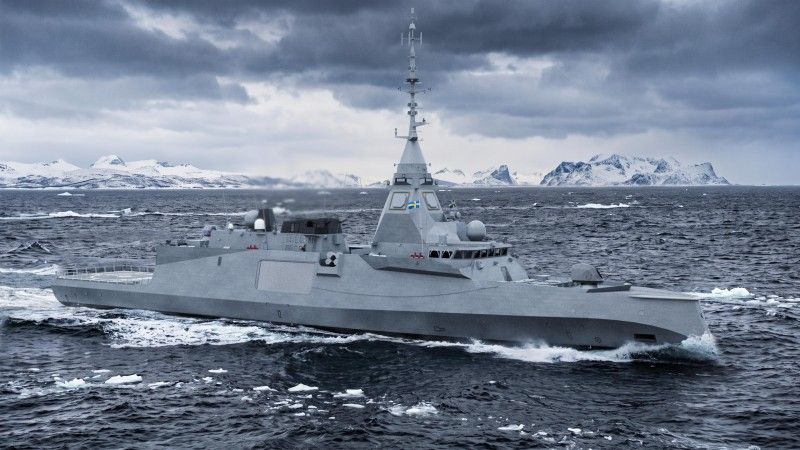
There are many indications that mutual purchases of military equipment by France and Sweden are merely the beginning of long-term, deepened cooperation. The relationship between Paris and Stockholm could be of vital importance to the security architecture of the entire Baltic Sea basin.
France and Sweden have concluded an implementation agreement worth €4.3 billion (approx. £3.6 billion) for the delivery of four Luleå-class frigates to the Swedish Navy Svenska marinen). The vessels will be built based on theFrégate de Défense et d’Intervention (FDI) design by the French Naval Group. Part of the equipment and armament will come from Sweden, such as the artillery systems, anti-ship missiles, and lightweight torpedoes for anti-submarine warfare. The first frigate, HMSLuleå, is scheduled to be delivered to the customer in 2030.
However, this contract is only part of a much more significant rapprochement between Paris and Stockholm in defence and the arms industry. Potential areas of cooperation include air and missile defence, the acquisition of Naval Cruise Missiles (MdCN –Missile de Croisière Naval), the French concept of extended nuclear deterrence, military cooperation with Finland, and potentially even Sweden’s entry into the future combat aircraft project.
Idag skrev Frankrike och Sverige kontrakt på fyra nya luftförsvarsfregatter. Arbetet med att förbereda marinen inför framtiden är redan igång. Exempelvis följer en grupp svenska officerare med Amiral Ronarc’h på resan tillbaka till Frankrike för att stifta bekantskaper fartyget. pic.twitter.com/MzFZCzzhiC
— Marinen (@Swedish_Navy) August 31, 2026
France and Sweden at the centre of NATO
The frigate purchase agreement was signed on 31 August during Emmanuel Macron’s visit to Stockholm. The French President and Swedish Prime Minister Ulf Kristersson presented it as another stage in strengthening NATO’s European pillar. Simultaneously, the defence ministers of both countries signed a framework agreement extending French-Swedish military and industrial cooperation, as well as the joint development of new capabilities. This is one of the most important defence and security agreements France has ever concluded with a Nordic state.
For Sweden, the purchase of four FDIs is one of the most important (and most expensive) elements of the modernisation and expansion programme for the Armed Forces Försvarsmakten), which has been underway since 2022. The Swedish Navy will gain modern, multi-role ships with displacement and combat capabilities far exceeding those of theVisby-class corvettes. Furthermore, the Swedish purchase will „close” the modernisation of NATO’s surface forces in the Baltic Sea basin. Over the next decade, new vessels will be commissioned by countries such as Finland Pohjanmaa-class corvettes), Germany (F128-class frigates), Norway (Type 26 frigates), and Poland Wicher-class frigates). The Danes are also planning a similar move.
See also 

Who offers more? Missiles for defence and attack
The French confirm that the Swedish ships are to retain the significant anti-aircraft and anti-missile capabilities possessed by the French and Greek FDIs. The Swedes will receive Aster 30 missiles (likely in the latest Block 1NT variant). Moreover, theLuleå-class frigates will be integrated with MBDA CAMM-ER missiles, the same as those to be used on the PolishWicher-class frigates. In practice, this means a significant increase in the ability to protect Allied forces in the Baltic against Russian aviation and air attack assets, ranging from cruise missiles (such as the Kh-101) to ballistic missiles (like the Iskander-M). To put it bluntly, once the new ships enter service, Stockholm will have fewer reasons to fear Moscow.
An even more interesting issue is the French government’s preliminary approval for the sale of MdCN cruise missiles to Sweden. Paris is ready to open this system for export to Stockholm, which is a significant distinction. Previously, such an opportunity was presented to Greece, which contracted four FDI HN project frigates from France. The MdCN missile provides the capability to strike targets deep within enemy territory, with its range estimated at over 1,000 km. Nevertheless, it should be emphasised that the potential integration of this weapon into the Swedish FDIs would necessitate replacing some of the Sylver A50 vertical launch system cells with the longer A70 variant. Furthermore, every MdCN installed in a vertical launcher would have to displace one Aster anti-aircraft missile or three CAMM-ERs.
There is no doubt that for Sweden, the introduction of cruise missiles with such a long range would represent a fundamental change—politically, technically, and mentally. In time, the new frigates could become more than just platforms for protecting their own and Allied coasts and the airspace over the Baltic Sea. MdCNs would give the Swedish Navy the capability to conduct strikes on the territory of the Russian Federation. For theFörsvarsmakten, which has hitherto used missile weaponry exclusively for defensive purposes (see RBS 15 anti-ship missiles), this would be a very serious shift in defence doctrine.
More Than One Winner
French-Swedish cooperation does not look like a classic relationship between a seller and a buyer of military equipment. In December, France ordered two Saab GlobalEye airborne early warning and control (AEW&C) aircraft for over one billion euro. Paris decided on this step despite loud protests from the national aerospace leader, Dassault Aviation. Furthermore, the French secured an option in the contract to purchase two more Saab machines. Now, Sweden is buying French frigates for €4.3 billion.
These are significant events from the perspective of both states. With these transactions, France has gained access to Sweden’s modern, export-oriented defence industry. Sweden, on the other hand, after joining NATO, has found a stable partner that can provide capabilities previously unavailable to its domestic arms industry.
Giants such as MBDA France, Naval Group, Thales, and Safran possess production potential that exceeds the capabilities of the Swedish defence industry, particularly in fields such as shipbuilding, jet engines, long-range air attack assets, and various types of anti-aircraft missiles. Conversely, Saab possesses extensive experience in the production and integration of complex military equipment, including combat aircraft, early warning machines, warships of various classes, advanced reconnaissance systems, electronics, and many types of weaponry. This provides a basis for cooperation that could, in the future, go far beyond individual (though highly publicised) export contracts.
Will Gripen and Rafale Start a Family?
The combat aviation thread is particularly interesting. Following the painful divorce in the Franco-German (with minority Spanish participation)Système de combat aérien du futur (SCAF/FCAS) project, Paris must again decide in what configuration it will develop the successor to the Dassault Rafale. Although the Rafale F5 project (also known as Super Rafale) will give the domestic industry a few years of breathing space, France risks a delay in the technical modernisation of its Air and Space Force Armée de l’air et de l’espace) compared to its NATO allies. Simultaneously, Sweden is analysing the future of the Saab Gripen combat aircraft family.

Photo. Master Sgt. Sarah McClanahan / U.S. Air Force
This does not mean that Dassault and Saab have already rushed to implement a joint future combat aircraft programme, the actual successor to SCAF. No such project currently exists, but there is clear motivation on both sides to launch one. The French are signalling that several possible areas for cooperation exist. Paris does not even rule out using French expertise in aircraft engines in a future Swedish combat aircraft, should Stockholm be interested. It is worth noting that for the Rafale F5, Safran is independently conducting a project for a modernised variant of the M88 engine called T-REX.
Such a form of cooperation would be a very significant qualitative change in the aviation market of both countries. Dassault and Saab have remained competitors in the field of multi-role combat aircraft for decades. Today, the situation on the Old Continent is changing, and the costs of building next-generation platforms have risen markedly. Although an agreement was reached at the political level, for industrial reasons, Germany and France were unable to maintain SCAF in its previous formula. Today, European states are increasingly seeking smaller, more flexible industrial cooperation configurations than before. A hypothetical collaboration between Dassault and Saab would fit perfectly into this new paradigm.
French Deterrence and the Baltic
There is one more issue that cannot be separated from the frigate contract. For months, Macron has been developing the concept of increased participation by European states in the discussion regarding French nuclear deterrence. Sweden has joined the group of countries interested in this dialogue (as has Poland).
The new missile defence capabilities that Sweden will acquire along with the French-built frigates are, according to Macron, to be part of a broader „forward deterrence” system. This does not mean that French nuclear weapons will be transferred to Sweden, nor the ability to co-decide on their use. Here, it must be noted—as always—that the decision to use the French nuclear arsenal remains the exclusive competence of Paris.

Photo. Catherine Vautrin / X
More significant than the futile discussion over operational control of French weapons of mass destruction is the synthesis of several elements of French and Swedish security policy: missile defence, long-range strike capabilities, industrial cooperation, and nuclear deterrence. In this way, France is attempting to build a group of states in Europe ready for much deeper military cooperation than before. In an era of uncertainty regarding US intentions in Europe, an aggressive Russia, and growing economic protectionism (or perhaps even deglobalisation), such regional defence and security agreements are gaining increasing importance.
This is also evident in the north of the continent. France is to participate in NATO’s forward forces in Finland, which will operate under Swedish command. At the same time, Finland and Sweden are deepening cooperation in air defence (as seen in the recent deployment of Swedish Gripens to Finland) and countering unmanned aerial vehicles (UAVs).

Photo. French defense attaché in SWEDEN/X
For France, entering this arrangement means a clear increase in its level of participation in the security architecture of the Baltic Sea basin. For Stockholm, Paris is becoming an increasingly credible and active partner, from whom it can also acquire ships and missile defence, and potentially the capability to strike at distances of over a thousand kilometres.
Bearing the above in mind, the €4.3 billion contract should not be treated solely as an export success for Naval Group and political points for the government in Paris. France is increasingly stepping into the role of a regional security leader in Europe, this time in the northern part of the continent. Four frigates are the most visible element of French-Swedish cooperation today, but they are unlikely to be the last. Both partners have opened their arms wide in welcome.


