- WIADOMOŚCI
- ANALIZA
Kim is nuclearising North Korea’s navy

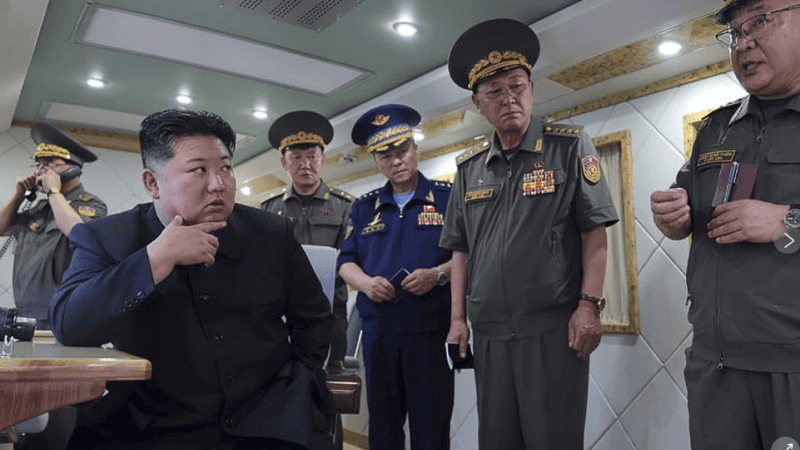
North Korea has commissioned its second large missile destroyer of a new generation. The 5,000-tonne “Kang Kon” will operate in the Sea of Japan and, according to Kim Jong Un, become part of Pyongyang’s “nuclear response system”. The most important point, however, is not the ship itself. North Korea is no longer building individual prestige platforms. It is trying to create a new navy capable of carrying strategic weapons and supporting a maritime element of its nuclear deterrent.
The “Kang Kon” is the sister ship of the “Choe Hyon”, which entered service three months earlier and was assigned to the Yellow Sea. North Korea therefore now has one large missile destroyer on each side of the Korean Peninsula. This is particularly important in the east, where the Sea of Japan opens the direction towards Japan and US military bases located there. The “Kang Kon” is also a much more serious strike platform than previous North Korean surface vessels. Ships of this class may have as many as 88 vertical launch system cells of different sizes. The larger cells could be used for land-attack weapons, including cruise missiles from the Hwasal family. In the case of the Hwasal-2, the range is estimated at around 1,850 kilometres.
In July, the “Kang Kon” actually conducted launches of strategic cruise missiles. The tests also included naval artillery, automatic weapons, electronic warfare and combat information systems. There is also discussion about a possible naval version of the Hwasong-11, also known as the KN-23, but this has not been publicly confirmed.
It is important to separate the ability to carry nuclear weapons from the actual deployment of nuclear warheads. Kim speaks openly about the “nuclearisation of the navy” and the integration of new destroyers into North Korea’s deterrence architecture, but there is no public confirmation that the “Kang Kon” already carries nuclear warheads. What the ship does provide is a platform that could in the future become part of the maritime component of North Korea’s nuclear forces.
The most interesting element, however, is Kim Jong Un’s announcement that in eight months he will once again “prove to the world” how much progress has been made in strengthening the navy. This does not necessarily mean another destroyer. In December 2025, North Korea for the first time showed the hull of a submarine described by state media as a nuclear-powered strategic guided-missile submarine. Its declared displacement is around 8,700 tonnes. The photographs indicated that construction was already at an advanced stage, while Kim was openly speaking about nuclear-powered submarines and new underwater weapons.

North Korea’s ambitions go far beyond two destroyers. Kim has ordered the shipbuilding industry to deliver at least two large surface combatants per year under the new five-year plan, either of the “Choe Hyon” class or larger. Pyongyang has also spoken about strategic vessels of around 10,000 tonnes, while a third destroyer of the new generation is already under construction. If this tempo is maintained, North Korea could within several years operate an entirely new group of large missile ships. At the same time, it is developing submarines, including a nuclear-powered design. This is no longer about modernising a few old vessels. Pyongyang is trying to rebuild the structure of the entire navy and create a maritime component of nuclear deterrence.
Russia also increasingly appears in this picture. Some experts believe that the rapid technological development of North Korea’s shipbuilding sector may have been accelerated by cooperation with Moscow. There is no public evidence, however, that Russia transferred the design of the destroyer, a specific radar, propulsion technology or the VLS architecture. What can be said is that military and technological cooperation between Russia and North Korea has deepened significantly. The timing is also important. The commissioning of the “Kang Kon” coincided with the start of Freedom Edge, the trilateral exercise conducted by the United States, South Korea and Japan. The drills include maritime, air and cyber activities and are partly focused on responding jointly to North Korean missile and nuclear threats.

Pyongyang is therefore commissioning a ship presented as part of its nuclear deterrence at exactly the moment when the US, Japan and South Korea are training how to respond to that threat. The “Kang Kon” is only the second destroyer. The more important point is that it will not be the last. North Korea is moving from individual demonstrations of military technology towards building an entirely new generation of naval forces.