












- WIADOMOŚCI
- ANALIZA
Poland is buying three new submarines. So why is it leasing a 37-year-old one?

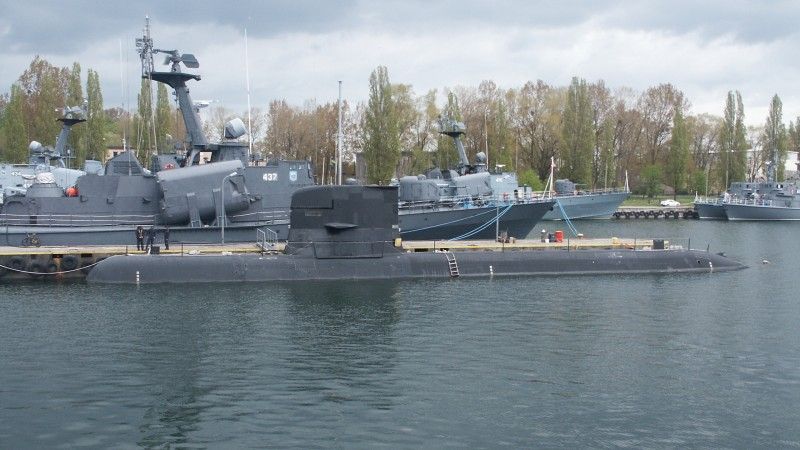
Photo. Jarosław Ciślak/Defence24.pl
According to the contract, the Polish Navy (Marynarka Wojenna) will receive the new A26-class submarines ordered from Sweden only successively at the end of 2032, 2036, and 2038. Consequently, for the third time, Poland must resort to a bridge solution.
The first bridge solution was implemented in the late 1980s. At the beginning of that decade, the Polish Navy operated four already obsolete Project 613 (NATO: Whiskey-class) submarines. All had been completed in 1955 for the Soviet Navy and were transferred to the Polish flag between 1962 and 1965. In the early 1980s, the Soviet shipbuilding industry prepared for the serial production of a completely new generation of submarines: Project 877 Palthus (NATO: Kilo-class). As part of the Warsaw Pact, Poland planned to acquire four next-generation vessels to replace the old ones on a one-for-one basis. For the first time since the end of the Second World War, Poland was to purchase brand-new submarines.
The commissioning ceremony (raising of the ensign) for the first of these, ORP Orzeł (291), took place on 29 April 1986 in Riga. The vessel was considered „super-technology”, and its interior and performance specifications were carefully concealed. A second submarine of this type was planned for the 1986–1990 five-year plan, but due to the total economic crisis in Poland, this was never realised. Consequently, plans to purchase the second Kilo-class vessel were moved to the following five-year period, 1991–1995.

Photo. Jarosław Ciślak/defence24.pl
Meanwhile, the remaining Whiskey-class vessels were being decommissioned. The ensign was lowered on ORP Orzeł (292) on 30 December 1983, and on ORP Kondor (294) on 30 October 1985. The other two vessels of this class, ORP Sokół (293) and ORP Bielik (295), were in such poor technical condition that they were reclassified as training submarines. This took place on 1 January 1987 and 1 January 1988, respectively. Simultaneously with their reclassification, operational restrictions were imposed, such as limits on diving depth. Ultimately, the Polish naval ensigns were lowered on 12 December 1987 and 30 September 1988.
As a member of the Warsaw Pact, the Polish Navy could not remain with only one submarine, ORP Orzeł (291). Therefore, the USSR offered to lease two used submarines. The Russians only had old Project 641 (NATO: Foxtrot-class) submarines available. Both units were also taken over in Riga, where their ensigns were raised. This occurred for ORP Wilk (292) on 3 November 1987 and for ORP Dzik (293) on 7 December 1988. This was undoubtedly a bridge solution, as they were old and heavily worn vessels. They had entered service in the USSR in 1964 and 1966, meaning that at the time of the lease, they were 23 and 22 years old, respectively.
When the Soviet empire collapsed, Russia no longer wanted these vessels back. At the beginning of the 1990s, their fleet was decommissioning or abandoning much newer ships. Had both Foxtrots returned to their owner, they certainly would not have been manned by Russian crews and would have been sidelined to await scrapping. The same applied to the leased destroyer ORP Warszawa (271). Consequently, a Polish-Russian agreement was concluded, under which the three leased ships became Polish property, and Poland cancelled Russia’s financial obligations in Polish shipyards.
In this way, what was intended as a short-term lease while waiting for the second Kilo-class vessel turned into a longer period of permanent service under the white-and-red ensign. The ships were in very poor condition, but Poland could not afford to purchase new, Western submarines at that time. Although such a purchase had been planned since the mid-1990s, it remained only on paper. Poland’s participation as an observer in the Scandinavian „Viking” submarine construction programme ended when that project collapsed. Continued operation of the Foxtrots became impractical, and the decision was made to decommission them. The ensign on ORP Wilk (292) was lowered on 10 October 2003, and on ORP Dzik (293) less than a month later, on 7 November 2003.

Photo. Jarosław Ciślak/Defence24.pl
For the second time, Poland could not remain with a single submarine—ORP Orzeł (291)—and for the second time, another bridge solution was decided upon. The Norwegians came to the rescue, donating their used Kobben-class submarines. ORP Sokół (294) was commissioned on 4 June 2002, followed by ORP Sęp (295) on 16 August 2002, ORP Bielik (296) on 8 September 2003, and ORP Kondor (297) on 20 October 2004. These vessels were already old, but their equipment and technical state were surprisingly good. At the time of their acquisition, they were 35, 36, 36, and 40 years old, respectively.
The second bridge was intended to provide time for the purchase of brand-new submarines. Therefore, the programme was formally named „New Type Submarines, code-name Orka” (Okręty Podwodne Nowego Typu – OPNT). The creators of this name did so deliberately; the words „New Type” were meant to prevent discussions about further bridge solutions.

Despite being small in size and advanced in age, the Kobbens earned a distinguished place in the annals of the Polish Navy. They served well and even participated in missions in the Mediterranean Sea as Polish Military Contingents (PKW). But time passes relentlessly for any ship, especially a submarine. As the vessels approached their 50th anniversaries, there was no longer any possibility of further extending their service. Their ensigns were lowered on 8 June 2018, 14 December 2021 (for two units), and 20 December 2017. In total, they served for 51, 55, 54, and 53 years across Norway and Poland.

Photo. Jarosław Ciślak/defence24.pl
Unfortunately, Polish decision-makers „overslept” during the period of this second bridge solution, and for the third time, ORP Orzeł (291) became the sole submarine under the Polish flag. There were countless discussions, assurances, and declarations regarding the need to purchase new vessels, but the years continued to pass.
It was not until 29 June 2026, in Gdynia, that an agreement was signed between the Armament Agency (Agencja Uzbrojenia) and the Swedish company Saab, worth nearly 47 billion Swedish kronor (approx. 18 billion PLN / $4.5 billion / €4.1 billion), for the purchase of three A26-class submarines. The delivery dates are set for the end of 2032, the end of 2036, and the end of 2038. Additionally, the contract includes armament, logistics, and training packages.

On the same day, but shortly before, the Armament Agency signed a separate agreement with the Swedish Defence Materiel Administration, FMV (Forsvarets Materielverk), worth approximately 1.9 billion Swedish kronor (approx. 740 million PLN / $185 million / €170 million) for the lease of the A17 Södermanland-class submarine along with equipment, armament, technical support, and training. Thus, the third bridge was born. This time it is a costly one, considering that the Norwegians had donated their Kobbens, including armament, free of charge.

Photo. Andrzej Nitka/Defence24.pl
On 19 August 2026, a video was published showing Polish sailors entering the gates of the Swedish 1st Submarine Flotilla for the first time, where they will undergo training. The training of the Polish crew is expected to last 18 months, though it is currently unknown exactly when the Polish ensign will be raised on the Södermanland. From the moment the unit is handed over, Poland will assume full responsibility for it and will be able to decide on its operations, including the use of torpedo armament. For now, it can be assumed that this will take place at the turn of 2027 and 2028. It can also be assumed that following this event, the ensign will be lowered on ORP Orzeł (291).
On 12 October 2026, the Swedish FMV signed a relevant agreement with the Swedish Armed Forces regarding the training of the Polish submarine crew and the lease of the Södermanland submarine to Poland.
Under current assumptions, the Södermanland, renamed, will operate until the end of 2032, when the prototype A26-class vessel built for Poland is commissioned. It will then be returned to the Swedes, and the new ORP Orzeł (the name it will likely receive) will once again be the only submarine in the Polish fleet. It will be joined by further „flying predators”, but according to the current schedule, not until 2036 and 2038.

Photo. www.saab.com
Thus, we are witnessing the third Polish bridge solution. Whether it will conclude in 2032 depends on the Saab Group, which is expected to deliver the first ordered A26-class vessel to Poland by then. How the Södermanland will perform under the Polish flag remains to be seen. It is not a young vessel, having been commissioned on 21 April 1989—making it only three years younger than the current ORP Orzeł, at 37 years old. The only hope lies in the fact that during its 2003 refit, its equipment was thoroughly modernised. At that time, a 12-metre section with a Stirling engine was added, providing air-independent propulsion (AIP).


