












- WIADOMOŚCI
- KOMENTARZ
Sweden becomes the land bridge to Finland

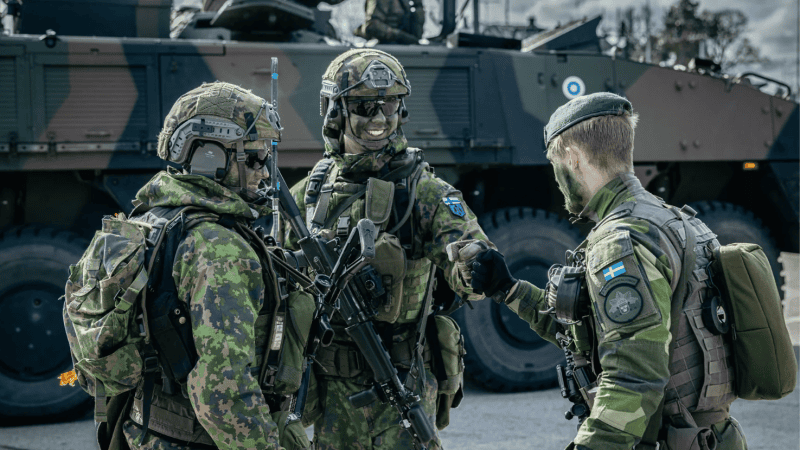
Sweden’s accession to NATO has changed the military map of northern Europe. The country is no longer only defending its own territory. It is becoming the corridor through which Allied troops, tanks, ammunition and supplies would move from the Atlantic towards Finland. That makes Swedish roads, railways, bridges and ports part of NATO’s northern defence plan, not just a domestic infrastructure issue.
For decades, Swedish infrastructure was built for a neutral state. Roads and railways connected the country mainly from north to south, serving industry, ports and internal transport. NATO needs a different direction. In a crisis, reinforcements arriving through Narvik, Trondheim and Gothenburg would have to move eastwards, across Sweden, towards Finland and the wider north-eastern flank.
This changes Sweden’s role. It becomes Finland’s logistical depth. If Swedish bridges cannot carry heavy vehicles, if railways are too vulnerable, or if damaged infrastructure cannot be repaired quickly, the whole concept of reinforcing Finland becomes weaker. This is why Boden, Haparanda, the Malmbanan railway and the routes towards Narvik have a different meaning today. They are no longer only parts of Swedish national infrastructure, but elements of a wider northern system linking the Atlantic, Sweden and Finland.

Sweden's role is already operational
This is not only about future transit. Sweden is the framework nation for NATO’s Forward Land Forces Finland, with the multinational staff element being established in Rovaniemi, in Finnish Lapland. That means Sweden is not simply preparing roads for somebody else’s war. It is preparing the infrastructure through which a NATO presence led by Sweden would have to function in Finland.
The same logic applies to the defence industry. Swedish-Finnish cooperation is already visible in platforms designed for Arctic conditions, logistics and sustainment. The Patria TRACKX programme, developed around common Arctic mobility, shows that both countries are thinking about the same operational environment: distance, snow, forests, weak infrastructure and long supply lines. Equipment, repair capacity and transport corridors have to work together. A vehicle is only useful if it can actually reach the area where NATO needs it.
Finland’s dependence on Sweden is also structural. Around 95 per cent of Finnish foreign goods transport by tonnage moves by sea. If the Baltic Sea became too dangerous for civilian shipping, western land corridors through Sweden would become essential for Finland’s military and civilian supply. In that scenario, Sweden would not be a supporting state on the map. It would be the route through which Finland remains connected to the West.

The bottleneck is at the border
The Haparanda-Tornio connection is one of the key points in northern Europe. It links Sweden and Finland, but it also exposes a technical weakness. Sweden uses the European standard gauge, while Finland uses the wider 1524 mm gauge. In peacetime this is a logistical inconvenience. In wartime it becomes a bottleneck.
That is why the discussion about extending European-gauge rail from Haparanda through Tornio towards Kemi matters. This is not about railway symbolism. It is about whether heavy equipment can move into Finland without losing time at the border. The same applies to Swedish bridges and roads. During the Cold War, parts of northern Swedish infrastructure were prepared for destruction in order to delay a Soviet advance. Today the logic is different: bridges must remain open, railways must be restored quickly, and roads must carry heavy military traffic eastwards.
Russia also understands the importance of these routes. Finnish infrastructure officials quoted in Sweden speak about drones appearing frequently in eastern Finland, including near railway lines and border areas. Public attribution in such cases requires caution, but the direction is clear. Russia is interested in the infrastructure NATO would need in a war.


