












- WIADOMOŚCI
Russia loses another cruiser. This time, it's not Ukraine's doing

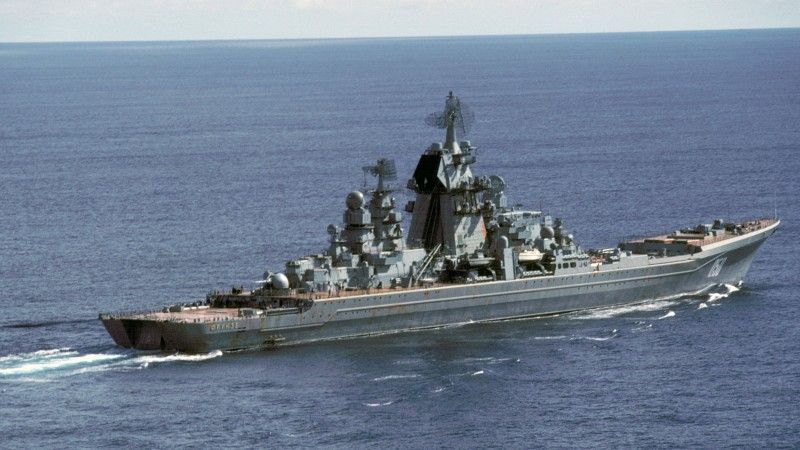
The Russian heavy nuclear-powered cruiser Pyotr Velikiy will not undergo a refit and will no longer return to service. A preliminary decision on this matter has already been made, as reported by Russian media and the TASS agency.
A special commission deliberated on the fate of Russian President Vladimir Putin’s favourite ship. Its conclusions are merciless: the ship is so heavily worn out that a general overhaul combined with modernisation makes no sense, and it will not return to service. It will be replaced by a vessel of the same type – Admiral Nakhimov, whose refit has recently concluded, having lasted since as far back as 1999. Work on the Nakhimov has thus been ongoing roughly since Putin took office in Moscow. Not only was the process incredibly long-drawn-out, but – as the commission indicated – its costs significantly exceeded the cost of building a new type of cruiser from scratch.
The mere fact that work on the Nakhimov has been completed is also an argument for decommissioning the Pyotr Velikiy. A replacement is now available, although original plans had called for expanding the fleet and increasing its potential. After the introduction of the second unit, the first was originally intended to be sent for similar work, which would have resulted in two vessels remaining in service.

Putin’s Favourite Ship
Commission representatives emphasise that the decision is not final, and if an „opportunity arises”, the ship might yet have a future. Considering they simultaneously stated that the Pyotr Velikiy is in such poor condition that it is unfit for repair, this „opportunity” can likely only be a political decision by Putin himself. The Russian President was closely associated with the Pyotr Velikiy and often appeared on its deck. With its elegant lines, and above all, its massive size and nuclear reactor, the ship was intended to be a testament to Russia’s greatness and superpower status. Putin generally favoured his cruisers and visited them frequently. Another such representative vessel was the slightly smaller cruiser Moskva.
The Pyotr Velikiy is the youngest ship of Project 1144 Orlan (NATO reporting name: Kirov class). During the Soviet era, five such units were planned, of which four were completed:
- Sergey Kirov (later Admiral Ushakov) was commissioned in 1980. Ten years later, it suffered a serious reactor failure in the Mediterranean Sea. It was temporarily withdrawn from frontline service and never returned. Scrapping operations began in 2002;
- Mikhail Frunze (Admiral Lazarev) entered service in 1984. It was withdrawn in 1999 following the commissioning of the Pyotr Velikiy. An overhaul and modernisation were planned but ultimately abandoned. Scrapping began in 2021;
- Mikhail Kalinin (Admiral Nakhimov) entered service in 1988 and had remained in the aforementioned refit since 1999;
- Yury Andropov (Pyotr Velikiy) was completed in 1998 after numerous delays and was the youngest and final ship of the class.
The Feliks Dzerzhinsky, however, was never finished; its name was changed several times before work was finally halted in 1990.

Degradation of the Russian Surface Fleet and the Withdrawal of Further Large Ships
It is worth noting that at the start of the invasion of Ukraine, Russia possessed five cruisers: two heavy Project 1144 Orlan/Kirov class and three smaller Project 1164 Atlant (NATO reporting name: Slava class). Today, it only has three, with no prospects for successors on the horizon.
The Russian surface navy is in an increasingly poor state. Recently, a decision was made to abandon the last aircraft carrier (aviation cruiser), the Admiral Kuznetsov. In recent years, the remaining Sovremenny-class destroyers and some Udaloy-class vessels have been quietly withdrawn. The latter, when undergoing reconstruction, are simultaneously being reclassified as frigates.


