











- WIADOMOŚCI
The Ukrainian army’s future infantry fighting vehicle. Germany paid for it

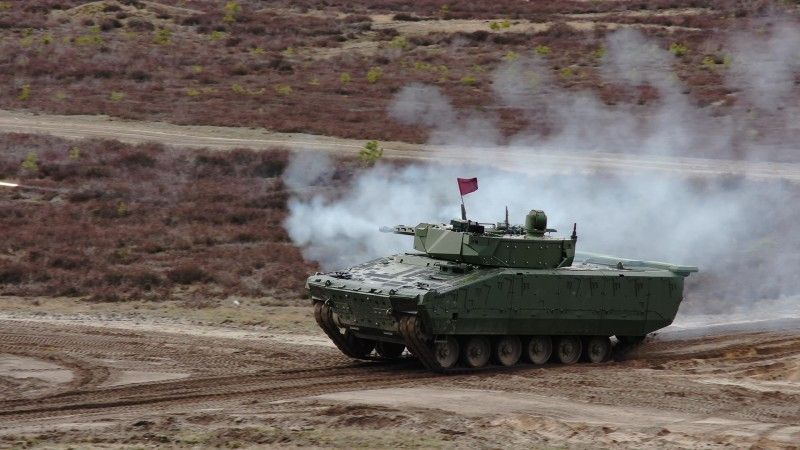
The Ukrainian Armed Forces have released the first video showing a KF41 Lynx infantry fighting vehicle. Five vehicles are due to be delivered to Kyiv as part of a donation by the German government, but deliveries have been delayed.
In late 2024, Ukraine received a single KF41 Lynx infantry fighting vehicle for testing, as confirmed in an interview with the Frankfurter Allgemeine Zeitung by Rheinmetall CEO Armin Papperger. The vehicle was built at the company’s plant in Unterlüß and was to be one of 10 vehicles destined for Kyiv. In mid-July, the head of the German defence company commented on the matter again, in an interview with the German newspaper Bild.
See also 
The German-Ukrainian armoured soap opera
He said that the Lynx was still being tested by the Ukrainian army, but well away from the front line (probably in the west of the country). In November, Papperger spoke again about deliveries and Lynx production in Ukraine, saying that five vehicles were currently being built for Kyiv. In the CEO’s view, setting up a production line in our eastern neighbour would only make sense if there were an order for around 200–300 vehicles (and there is no such order).
On 12 January, Rheinmetall announced that five KF41 Lynx infantry fighting vehicles would be delivered to Ukraine at the beginning of the year. The contract was signed back in December 2024 and was valued at tens of millions of euros. The German government is to provide the funding. This marked the end of one chapter in this “German-Ukrainian armoured soap opera”.

Photo. Damian Ratka
The vehicles were to be adapted to the requirements of the Ukrainian army and the findings from its tests to date. As with the Hungarian configuration, the vehicles were to be fitted with a Lance 2.0 turret. The head of Rheinmetall stressed at the time that the next step should be further batches of Lynx vehicles for Ukraine, along with their production in the country.

We had to wait… 11 months for the first footage confirming that the KF41 had entered service with the Ukrainian army. At least one of the five vehicles paid for has been delivered to the 21st Mechanised Brigade. In the video, soldiers show part of its interior and share their initial impressions from operating it. The vehicle has not received typical front-line modifications, so it remains outside the combat zone and is primarily used for training.
The AFU has released a first video of a German-delivered Lynx KF41 IFV in service with the 21st Mechanized Brigade. An initial batch (total of five of these IFVs) worth a mid double-digit million euro sum has been financed for Ukraine by the German government. H/t @Jeff21461 https://t.co/jIghXJlPtT
— GAU (@deaidua) November 24, 2026
KF41 Lynx infantry fighting vehicle
The KF41 is a tracked infantry fighting vehicle developed and built by the German company Rheinmetall Defence. Its modular design allows many of its components to be replaced to meet the customer’s requirements. Its main armament is a 30/35 mm automatic cannon capable of firing programmable ammunition. It can be elevated by up to 45 degrees and depressed by up to 10 degrees. Its main anti-tank weapon is the Spike-LR/LR2 guided missile, housed in a twin launcher on the vehicle’s turret.
The rapid-fire cannon is complemented by a coaxial 7.62 mm machine gun, and the turret can also be fitted with a remotely operated weapon station. If required, the vehicle can be equipped with a different turret system, such as one armed with a 105/120 mm tank gun, turning it into a fire-support vehicle or medium tank. It will still offer good mobility thanks to its 1,140-horsepower power unit. In its infantry fighting vehicle configuration, it can reach speeds of up to 70 km/h.

The Lynx’s armour protects the crew against various threats, including small-calibre cannon rounds, artillery fragments, mine blasts and improvised explosive devices (IEDs). Its mine protection is designed to withstand heavy mine blasts, explosively formed projectiles and IEDs. Enhanced protection against rocket-propelled grenade warheads and anti-tank guided missiles is also available as an option, in the form of Rheinmetall’s Active Defence System (ADS).
The crew consists of three people, while the vehicle can carry eight soldiers. The commander, gunner and driver each have a hatch above their position. This provides optimal situational awareness and makes it easier to get in and out of their stations. This is an important feature in dangerous situations, when the time needed to evacuate the vehicle must be kept to a minimum. In addition to these hatches, the crew can leave the vehicle in the same way as the troops it carries: via a hydraulically lowered ramp at the rear.

Photo. honvedelem.hu