












- WIADOMOŚCI
Ahead of the Polish Prime Minister's visit to India – what to expect

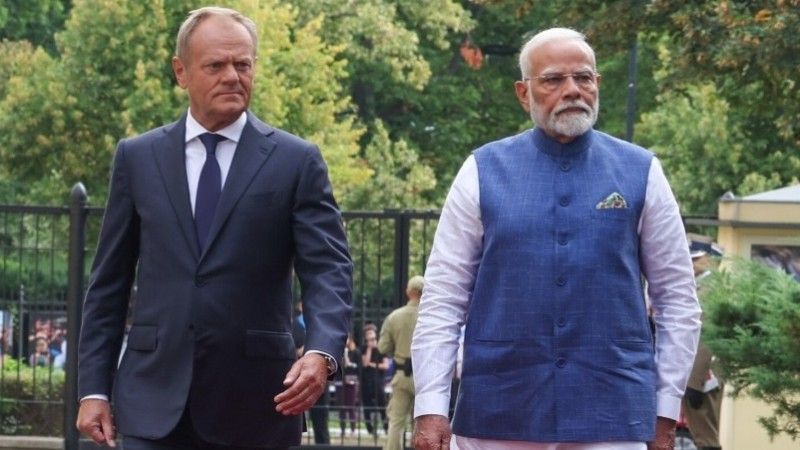
Photo. Wikimedia Commons
On 22–23 October, Polish Prime Minister Donald Tusk will pay an official visit to India. The central focus of his talks with Prime Minister Narendra Modi will be economic cooperation.
This will be the first visit by a Polish prime minister to India in 16 years. The previous one was also made by Tusk, in 2010. Since then, both countries have travelled a remarkably long distance, and in both cases, that distance has led to success. Poland’s economy has become one of the largest in Europe, while India’s has grown into one of the largest in the world. Today, Poland aspires to join the G20, while India aims to become the world’s third-largest economic power.
It is therefore no surprise that the economy will dominate the entire visit. Poland’s Minister of Finance and Economy, Andrzej Domański, will also take part. In addition to the leaders« talks, two business forums are planned – in Delhi and Bengaluru. Several dozen Polish companies and a similar number of Indian firms have already registered to participate. Among them will be PESA, Poland’s largest manufacturer of rail vehicles, and WB, a defence company that has been cooperating with India for a few years already. In Bengaluru, the Polish Space Agency will also hold discussions with India’s ISRO. A number of agreements between Polish and Indian entities are expected to be signed.

At present, bilateral trade between Poland and India stands at approximately USD 6 billion. During the recent visit of India’s external minister to Warsaw, both sides declared their intention to raise this figure to USD 10 billion. Poland also aims to rebalance the trade relationship, as India currently accounts for the majority of exports.
Next year, the long-awaited free trade agreement between the European Union and India will enter into force. It will eliminate or substantially reduce tariffs on nearly all goods. This represents both a major opportunity and a significant challenge. The tariff schedules alone run to roughly 2,500 pages. The agreement is being carefully analyzed by all interested governments and will also be discussed during a substantive session of the business forum in Delhi.
New avenues for academic cooperation are opening as well. On the day before the visit, on 21 October, a seminar on the subject will be held at the prestigious Jawaharlal Nehru University in Delhi, organized with the participation of the University of Warsaw and the ITECH Łukasiewicz. An agreement on the establishment of a Polish–Indian academic hub will also be signed. Talks will cover collaboration in research and development. Space research has already been mentioned, but it is not the only potential area of cooperation. Joint projects are also possible in artificial intelligence, chemical industry, drones, and other dual-use technologies.
Will this visit open a new chapter in bilateral relations? In 2019, a direct air link between Warsaw and Delhi was launched by LOT Polish Airlines. In 2024, during Prime Minister Modi’s visit to Warsaw – the first at this level since 1979 – a strategic partnership document was signed. That partnership is now being filled with concrete substance.
Both Poles and Indians remember that during the Second World War, the Maharajas of Kolhapur and Jamnagar provided shelter to Polish refugees. Poland, in turn, assisted Indian students evacuating from Ukraine in 2022 as they fled Russian military aggression. Poland and India therefore share a unique history of mutual support in difficult times – a foundation on which successful cooperation can be built. Whether the target of USD 10 billion in bilateral trade will be achieved depends on the determination of both sides.


