- WIADOMOŚCI
- ANALIZA
BRICS summit in New Delhi: A display of unity and a showcase for India

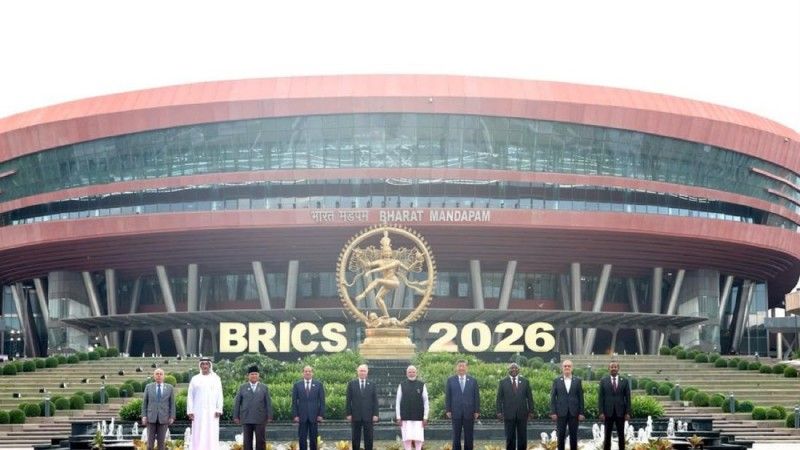
Photo. https://www.brics2026.gov.in/
India discharged its role as BRICS chair with real skill. Despite visible contradictions among the group’s members, a joint declaration was adopted. Guests were also given a view of a modern New Delhi.
The expansion of BRICS is by now taken as given. The name has been retained; even the „plus” once attached to the acronym (for a time the grouping was styled BRICS+) has been dropped. The BRICS brand is recognised worldwide. Depending on where one asks, it evokes very different emotions – but everyone is aware of it. Leaders of ten member states attended (Brazil was represented by its foreign minister); Saudi Arabia, whose status remains ambiguous, sent its foreign minister; and partner countries were represented at varying levels. Also present were the heads of major regional organisations – the African Union and ASEAN – and UN Secretary-General António Guterres, who has for several years been a regular visitor to successive BRICS summits.
It was a vast occasion, and the Indian authorities used it, understandably, to promote the country. Guests saw the modern Bharat Mandapam convention centre, stood before a vast image of the iconic Ramanathaswamy Temple in Rameswaram, heard Indian music (the prime minister of Malaysia even sang the well-known Hindi song „Khwab Ho Tum Ya Koi Haqeeqat”) and were served traditional vegetarian cuisine. India advertised itself on a global stage.
The hosts’ greatest diplomatic success was the adoption of a long, 140-point joint declaration. BRICS summits usually end with such texts; this time, however, given the war in the Middle East, the contradictions among members were enormous. Agreement was reached only at 4 a.m. on 12 September. The result was the „BRICS New Delhi Declaration: Building for Resilience, Innovation, Cooperation and Sustainability”.
Like its predecessors, the declaration carries the group’s core message: a critique of the balance of power in the principal global institutions, which favours Western states, and a call for more inclusive global governance. That position was echoed by UN Secretary-General António Guterres, who said in his address that the world is moving towards multipolarity and that global institutions, including the United Nations, therefore require recalibration to restore greater balance.

On wars and conflicts under way around the world, the language of the BRICS declaration was relatively restrained. It expressed „serious concern” over attacks on civilian infrastructure, including nuclear installations used for civilian purposes. Considerable attention was given to Palestine and the Gaza Strip, condemning the deteriorating humanitarian situation and the forced displacement of civilians. Israel was called upon to abide by agreements already signed, including with Lebanon. „Grave concern” was also registered over Sudan. The terrorist attack in Jammu and Kashmir was condemned. Ukraine is not named in the document. The most difficult passage to draft concerned the Middle East; the formula finally agreed was: „We express deep concern over the continued escalation of tensions in the Middle East/West Asia and, recalling our respective national positions, call for exercising maximum restraint, as well as avoiding actions that could further aggravate the situation.”
Economic issues received substantial weight. Members called for greater use of national currencies in settlements – a process that has, in fact, already been under way for some time. The New Development Bank, still the only common BRICS institution, was the subject of one of the points. The Indian-backed BRICS–NDB Knowledge Portal, intended to support the exchange of expertise, was welcomed. Work was also promised on another initiative that may in time become a shared institution: the BRICS Grain Exchange, a priority for Russia. Advanced work is likewise proceeding on India’s BRICS AGRIN (Agro-Inputs, Genetic Resources and Information Network), a network for the exchange of agricultural information, to be run through agricultural institutions.
India also tabled an initiative that could give BRICS a more permanent institutional character. Prime Minister Narendra Modi proposed a „troika” of the outgoing, current and incoming chairs. As BRICS has no secretariat, this would be a step towards greater institutionalisation.
Several bilateral meetings took place on the sidelines, including Narendra Modi–Xi Jinping, Narendra Modi–Vladimir Putin, and Iranian President Masoud Pezeshkian with Abu Dhabi Crown Prince Sheikh Khaled bin Mohamed bin Zayed Al Nahyan. The most important was Modi’s meeting with Xi, who was visiting India for the first time since 2019. He did not stay for the whole summit and missed a few events, but treated the conversation with Modi as a priority. Both leaders agreed that border issues should be handled so that „differences should not become disputes.”
The BRICS summit was a demonstration of the group’s unity. A joint statement adopted despite genuinely deep contradictions among members should be counted a success. Visually it was impressive: a flood of photographs, a good atmosphere, talks, visions and projects. If the „troika,” the Grain Exchange and AGRIN actually take shape, one will be able to speak of further consolidation of a group that is still far from cohesive. BRICS has further entrenched its global visibility.

The summit was also a major success for the hosts. India once again presented itself as a country to which world leaders travel to discuss matters of consequence. New Delhi has strengthened its standing in BRICS and in the non-Western world – and in a few months another landmark awaits on a different track: the final signing of the European Union–India free trade agreement.