












- ANALIZA
- WIADOMOŚCI
Blockade of Ukrainian Black Sea ports: Will Poland once again fall victim to a grain crisis?

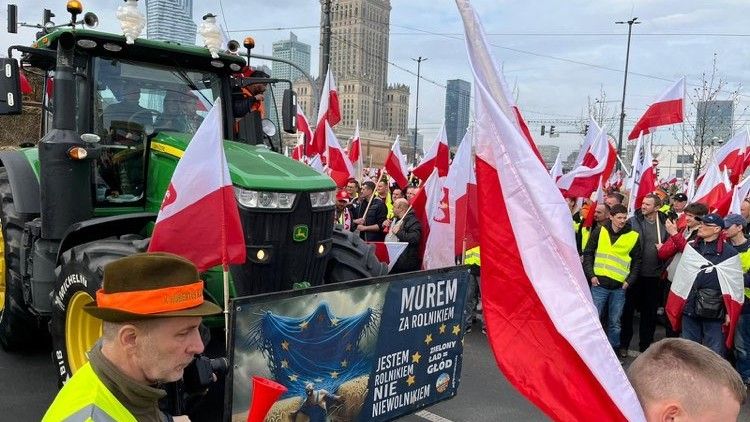
Photo. Energetyka24 / red. Karol Byzdra
The suspension of merchant vessel calls at Ukraine’s Black Sea ports could mark the beginning of another crisis involving Ukrainian grain exports. Although Kyiv stresses that it is still too early to speak of a complete blockade of seaborne exports, the coming weeks may prove critical not only for Ukraine, but also for neighbouring countries, including Poland.
The suspension of merchant vessel calls at Ukraine’s Black Sea ports could mark the beginning of another crisis involving Ukrainian grain exports. Although Kyiv stresses that it is still too early to speak of a complete blockade of seaborne exports, the coming weeks may prove critical not only for Ukraine, but also for neighbouring countries, including Poland.
Ukraine’s Minister of Agrarian Policy, Taras Vysotskyi, announced that inbound vessel traffic to Ukrainian Black Sea ports had been suspended because of the heightened threat of Russian attacks. The decision, however, was not taken by the Ukrainian authorities, but by shipowners themselves, who are concerned about the safety of their vessels.
„Only yesterday, four or five ships were entering the ports. That is not many, but traffic was continuing. Vessel entries have now been suspended. This is a decision taken by the shipowners; the state, for its part, has imposed no restrictions,” Vysotskyi said.
At the same time, the Ukrainian minister stressed that it was still too early to speak of a complete blockade of Ukraine’s seaborne exports. In his view, the situation could change very rapidly, and the current difficulties should be assessed over a period of months rather than days. For the agricultural market, however, it may not be the coming months but the next few weeks that prove decisive.

Black Sea escalation
The crisis surrounding Ukraine’s ports did not emerge overnight. It is the result of successive actions taken by both sides in the Black Sea. The first stage involved Ukrainian attacks on Russian merchant vessels and infrastructure associated with Russian maritime transport. Using unmanned strike systems, Kyiv launched operations intended to restrict Russia’s ability to use its own sea lanes. The next step was to expand these operations to vessels sailing under neutral flags and operating in the Black Sea. This meant that the risks associated with navigation were no longer confined to Russian ships, but began to affect international shipowners as well. Ukraine, too, had attacked vessels sailing under neutral flags.
Following Russia’s response, Ukraine launched an international information campaign accusing Moscow of attacking civilian shipping and attempting to obstruct Ukrainian exports. The problem, however, is that Russia’s actions came in response to an earlier escalation in which Ukraine itself had used attacks on merchant vessels as a means of exerting pressure on Russia. Kyiv subsequently asked for the issue to be raised at the United Nations, calling on the international community to respond to Russian attacks on shipping. This raises the question of how Ukraine intends to persuade UN member states to condemn Russia’s actions when it had previously employed the same methods now being used by Russia.

Black Sea ports are vital to Ukraine
Since the beginning of Russia’s full-scale invasion, Ukraine has sought ways to maintain exports of its agricultural products. After Russia withdrew from the UN-brokered grain initiative in 2023, Kyiv established its own maritime corridor, allowing part of its export trade to resume. The ports of Odesa, Chornomorsk and Pivdennyi are of the greatest importance to Ukraine’s foreign trade. Their closure would mean having to divert larger volumes of goods to alternative routes—through the Danube ports and by rail and road through European Union member states. The problem is that overland infrastructure cannot replace the capacity of Ukraine’s Black Sea ports. If the blockade continues for an extended period, Ukraine will have to seek new export channels. Neighbouring countries, including Poland, remain among the most natural alternatives. This is precisely where the greatest risk to Poland’s agricultural market arises.
The scenario feared by Polish farmers is already well known. In 2022, following Russia’s invasion of Ukraine and the restrictions on exports through the Black Sea, the European Union opened its markets to Ukrainian agricultural products. Officially, the primary objective was to enable Ukrainian grain to transit through the EU to third countries. In practice, a significant proportion of these products remained on the markets of countries bordering Ukraine, including Poland. This led to a sharp rise in discontent among farmers, who argued that domestic production could not compete with cheaper imports. The result was a wave of protests, blockades of border crossings and escalating tensions between Warsaw and Kyiv.
Concerns that this scenario could be repeated have once again become relevant. If Ukraine’s seaborne exports remain restricted for an extended period, pressure to use Polish infrastructure could increase significantly. The difficulty is that the Polish market is already in a challenging position. Domestic prices are becoming increasingly detached from commodity exchange prices. Global market quotations do not always reflect the reality faced by agricultural producers, who sell their products under entirely different conditions. Commodity exchanges operate according to their own mechanisms, whereas the domestic market depends on the decisions of purchasing companies, processors and the level of supply at any given time. Some farmers have also accused major processing companies of taking advantage of producers« difficult position to keep farm-gate purchase prices low.

Critical significance of the forthcoming 2 weeks
The most important issue will not necessarily be whether the blockade lasts one or two months. The next few weeks may prove decisive. If the situation in the Black Sea does not improve within approximately two weeks, a process of redirecting larger volumes of Ukrainian exports to overland routes may begin. For Poland, this would come at a particularly difficult time. Polish farmers have already incurred high production costs. In recent years, the prices of fertilisers, fuel and energy have remained elevated, placing an additional burden on farms. Under such circumstances, an influx of large volumes of cheaper Ukrainian grain could prevent domestic producers from offsetting their costs through higher selling prices. The problem is not Ukrainian exports in themselves, but the manner in which they are organised. The experience of 2022 demonstrated that the term „transit” did not always correspond to market reality. Should a similar mechanism be repeated, Polish farmers may once again come under pressure from falling prices while their production costs remain high.
The potential rerouting of larger volumes of Ukrainian exports through Poland could also have political consequences. A new wave of farmers« protests, border blockades or opposition to imports of Ukrainian grain could once again deepen tensions between Warsaw and Kyiv. Polish-Ukrainian relations are already burdened by numerous disputes, ranging from economic issues to historical grievances. Another agriculture-related crisis could further intensify mutual distrust. For the time being, the situation remains fluid. Ukraine maintains that a complete blockade of seaborne exports has not yet occurred and that shipowners may reverse their decisions at any time. However, if Russian attacks continue and the Black Sea ports remain inaccessible, the consequences could extend far beyond Ukraine. Under such a scenario, the problem in the Black Sea could rapidly become a problem for Poland’s agricultural market as well.


