












- WIADOMOŚCI
- ANALIZA
How Russia could attack Poland. Three scenarios

Massive drone strikes, a limited land offensive, or a full-scale Ukraine-style invasion? A recent Polish report on the economic cost of war with Russia sheds light on possible aggression scenarios, their objectives, and their potential consequences.
„Armed conflict is inherently defined by uncertainty,” writes Jakub Palowski, Defence24’s deputy editor, referring to the constant evolution of the war in Ukraine. The conflict for which Poland had been preparing only a few years ago is unlikely to materialise in that form. At the same time, a potential war on Polish territory would not simply reproduce the patterns now observed in Ukraine. However, this is not to say that war scenarios are useless, but rather that they must be constantly adapted to the changing characteristics of war. This is precisely the attempt made by Palowski in the recent report „Economic Costs of War for Poland”.
According to Palowski, any larger Russian attack on Poland would first require the Ukrainian front to freeze or stabilise enough for Moscow to redeploy its overstretched forces elsewhere without creating dangerous exposure in Ukraine. In that case, the Baltic states would be the most vulnerable and therefore the most likely target of Russian aggression. This is why, in the first two of Palowski’s three scenarios, Poland is not the primary target but a supporting theatre in a broader Russian operation against the Baltic states.
Scenario 1: mass air campaign
The first scenario envisages a land invasion of the three Baltic states, with the objective of rapidly seizing their territory. In this variant, Poland would not be the main theatre of operations. It would instead be targeted primarily through drone, missile, and air strikes designed to disrupt NATO’s ability to move reinforcements through the Suwałki Gap, the Alliance’s only land corridor to Lithuania, Latvia, and Estonia. By paralysing or delaying NATO’s response, Russia would seek to create a narrow window in which it could overrun the Baltic states and present the Alliance with a fait accompli. If this were achieved within three to five days, restoring the previous situation would become dramatically more difficult, costly, and escalatory.
In this context, Palowski argues, Russia’s objectives in Poland would be limited but strategically decisive: to obstruct the movement of NATO reinforcements from Poland into Lithuania, Latvia, and Estonia; then to neutralise or destroy Poland’s military capabilities; cripple its industrial base, particularly the energy and fuel sector; and ultimately break the will to resist. As he notes, this would be „theoretically the least damaging scenario for Poland, but also the easiest for Russia to carry out, and therefore the most likely.”
Even in this least damaging scenario, the potential cost for Poland could reach €250 billion, with the most severe destruction concentrated in the north-east of the country. The deeper cost, however, would lie in the political and security dimension. If Russia occupied the Baltic states, Poland’s strategic position would deteriorate dramatically, making it far more exposed and potentially the Kremlin’s next target. At the same time, NATO’s credibility would be severely undermined, while Poland’s image as a safe and stable country would be shaken, weakening its long-term economic and social prospects.

Scenario 2: limited land offensive
The second scenario follows a similar logic, as the main Russian strike would still be directed against the Baltic states. This time, however, it would be accompanied by a limited supporting land offensive against Poland. While Russia’s broader objectives in the Baltic theatre would remain unchanged, the operation on Polish territory would go further than air and missile strikes. Its purpose would be to occupy parts of north-eastern Poland and physically block the Suwałki Gap, thereby cutting off NATO’s only land corridor to the Baltics.
That would mean a conventional confrontation on Polish territory, accompanied by extensive air, missile, and drone strikes, inevitably causing far greater losses. Although the Russian occupation of parts of north-eastern Poland could be temporary, as Palowski assumes, the total cost of such a scenario could exceed €500 billion, a figure comparable to the estimated cost of Ukraine’s post-war recovery.
Scenario 3: full-scale invasion
The third and final scenario developed by Palowski is, in his words, „the most dangerous variant from Poland’s perspective: a decision by the Russian authorities to make Poland the main target of the attack.” Although „relatively less likely,” it would be far more devastating for Poland, with estimated recovery costs exceeding €1 trillion.
In this scenario, Russia’s aim would be to seize a substantial part of Poland, expose the weakness of Warsaw, NATO, and the EU, and impose a new European security architecture on Moscow’s terms. The operational logic would be speed and surprise: a rapid campaign conducted before NATO could bring sufficient reinforcements to the theatre. In the worst case, Russian forces advancing from the north (Kaliningrad Oblast) and east (Belarus) would break through Polish defences, link up, and push as far as the Vistula and San rivers. As the Dnieper does in Ukraine, these rivers would create a natural line of defence and a barrier to further movement, leaving nearly half of Polish territory in Russian hands.

Lessons: air defence, forward presence, and escalation control
Palowski’s analysis points to several key conclusions about Russia’s most likely actions and the greatest dangers they would pose. The most plausible threat is a mass air campaign designed to overwhelm Polish air defences through the simultaneous use of thousands of drones and missiles. In a conventional land invasion, the logic is even more brutal: every inch of Polish soil lost to Russia would later have to be retaken at enormous human and material cost. This underscores the importance of stopping any attack as close to the border as possible.
The scenarios also highlight a structural vulnerability on NATO’s eastern flank: the limited Allied troop presence in Poland and the Baltic states. Such a posture may prove too small to deter Russia and too weak to defend Allied territory in the first, decisive days of a conflict. One lingering constraint is the 1997 NATO-Russia Founding Act. Despite Russia’s gross violations, it remains de jure in force and still formally bans NATO’s permanent deployment of substantial combat forces in member states that joined after 1999. In Palowski’s simulations, this limited forward presence forces NATO to rely on reinforcements from the West, giving Russia valuable time to seize territory and confront the Alliance with a fait accompli.
Another critical issue is NATO’s assumed restraint in counteroffensive operations, driven by the risk of Russian nuclear escalation. In his third scenario, Palowski notes that NATO forces would not permanently occupy territory inside Russia or Belarus, conducting only limited raids to improve their position. This one-sided restraint creates a dangerous asymmetry. By threatening nuclear escalation, Moscow could narrow the limits of NATO’s response and preserve a degree of control over the escalation ladder, even after striking Allied territory.
The war already under way
These scenarios, however, would not emerge out of nowhere. They would represent an escalation of the sub-threshold war that Russia is already waging against the West, with Poland among its primary targets. Today, its main front is the information and cyber domain, where Russian hostile activity seeks to disrupt the functioning of societies, state institutions, and critical infrastructure. In 2025 alone, Poland recorded 682,000 reports of cyberattacks, with many of them inspired or supported by Russia. The largest such attack to date occurred in December, when an operation aimed at paralysing Poland’s energy system was fortunately neutralised.
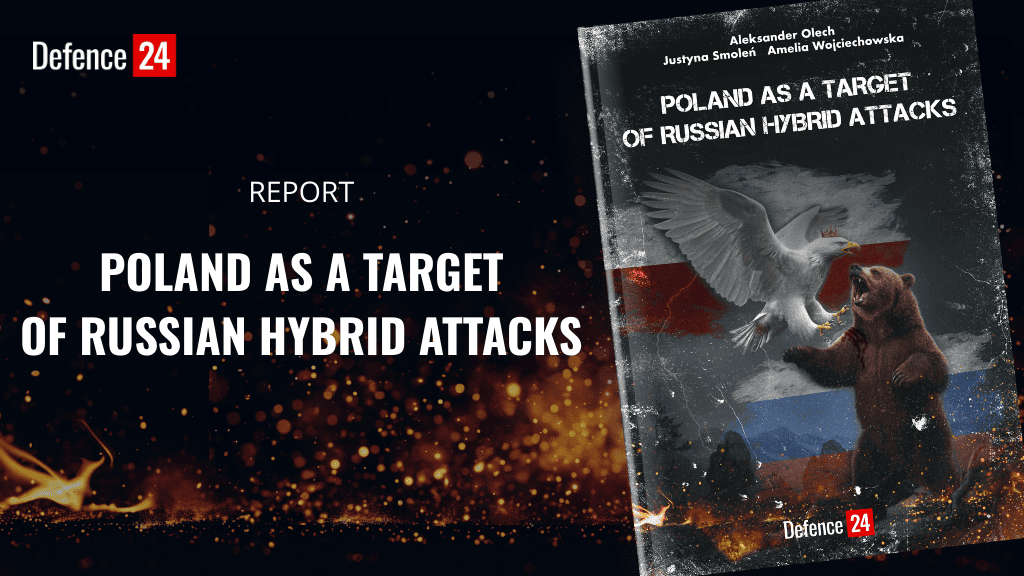
Yet Russian hybrid warfare is increasingly moving into the physical domain, including on Polish and other European territories. Moscow has been linked to numerous acts of sabotage and subversion, many of which were summarised in Defence24’s latest report, Poland as a Target of Russian Hybrid Attacks. This comes on top of repeated violations of Polish airspace by Russian drones, including the major incident in September last year, when NATO aircraft were scrambled and four drones were shot down.
War is already reaching NATO territory. Worse still, the Kremlin does not need to launch any of the scenarios outlined above to raise the cost for Poland. It can simply intensify the operations already underway. More frequent drone incursions, sabotage attempts, and cyberattacks would be enough to erode Poland’s status as a safe area, increase risk premiums on investment, trade, and infrastructure, while spreading fear and causing physical damage.
The report „Economic Costs of War for Poland” was published by the Związek Przedsiębiorców i Pracodawców (ZPP) and the Polish advisory think tank Defence Institute, under the media patronage of Defence24. It was authored by Prof. Konrad Trzonkowski and Jakub Palowski, with a foreword by Gen. Jarosław Gromadziński, and edited by Miłosz Marczuk. The full report (available in Polish only) can be accessed via the following link.


