












- WIADOMOŚCI
- POLECANE
Is Poland Ready for War? New Book Examines Poland’s Defence and Global Role

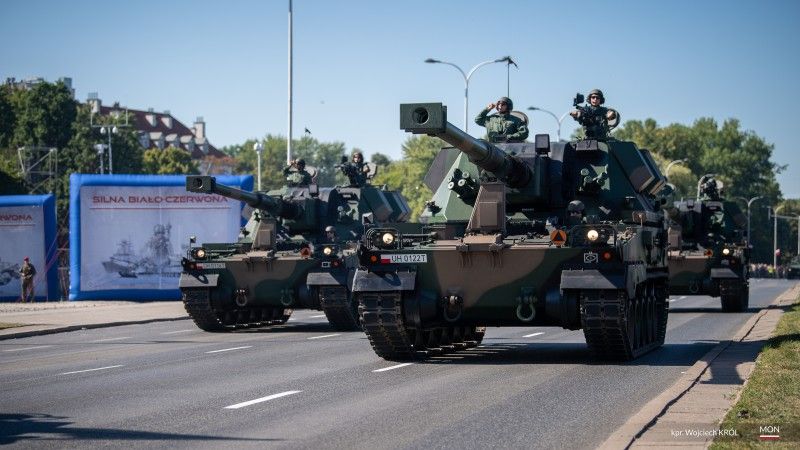
Is Poland Ready for War? This question appears increasingly often in public debate. In their latest book, Defence24.pl editors Wojciech Kozioł and Bartłomiej Wypartowicz seek to provide an answer by examining the geopolitical landscape, the modernisation of Poland’s armed forces, and the current state of civil defence.
Defence24 is the media patron of the book
“The War We Don’t Want” is a book written by Defence24.pl editors Wojciech Kozioł and Bartłomiej Wypartowicz. They attempt to present the state of Poland’s preparedness in the event of an armed conflict. The authors point out fundamental shortcomings and mistakes made over the past 35 years, while outlining the areas on which Polish authorities should focus to enhance the nation’s security.
According to the authors, for more than fifteen years after joining NATO and the European Union, it might have seemed that Poland had entered a calm and predictable stage of its history. For many elites - both in Warsaw and Brussels - it was a moment of the “end of history.” From today’s perspective, we know that this was a dangerous illusion. The world began to change much earlier than we were willing to admit. The attack on the World Trade Center in 2001 triggered a series of events in which the United States became involved in costly conflicts - from Afghanistan and Iraq to North Africa - often with results far from the expected success.

Under Vladimir Putin’s rule, Russia gradually returned to its neo-imperial ambitions: first Chechnya, then Georgia, and finally Ukraine. At the same time, it enticed Europe with the slogan “business as usual” while expanding its influence across the Global South. Meanwhile, after the 2008 financial crisis, China rapidly rose to become America’s primary strategic rival. And Europe? Many Euro-enthusiasts described that period as one of “stable growth” and “sustainable development.” In practice, it resembled the complacency of the nobility of the Polish–Lithuanian Commonwealth - a passivity that ultimately led the old Polish state to collapse.
The authors argue that many of these mistakes could have been avoided. It would have been enough to look at reality soberly and adjust policies to changing circumstances instead of pretending the world stood still. Europe chose to disarm its armies, become dependent on Russian energy, and pursue an open migration policy. No one forced it to do so. Amid this global turmoil, Poland does not fare the worst. We have made our own mistakes - especially in eastern and regional policy - but we are making up for many of them. Since 1989, Poles have done tremendous work: today, the Third Polish Republic is among the world’s twenty largest economies, consistently modernizing itself, with strong prospects for further growth. This is no coincidence but the result of hard, systematic effort. Yet the greatest challenge now lies not in external factors but in how we perceive ourselves.
Ukraińcy swoim uporem "kupili" nam czas. Co Polska zrobiła z tym czasem przez cztery lata wojny? Czy dziś jesteśmy gotowi na sytuację, której jeszcze niedawno nie chcieliśmy nawet brać pod uwagę?
— Wydawnictwo Prześwity (@Przeswity) March 27, 2026
W nowej książce @KoziolWojciech i @WypartowiczBa analizują zmieniającą się… pic.twitter.com/HtweOor9Bn
For decades, many of us - especially parts of the elite - have viewed Poland as an “unattractive bride without a dowry,” a peripheral state doomed to play a subcontractor’s role. That narrative made sense in the 1990s, when we were emerging from deep underdevelopment. Today, it is outdated and harmful. Peripherality is no longer a fact - it has become a complex that paralyzes ambition. Objective data tell a different story. Poland is no longer catching up with Europe - it is co-creating its growth dynamic. We are located at the strategic center of the continent, at the crossroads of East and West, North and South. Key transport, energy, and logistics corridors run through our territory. We are a natural regional hub - a country that cannot be bypassed. As the largest state in Central and Eastern Europe, a key element of NATO’s eastern flank, and a logistical base for Ukraine, Poland carries far greater weight than smaller countries in the region. Much has changed since Russia’s invasion of Ukraine in 2022.
Suddenly, the world discovered that there are no bears roaming Poland’s streets, that life and investment here are good, and that our entire region is gaining importance as a stable, dynamic, and secure area. Even the United States increasingly recognizes that the future of its engagement in Europe lies precisely in Central, Eastern, and Northern Europe - a fact confirmed by the latest U.S. National Security Strategy of December 2025. This is no longer just an external assessment.
See also 
We ourselves are beginning to understand it. Initiatives such as the Bucharest Nine, the Three Seas Initiative, and Nordic-Baltic cooperation formats demonstrate a growing sense of shared interests. Ironically, Russia - by trying to divide us - has achieved the opposite effect: the greatest regional consolidation in years. Yet the deeper question remains: does Poland want to be merely a solid regional player, or is it ready to become a core state of Europe?
Will we continue to define ourselves through shortcomings and complexes, or will we finally recognize our own strengths - our geographic position, growing economic power, and ability to initiate processes? The emerging era of multipolarity will no longer be a world of a single hegemon. A new, more complex balance of power is taking shape, in which civilizational and cultural blocs play an increasingly important role. Poland, rooted in Western civilization for over a thousand years, remains geographically a bridge between East and West. If we can harness this - by realistically assessing our strengths and weaknesses—we have a genuine chance to become one of the key nodes of a new, polycentric Europe.

Poland has no need to imitate Germany or France, for it possesses its own universal tools and advantages that can attract cooperation and foster development. Our position also elevates the significance of the entire Central and Eastern European region and NATO’s eastern flank. This is recognized not only by us but also by the U.S. administration, as reflected in the new National Security Strategy.
The Polish state must take all these factors into account in a world that is visibly changing before our eyes—perhaps returning to a new “concert of powers,” though one very different from that of the 19th century. Back then, it was a rivalry among European powers - nations that thought alike, believed alike, and read the same philosophers. The current situation is entirely different, and new geopolitical blocs are emerging—unlike those envisioned by Huntington or Koneczny: a Western bloc led by the United States; an anti-Western bloc headed by China and Russia; and a third group seeking to reshape the international order, though not explicitly anti-American or anti-Chinese.
See also

This is precisely why”The War We Don’t Want” stands out as a particularly valuable contribution to the ongoing debate. It not only diagnoses key challenges, but also opens broader perspectives on how Poland should think about its future in a changing world. It is a highly recommended read, opening very interesting horizons and particularly important for understanding the current security dynamics of Poland and the wider Central and Eastern European region.
Defence24 is the media patron of the book


