- ANALIZA
- WIADOMOŚCI
NATO intern arrested on suspicion of espionage

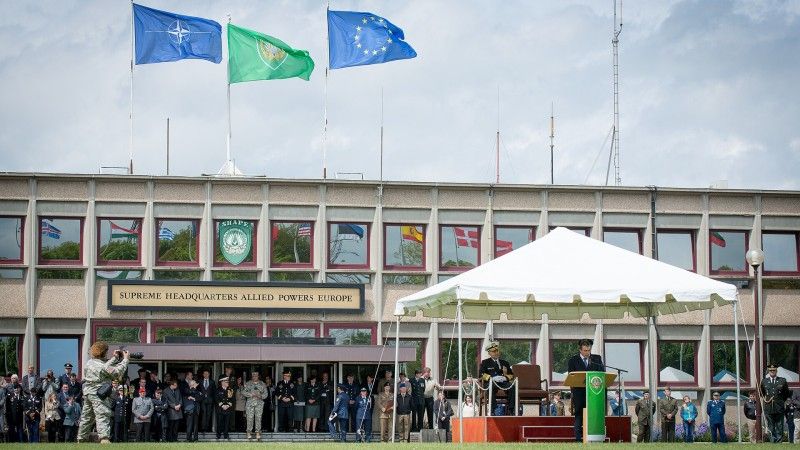
Photo. Sgt. 1st Class John Laughter / Wikimedia Commons
The arrest of an intern working at NATO’s main military headquarters in Belgium shows that the threat of espionage does not concern only classified documents or senior officers. Access to personnel, internal procedures and everyday activity may also provide foreign intelligence services with information that can later be used against the Alliance.
According to the Belgian Federal Prosecutor’s Office, police arrested a Canadian national of Chinese origin who had been working as an intern at Supreme Headquarters Allied Powers Europe in Mons. She is suspected of spying on behalf of an unnamed third country and of belonging to a criminal organisation. Her home and workplace were searched, although prosecutors have not disclosed what information she allegedly collected or for whom she was working.
It must be underlined that the woman has only been arrested and has not been convicted. Her Chinese origin does not prove that she was working for Beijing, particularly because the Belgian authorities have deliberately not identified the state concerned. Nevertheless, the case is significant because SHAPE is responsible for the planning and execution of NATO operations and remains one of the most important military headquarters in Europe.
The suspect reportedly first came to the attention of SHAPE’s own security services, which later informed Belgian intelligence. NATO stated that operational readiness, command-and-control arrangements and ongoing tasks had not been affected. This is important, but it does not remove the need to establish what level of access the intern possessed and whether information was collected before the intervention.
See also 

NATO remains a major intelligence target
This is not an isolated incident. In Poland, Wiktor Ź. was accused of passing information concerning NATO’s Joint Force Training Centre in Bydgoszcz and other military facilities to Russian intelligence. A foreign national detained by the Polish Internal Security Agency was described as a military intelligence officer conducting operations against Poland and the military structures of other NATO states. In Germany, Sergej K. was accused of photographing NATO military convoys and collecting information about assistance to Ukraine, while a Russian-linked Bulgarian network convicted in the United Kingdom conducted surveillance operations across several European countries. In the United States, former military personnel have also been sentenced for transferring sensitive defence information to individuals connected with China.
These cases are different and should not be treated as one coordinated operation. Some concern Russia, others China, while several remain at the stage of allegations rather than final court judgements. On the other hand, they demonstrate that NATO is targeted not only through cyberattacks and satellite reconnaissance, but also through individuals who have legitimate access to offices, military installations and political institutions.
An intern may not have access to the most highly classified operational plans. However, intelligence work does not depend exclusively on obtaining one secret document. Internal contact networks, organisational structures, security routines, travel patterns and seemingly insignificant information can be combined to provide a much broader picture. In this context, a person in a junior position may still be valuable to a foreign service.

The Alliance must therefore examine not only access to classified material, but also the entire process of recruiting, screening and supervising personnel. NATO employs and cooperates with thousands of civilians, military officers, contractors and trainees from across the member states. This openness is necessary for the organisation to function, but it also creates opportunities for hostile intelligence services.
I reckon that the arrest in Belgium does not mean that NATO’s operational structures were successfully penetrated. It does, however, show that the Alliance remains under constant observation and that even temporary personnel may become part of an intelligence operation. Russia, China and other states will continue to search for the weakest points, not necessarily at the highest level, but wherever access is easier and vigilance is lower.