- ANALIZA
- WIADOMOŚCI
New secret drone bases in Russia? That's baseless fearmongering

Information has begun appearing in the media regarding “20 new secret Russian drone bases” whose range is said to cover NATO member states, including Poland. The starting point for these publications is an article in the British newspaper The Telegraph, which, based on satellite imagery, documents, and OSINT analysis, described the expansion of Russian infrastructure intended for operating unmanned aerial vehicles (UAVs).
Earlier today, Defence24.com published an article claiming that “the Russian Federation has installed several secret bases capable of launching drones deep into NATO territory.” According to The Telegraph, a total of 59 new launch rails were identified across at least 10 Russian facilities, approximately 20 of which are reported to be longer and likely intended for new variants of Russian drones. The problem lies in the fact that, within the information space, these new launch positions have been misidentified as “new secret bases”. This is a fundamental distinction which, in this case, creates a narrative that does not correspond to what the available data actually shows.
We are not, in fact, dealing with the construction of 20 new drone bases from scratch. Russia has possessed these bases and an extensive network of sites used for operating Shaheds/Gerans for years. As early as April 2023, the Ukrainian Air Force pointed to Shahed launches from the area of the Seshcha airfield, and in August of the same year, reports were made regarding the use of Seshcha, Primorsko-Akhtarsk, and Kursk—locations currently being presented as “incredibly secret bases”.
Therefore, it is not the case that in 2026 the Russians suddenly created a new network of bases in the western part of the country that did not exist before. They have been operational there for several years. Existing sites are being expanded and adapted to the increasing scale of UAV employment and new types of machinery. This is the most important information resulting from the satellite imagery analysis—not that Russia is suddenly building bases somewhere close to NATO.

Not new bases, but new infrastructure
In the case of the facilities described by The Telegraph, a distinction must be made between two things: the basing location and the infrastructure situated on its grounds. A base or airfield may have been functional for many years. It may have been used by the Russian military and, since 2023, also as a site for preparing and launching drones. If the Russians build additional guide rails, warehouses, or auxiliary infrastructure there in 2026, it does not signify the creation of a new base. It signifies the modernisation of an existing facility. This perhaps needs to be explained to several media outlets in Poland; then, maybe, the sensationalising of everything under clickbait titles will cease.
A good example is Tsymbulovo in the Oryol Oblast. The facility has been known since 2022 as a Russian centre used for operating Shaheds and subsequently Gerans. In November 2025, satellite imagery analysis already indicated at least 93 garages, 15 storage facilities, and eight permanent launch positions there. The entire complex occupied over 5 km². In 2026, a new secret base was not “discovered” in Tsymbulovo. Rather, another stage of its expansion was observed. In April 2026, new positions intended for jet-powered variants of the Geran appeared there. These new guide rails mentioned in The Telegraph article are adapted for the Geran-3/4 and Geran-5 and are approximately 80 metres long—roughly three times longer than the positions used by older models.

Why are the guide rails so long?
The answer is relatively simple: it concerns the characteristics of the new drones. The classic Geran-2 is a significantly smaller and slower UAV with a piston engine and a propeller. New variants, such as the Geran-3, Geran-4, and Geran-5, utilise jet propulsion and are significantly faster, with the Geran-5 also being considerably larger and heavier. A long guide rail allows the machine to achieve the necessary speed during take-off and safely manage the initial flight phase before the UAV transitions to independent flight.
Another problem with some publications is the grouping of all new Gerans into one category. The Geran-4 is already in combat use. According to Ukrainian intelligence data, its maximum range is approximately 770 km, with a maximum speed of 350 km/h and a cruising speed of around 320 km/h. Therefore, the Geran-4 cannot be presented as a design with a range of 1,000 km, as it simply does not possess such a capability.
Even more important than the Geran-4 itself in this context is the Geran-5. This is not merely another standard modification of the classic Shahed-136, but a much larger, jet-powered strike UAV whose design brings it closer to a low-cost cruise missile in terms of employment. According to Ukrainian intelligence data, the Geran-5 has a take-off weight of approximately 850 kg, a cruising speed of 450–600 km/h, a flight time of about two hours, and a declared range of up to 950 km. The machine uses a turbojet engine with approximately 200 kgf of thrust and can carry a warhead weighing about 90 kg.
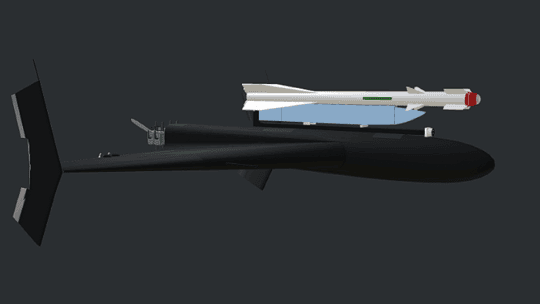
However, what is particularly significant regarding the entire story of “extended rails” and “UAVs that suddenly have Warsaw within reach” is that the Geran-5 can be launched in more than one way. The UAV can take off from a ground platform, but also from an aerial one. Ukrainian intelligence reported as early as January 2026 that the Russians had developed the capability to launch the Geran-5 from Su-25 aircraft. The IISS (International Institute for Strategic Studies) also indicated that Russia possesses the capability to use the Su-25 as a carrier for new Geran variants.

The Geran-5 can be air-launched
This is of fundamental importance for the interpretation of The Telegraph’s material. Even if we accept the most alarmist interpretation of the British report and assume the objective were to use the Geran-5 to attack Warsaw, Russia does not need to build a special ground base anywhere near its western border to increase the range of such a strike. It is sufficient to change the point from which the flight begins. If the Geran-5 is carried by an Su-25 and released in mid-air, it does not require a ground-based, several-dozen-metre-long guide rail to commence its flight. The aircraft can take off from an existing airfield, for instance, somewhere in Belarus, climb to the appropriate altitude, fly a certain distance, and only then release the UAV. Only from that moment does the Geran-5 begin its own flight to the target. Consequently, the stationing or launch site of the drone itself does not have to be identical to the take-off site of its carrier.
If the argument is: Russia is building new launch positions near the western border because they allow the new drones to attack Warsaw, then a fundamental question must be asked: are these positions actually necessary to achieve this effect? In the case of the Geran-5, the answer is: not necessarily. This leads to a primary question: what, then, do the new, extended guide rails actually show?
Primarily, they show that Russia wants the capability to launch new, heavy, and fast UAVs from the ground in larger quantities. This is important information in itself. It signifies greater flexibility, the ability to disperse launch sites, and an increase in the number of machines being prepared simultaneously. It does not, however, mean that without these rails, Russia would be unable to carry out an attack on targets hundreds of kilometres away. That is a fabrication by The Telegraph and the Polish media outlets that copy these revelations.
At this point, another overinterpretation arises. Yes, Russia possesses drones with a range that can potentially cover targets located on the territory of NATO states. But it does not automatically follow that a specific Russian base is prepared for an attack on Warsaw. To reach such a conclusion, one must know the exact location of the position, the specific type of drone, its configuration, warhead mass, actual flight profile, and true combat range. Simply drawing a circle with a radius of 950 or 1,000 km on a map is not proof of operational capability. Those reading this likely know what I am hinting at. There is even less evidence of any intent to use this capability, as technical possibility does not equate to operational intent. Even The Telegraph itself admits, moreover, that there is no evidence that Russia is planning such an attack.