- WIADOMOŚCI
- ANALIZA
North Korean prisoners of war trigger tensions between Seoul and Kyiv

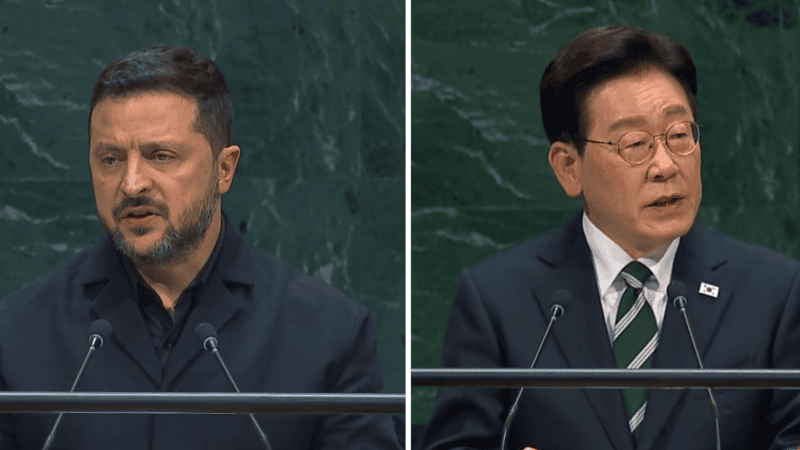
Photo. Screenshots taken during a UN General Assembly broadcast.
Two North Korean soldiers captured fighting for Russia have unexpectedly become a source of tension between South Korea and Ukraine. Their transfer to Seoul was supposed to remain confidential. Instead, Ukrainian President Volodymyr Zelenskyy announced it from the podium of the United Nations General Assembly, prompting an unusually direct response from South Korean President Lee Jae Myung.
The two North Korean soldiers were captured by Ukrainian forces in Russia’s Kursk region in January 2025, after Pyongyang deployed thousands of troops to support Moscow. Both subsequently expressed a desire to go to South Korea, prompting months of consultations between Seoul and Kyiv. South Korea regards North Koreans as citizens under its constitutional framework and had signaled that it was prepared to accept soldiers who voluntarily chose resettlement.
The transfer eventually took place quietly. That changed on September 23, when Zelenskyy told the UN General Assembly that Ukraine had “recently” sent the two prisoners to the Republic of Korea. He used their experience to illustrate the nature of the North Korean regime and Pyongyang’s involvement in Russian aggression.
For Kyiv, the political logic of highlighting the case is understandable. Living North Korean soldiers provide particularly powerful evidence of Pyongyang’s direct military involvement alongside Russia. Their story also strengthens the argument that the war is not simply a European conflict but increasingly involves security actors from Asia.
For Seoul, however, publicity was precisely what it had sought to avoid.
President Lee publicly expressed regret over Zelenskyy’s announcement, saying that South Korea and Ukraine had agreed not to disclose the transfer. He described the issue as highly sensitive because of its possible consequences for national security and the situation on the Korean Peninsula. Seoul had previously declined to confirm the soldiers’ arrival, also partly because of concerns for their safety and that of their families remaining in North Korea.
The situation is somewhat more complicated than a straightforward diplomatic leak. A South Korean presidential official subsequently acknowledged that Kyiv had informed Seoul beforehand that Zelenskyy intended to mention the transfer. Yet, Ukraine provided only vague information about how the issue would be presented, while Seoul most probably believed the previous understanding on confidentiality remained in place.
Kyiv has offered a different interpretation. The Ukrainian presidential office stressed that it would be difficult to keep the entire transfer a secret, and that Zelenskyy did not disclose sensitive details of the process.
A potential problem for Lee's strategy towards North Korea
The controversy also quickly entered South Korean domestic politics. Opposition People Power Party lawmakers questioned why South Koreans had first learned about the soldiers’ arrival from the Ukrainian president rather than their own government.
Lee strongly defended secrecy. His argument was essentially that foreign and security policy should be conducted according to the national interest rather than used to generate favorable headlines. Publicizing the successful transfer could undoubtedly have been politically advantageous for his administration, but Seoul concluded that the risks outweighed those benefits.
That calculation also fits Lee’s broader North Korea policy. His administration is attempting to reduce tensions and restore channels of communication with Pyongyang. Lee has advocated a gradual approach to the nuclear issue and argued for confidence-building measures rather than relying exclusively on pressure.
Before Zelenskyy’s announcement, the possibility that captured North Korean troops might eventually reach South Korea existed largely in the realm of diplomatic speculation. Now there is a confirmed precedent.
Pyongyang can potentially turn the two soldiers into symbols of what it portrays as hostile South Korean activity. If Seoul attempts to reopen dialogue with the North, their status could become another point of contention or even a demand in future negotiations.
Returning them to North Korea, however, would be extraordinarily problematic. Both reportedly expressed a wish to settle in South Korea, and forced repatriation could expose them to severe punishment. Seoul consequently faces a situation in which humanitarian obligations, its constitutional understanding of Korean nationality, national security and its policy toward Pyongyang intersect.
See also 

South Korea's careful support for Ukraine
The diplomatic disagreement should nevertheless not be mistaken for a broader crack in South Korea-Ukraine relations. Seoul has supported Kyiv since the beginning of Russia’s full-scale invasion, although it has been considerably more cautious than many Western partners about lethal assistance.
South Korea has provided non-lethal military supplies, including helmets, bulletproof vests and combat rations, while becoming considerably more involved in humanitarian assistance. South Korea has delivered engineering and medical equipment, medicines, generators and energy-related supplies, as well as other support for Ukraine’s civilian infrastructure. Altogether, South Korean assistance has amounted to several hundred million dollars, provided both directly and through international organizations such as the WFP and UNICEF.
Support has not been limited to the central government. South Korean local authorities have also contributed: the Seoul Metropolitan Government provided $200,000 in humanitarian assistance through the Ukrainian Embassy in Korea and later donated ambulances and fire engines, while Ulsan contributed approximately $70,000 through the FAO. The latter funding was used to provide irrigation equipment kits to 500 farms in Ukraine’s Odesa region.
Military assistance has not been possible. Yet, in 2023, the South Korean government agreed to lend the United States 500,000 rounds of 155 mm artillery ammunition, giving Washington greater flexibility to draw on its own stocks in supporting Ukraine. South Korean policy and legal constraints have made direct transfers of lethal weapons to a country at war politically difficult.
This makes the latest disagreement revealing rather than necessarily transformative. Seoul and Kyiv share significant interests, not least because Russia and North Korea have developed a military partnership that affects the security of both countries. But they do not always view that challenge through the same lens.
For Ukraine, North Korean involvement is part of its effort to demonstrate the increasingly international character of Russia’s war. For South Korea, every decision involving North Korean citizens is also part of a seventy-year-old unresolved conflict on the Korean Peninsula.
The two captured soldiers now stand at the intersection of those realities. Their transfer shows how closely European and Korean security have become connected, while the controversy surrounding its disclosure demonstrates how difficult managing that connection can be.