- WIADOMOŚCI
- KOMENTARZ
Pentagon’s Colby presents plan for a stronger NATO

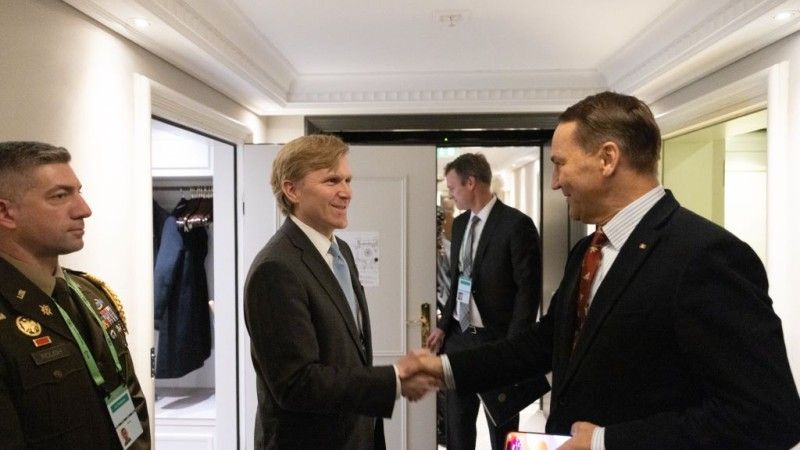
The United States will not leave Europe, but without a proper increase in the Old Continent’s commitment to its own security, NATO will no longer make sense – this is, in short, how one can summarize the recent and significant speech delivered by the third-ranking official at the Pentagon, Elbridge Colby.
On Thursday, a meeting of NATO defenCe ministers was held at NATO headquarters in Brussels. The speech by U.S. Under Secretary of Defence for Policy Elbridge Colby, who called on NATO to be based on „partnership, not dependency,” resonated widely.
The Under Secretary of Defence for Policy represented Secretary of Defence Pete Hegseth during the meeting of NATO defense ministers in Brussels. Colby spoke about the direction NATO should take today, furthermore he elaborated on what the relationship between the United States and the European members of the Alliance should look like.

New world order?
Rubio said recently that the world is changing very fast right in front of us, adding the old world is gone. He reiterated that we live in a new era in geopolitics, and it’s going to require all of us to sort of re-examine what that looks like and what our role is going to be. These words closely align with what Colby presented, as he sought to explain how NATO should operate today.
.@SecRubio: "The world is changing very fast right in front of us. The old world is gone ... We live in a new era in geopolitics, and it's going to require all of us to sort of re-examine what that looks like and what our role is going to be." pic.twitter.com/wgPrl2xJZC
— Department of State (@StateDept) February 13, 2026
At the beginning of his remarks, Colby referred to the U.S. National Security Strategy and the National Defence Strategy (which he co-authored). He stated that, as both documents indicate and as Rubio noted, we are currently witnessing significant strategic changes worldwide. In turn, this requires hard realism and the ability to adapt. Colby noted that the unipolar world order shaped after the Cold War no longer exists. Instead, what we are witnessing is the return of „power politics” and a stronger use of armed forces to pursue political interests.
Colby emphasized, adding that the United States and its allies must be prepared for potential adversaries acting simultaneously across multiple theaters, elaborating on this, suggesting such actions could be more calculated and coordinated.
Colby also stated that times have changed, and the reasonable course of action is to adapt, stressing that this does not mean the United States wants to leave NATO. On the contrary, it means returning to the Alliance’s roots.
Colby noted that the Alliance was founded in the late 1940s to provide strong, credible, and fair defense of the North Atlantic area. Throughout the Cold War, »NATO 1.0,« as he referred to it, was characterised by a tough, realistic, and sober approach to deterrence and defence. From the outset, Colby continued, allies were expected to meet their obligations, as reflected in Article III of the Washington Treaty and the 1951 Lisbon commitments. He added that „difficult conversations” about burden-sharing have always been a natural part of the Alliance.
This strategy, Colby argues, worked for over four decades and ensured that the Soviet Union never considered military aggression against the Western Alliance a viable strategy.

NATO 2.0 - burning issues and the necessity to upgrade to 3.0
According to Colby, NATO’s current problem is that after the Cold War, this model ran its course and the Alliance evolved into „NATO 2.0.” Under this concept, the Alliance focused more on out-of-area operations beyond Europe, which – inevitably – contributed to Europe’s gradual disarmament. The current situation requires a completely different approach. Colby’s proposal is to create a NATO 3.0 model – one that more closely resembles what the Alliance was during the first decades of its existence.
Colby continued, saying NATO 3.0 requires the allies to make far greater efforts and assume primary responsibility for the conventional defense of Europe. This does not, as he wrote, mean a unilateral focus solely on military strength, pointing to the need to combine military efforts with diplomacy.
In his view, 2025 marked a turning point in setting the right course for change, notably at the NATO Summit in The Hague, where allies committed to significantly increasing defense spending (by 2035, NATO members are to spend at least 5% of GDP on defence). The European member states must fulfill these commitments and take greater responsibility for collective defense, especially since – as Colby notes – they possess the necessary economic and other capabilities.

After Friday’s meeting in the Oval Office there were reports that U.S. Cyber Command had suspended operations against Russia. Now the Pentagon has denied those reports.
The United States, he stressed, must and will prioritize areas where only American power can play a decisive role, in line with the National Defense Strategy. This is not a withdrawal from Europe, Colby noted, but rather a recognition of Europe’s undeniable capacity to take the lead in its own defence - in a way that would make NATO stronger and far more secure. Colby wrote that by leveraging NATO’s respective strengths and specializing in the areas where the organization is best positioned to act, the partners can build a more sustainable, effective, and resilient alliance, emphasizing the shift in priorities that took place during the presidency of Donald Trump. At this point, Colby recalled what he had previously pointed out, among other places, in the National Security Strategy — namely that the Indo-Pacific is for the United States the central geopolitical theater of paramount importance to the security, economic vitality, and technological leadership of the United States.
He noted that Europe should possess the preponderance of forces necessary to deter, and if necessary defeat, conventional aggression, explaining that this means not only increasing defense spending, but also ensuring proper military readiness, large stockpiles of ammunition, well-functioning logistics, and integrated command structures.
Colby stated that measure of seriousness is whether European forces are able to fight, sustain themselves, and prevail in the scenarios that matter most for the defense of the Alliance, announcing „honest” communication between the United States and its European allies.
USA and its role
The third-ranking official at the Pentagon also listed U.S. commitments toward its allies. These include extended nuclear deterrence and the provision of conventional capabilities that will contribute to the defense of NATO (though in a more „limited and targeted scope”).
Colby said the US is committed to be frank towards NATO, both regarding the timeline and scale of the changes, as well as the challenges and trade-offs that the partnering entities face. The US will continue to train, exercise, and plan together with its allies, Colby added, also saying the Department of War will continue to prepare the US forces to fulfill our Article V obligations, with Europe taking the lead in conventional defence.
Toward the end of the speech, he also expressed appreciation for some U.S. allies (unfortunately not named by Colby — ed.). The US official noted that the encouraging news is that signs of significant progress have already become visible, with several European allies substantially increasing defence spending. Colby noted others are reforming procurement and combat readiness systems that had long been neglected. He appreciated the outstanding leadership of General Grynkewich and Admiral Vandier, saying NATO’s defence planning process is becoming more demanding, more operationally driven, and more focused on real warfighting requirements.

What the future may bring?
The American strategist also outlined plans for 2026. In his view, Europe should already be capable of serving as the primary conventional defender of its own theater of operations. The United States would play a supporting role. According to Colby, NATO itself should be a militarily credible, politically durable, and strategically realistic alliance. Transatlantic relations, he noted, should be defined not by dependency or unrealistic declarations, but by shared strength rooted in flexible realism.
He also said that this future cannot be achieved through mere declarations alone. It will require sustained political will, investment, and consistent action, he continued, also noting the necessity to hold uncomfortable conversations and reach difficult compromises. He stated that it would be desirable to have a shared understanding that the essence of NATO lies not in symbolism or abstract aspirations, but in deterrence — and if deterrence fails, in effective defense that secures a better future for all involved nations. Elbridge Colby declared the United States« readiness walk this path together with the European partners, adding that partnership, by definition, means walking this path together — each of the parties involved bearing a fair share of the burden. Colby said that we must — and the United States will insist on this — hold one another accountable for fulfilling our commitments. He stated that in that spirit, the US looks forward to the fifth stage of the NDPP and the suitability and risk assessment conducted by the Deputy SACEUR, to be published upon completion of the fifth stage.
See also