












- ANALIZA
- WIADOMOŚCI
Russia and Belarus preparing for escalation with Ukraine and NATO

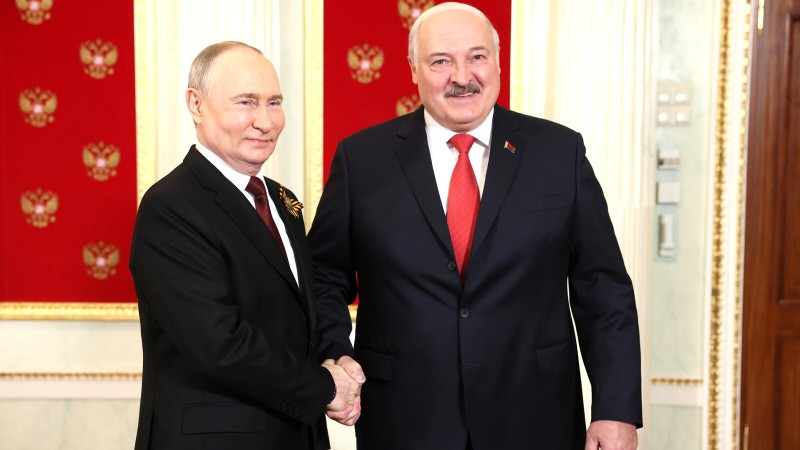
President Zelenskyy warns the West that Russia is seeking ways to draw Belarus deeper into the war against Ukraine. Not only that, Moscow is supposedly examining operational plans for actions from Belarusian territory against a NATO member state.
On May 15, following consultations with the leadership of the Ukrainian Armed Forces (AFU) General Staff, the Defence Intelligence of Ukraine (HUR), the Foreign Intelligence Service, and the Security Service of Ukraine (SBU), Ukrainian President Volodymyr Zelenskyy stated that Russia is seeking to draw Belarus more deeply into the war against Ukraine. Zelenskyy also said that Russia is examining operational plans for actions from Belarusian territory against either Ukraine or a North Atlantic Treaty Organisation (NATO) member state. Ukraine says it has obtained intelligence regarding ongoing negotiations between Russian and Belarusian leadership on this matter. According to this intelligence, Russia is assessing operational plans to be launched from the southern or northern borders of Belarus—either against the Chernihiv–Kyiv axis in Ukraine, or against a NATO member state. Zelenskyy cautioned that Ukraine would defend itself should Belarusian President Alyaksandr Lukashenka allow these operations. Zelenskyy has directed Ukraine’s Defence Forces (UDF) to reinforce Ukraine’s border with Belarus and to submit a contingency plan. Zelenskyy’s statements came in the wake of a telephone conversation between Lukashenka and Putin, during which the two leaders discussed defence cooperation.
AFU Commander-in-Chief General Oleksandr Syrskyi regards the threat of a Russian offensive from Belarusian territory as credible. According to Syrskyi, the Russian General Staff is actively war-gaming and planning offensive operations from the Belarus–Ukraine border with the objective of stretching the front line to exploit Russia’s numerical superiority in manpower and equipment.

According to Ukrainian intelligence, the Russian General Staff is developing five scenarios for expanding the war through northern Ukraine. These plans may encompass both the use of Belarusian territory in proximity to the Russian border and operations conducted directly from Russian soil without Belarusian involvement. According to Ukrainian intelligence assessments, the most credible of these five scenarios—should Russia decide to launch a new offensive operation—is an attempt to establish a buffer zone in the Chernihiv Oblast extending 10 to 20 kilometres (6 to 12 miles) into Ukrainian territory. The least credible scenario is an advance on Kyiv. Under all potential courses of action, the Russian Armed Forces would not be able to initiate offensive operations before autumn at the earliest. To this end, the Kremlin is planning a new mobilisation wave of an additional 100,000 soldiers.
On May 21, Zelenskyy visited Slavutych in northern Ukraine, where he met with the heads of the Kyiv and Chernihiv oblasts. He stated that Ukraine is reinforcing its defences along its northern border with Belarus, including its protective infrastructure and the defence and security forces deployed in that direction. Zelenskyy noted that Ukraine possesses the capability to act pre-emptively against Russian territory from which threats may emanate, and against the Belarusian leadership. The next day, in Rivne, he said that there is a threat of an attack from Belarus against Volyn, Zhytomyr, and Rivne oblasts in addition to the Kyiv and Chernihiv oblasts. Ukraine receives some supplies from Western partners through these regions, making a potential attack particularly problematic. Moreover, the Rivne Nuclear Power Plant, which supplies electricity to Kyiv and surrounding areas, is located just 60 kilometres (37 miles) from the border with Belarus. Russian control over this area would open the way for the encirclement of Kyiv and create a potential axis of advance toward the Lviv Oblast—a key logistics hub via which Ukraine gets almost all military and economic support from the West.
Kyiv has already transmitted the relevant intelligence through diplomatic channels to its NATO partners and has tasked the relevant agencies with developing diplomatic pressure and conveying direct signals to the Belarusian leadership. According to Ukrainian intelligence assessments, activity along the Chernihiv–Kyiv axis and the overall threat level from Belarus remain low. Ukrainian leadership is, however, tracking several indicators that may point to Russian preparations for potential offensive action there.

The first indicator is that four battalions—approximately 1,900 troops—of the Belarusian Armed Forces (BAF) remain deployed on a continuous rotation basis at the Belarus–Ukraine border. At present, however, there are insufficient Russian forces on Ukraine’s border with Belarus or in Russia’s Bryansk Oblast to conduct offensive operations. The second indicator, which has not yet been openly observed, is an intensification of reconnaissance and sabotage-reconnaissance activity on the part of Belarus and Russia along the axis of a potential strike.
The third indicator is Belarus’s expansion of logistics routes and the construction of training ranges and bases near its border with Ukraine that could be utilised by Russian forces within the framework of their Union State treaty. Ukrainian intelligence indicates that road construction toward Ukrainian territory and the preparation of artillery positions are underway in the Belarusian border zone. Ukraine has also reported that Russia has deployed ground control stations for long-range drones in Belarus for strikes against Ukraine’s Kyiv Oblast. Furthermore, Serhii „Flash” Beskrestnov, adviser to the Ukrainian Ministry of Defence on defence technologies, stated that Russian Shahed-type unmanned aerial vehicles (UAVs) are utilising Belarusian cellular roaming in the border area during strikes against Ukraine. During recent large-scale strikes against Ukraine, Russia once again used Belarusian airspace for drone transit. Russia could therefore once again employ air attack assets on a large scale from Belarusian territory—especially given their significant qualitative and quantitative expansion compared to 2022—even without deploying ground forces into Ukraine. Russia and Belarus are close to completing the implementation of two new military infrastructure programmes, indicating preparations for a larger-scale conflict. These were developed because of operational shortcomings encountered during the first phase of Russia’s full-scale invasion of Ukraine launched from Belarusian territory in 2022:
- Improvement of military infrastructure facilities designated for joint use in support of the Regional Troops Grouping (RTG) of the Republic of Belarus and the Russian Federation in 2023–2026;
- Modernisation of rear support facilities designated for joint use in support of the RTG of the Republic of Belarus and the Russian Federation in 2023–2027.
The fourth indicator comprises joint Belarusian–Russian nuclear exercises. Some of these exercises have taken place on Belarusian territory, designed as a demonstration of force as well as preparation for nuclear strikes directed at Ukraine and neighbouring NATO member states. Under the cover of such exercises, Belarusian and Russian forces may increase their troop presence along Ukraine’s borders. To this end, and for the purpose of rehearsing joint operations, Belarus and Russia may attempt to conduct additional unscheduled exercises similar to Zapad-2025 or Soyuznaya Reshimost-2022 (Union Resolve-2022), which served as cover for the large-scale concentration of Russian forces ahead of the full-scale invasion of Ukraine in February 2022. Putin has already announced a joint exercise with Belarus designated Schit Soyuza-2027, and the possibility of a snap exercise along the lines of Soyuznaya Reshimost-2022, which the Kremlin used as cover to mass troops, equipment, and logistics in Belarus for the full-scale invasion of Ukraine from February 10–20, 2022, cannot be ruled out. In such a scenario, the primary indicator of preparations would be the planning of a mass railway transfer of Russian forces into Belarus. The redeployment of a 100,000-strong grouping would require approximately three to four weeks and some 15,000 railcars and flatcars—at least twice the volume recorded ahead of the Soyuznaya Reshimost-2022 exercise.
See also 

In April, former Ukrainian Foreign Minister Dmytro Kuleba said that Belarus is systematically preparing for military escalation and is examining the possibility of opening a second front against Ukraine or the Baltic states under Russian direction. He identified five key signs of Belarusian military preparation: continuous combat training conducted under Russian instructors, an emphasis on combat mobilisation readiness, large-scale command-and-staff exercises, the reinforcement of air defences with Russian systems, and the deepening of command coordination between Russian and Belarusian military structures. According to Kuleba, Moscow views the potential activation of the Belarusian front as a way to stretch AFU resources, compelling Kyiv to redeploy experienced units from other sectors of the front line to defend the northern border. Kuleba does not exclude the possibility that Belarusian military activity may be directed at intimidating the Baltic states and Poland, generating additional pressure on the region in the event of further Russian escalation.
Moscow may be pursuing several additional objectives simultaneously. Preparations in Belarus are an element of Putin’s plan to establish a „buffer zone” around Russia’s border with Ukraine. The Russian president assigned this objective to his military commanders two years ago. Military buildup in Belarus also creates psychological pressure on the Ukrainian population, with the aim of rendering Kyiv more amenable to Moscow’s terms. Finally, should Putin ultimately decide to advance on Kyiv from Belarus, he would attempt to decapitate and seize Ukraine’s military–political leadership. Currently, however, this scenario appears to be the least probable.
In a May 21 statement, Lukashenka was quick to assert that he has no intention of attacking neighbouring states and even proposed holding talks with Zelenskyy to dispel Ukrainian concerns. He stated that Belarus would be drawn into Russia’s war against Ukraine only if aggression were committed against its territory. In such a scenario, Belarus and Russia would conduct military operations jointly. Given that Belarusian political and military leadership was involved in a strategic disinformation campaign denying even the possibility of an attack being launched from Belarusian territory in the run-up to Russia’s full-scale invasion of Ukraine in 2022, such assurances are met with little trust in Kyiv.

If Russian forces use Belarusian territory as a staging ground for an attack on Ukraine, the Armed Forces of Ukraine would then conduct retaliatory strikes against Belarusian territory, thereby „legitimising” the involvement of the Belarusian Armed Forces in the conflict. Two parallel combat readiness inspections conducted from January to April—one ordered by Lukashenka and the other initiated by the Belarusian Ministry of Defence—indicate that the Belarusian leadership is preparing for the possibility of a major regional escalation. In an article released on April 17, Belarusian Defence Minister Viktar Khrenin stated that the comprehensive inspection of Western Operational Command, responsible for Belarus’s border with Poland and Lithuania, provided a cross-sectional assessment of the overall level of readiness of the BAF to repel aggression, which he claimed persists on the European continent. On April 1, Lukashenka said that Belarus is preparing for war and underlined the need for the BAF to adapt to highly manoeuvrable, high-intensity combat operations concepts. Such statements indicate anticipation of escalation involving the expansion of Russia’s war against Ukraine. In this context, preparations are underway for the involvement of the BAF in military operations against Ukraine and for potential military actions against NATO’s eastern flank.
During a May 12 briefing from Khrenin regarding the comprehensive combat readiness inspections of the BAF, Lukashenka stated that he intends to continue selectively mobilising military units to prepare them for war. The fact that the Immediate Reaction Forces, a grouping of the most combat-ready formations and permanently ready units of the Belarusian military, are being transitioned to a wartime footing serves as another indicator of Belarus’s preparation for military engagement.
Ukraine accordingly views the possible reopening of a northern front as a credible threat. Should this happen, Kyiv would likely seek to transfer military operations onto Belarusian territory as rapidly as possible. These developments, if they occur, could destabilise the Lukashenka regime and deprive Russia of the ability to continue using Belarusian territory as a staging area for operations against Ukraine and NATO’s eastern flank states.
Author: Jamestown Foundation/Alexander Taranov


