


- ANALIZA
- WIADOMOŚCI
Russian satellite approaches ICEYE-X36. Crisis in orbit

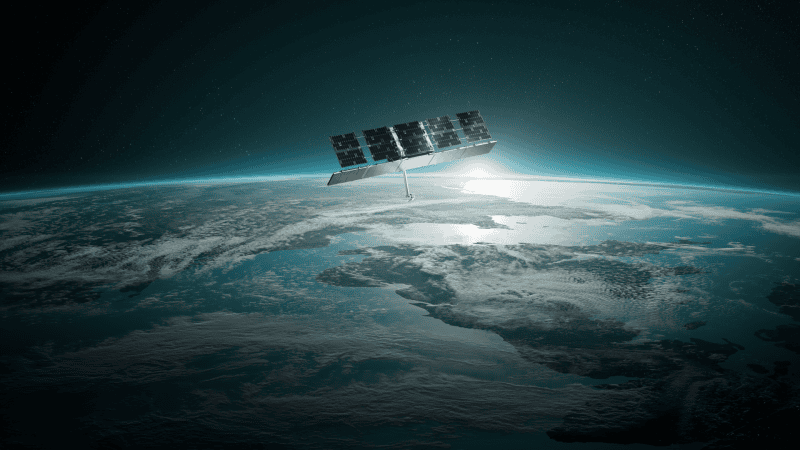
Photo. ICEYE
Following a series of sudden manoeuvres, Cosmos 2612 has caught up with a Western satellite, taking up a favourable position for a potential attack from just several dozen metres away. What game is Moscow playing?
On 14th October this year, we reported that the Russian satellite Cosmos 2612 had approached to within 475 km of a radar reconnaissance satellite belonging to the Finnish-Polish company ICEYE. At the time, we did not yet know whether Russia would decide to continue these manoeuvres. Today, we know that we are most likely witnessing the closest-ever uncoordinated approach between two active satellites in Earth orbit.
On 15th and 16th October, Cosmos 2612 performed a series of manoeuvres that reduced its distance from ICEYE-X36 from several hundred kilometres to several hundred metres or even less, according to estimates from several independent sources. CelesTrak data indicate that the distance may have fallen to just 26 metres at the point of closest approach on Sunday, 18th October, at 03:41 Polish time.

The Russian satellite has almost perfectly matched its orbital parameters to those of ICEYE-X36, meaning that it can remain in its immediate proximity virtually continuously. This position creates favourable conditions for a whole range of actions against the Western satellite, although the nature of those actions remains the greatest unknown.
The first, highly likely possibility is optical inspection and signals intelligence (SIGINT) collection targeting ICEYE-X36 for intelligence purposes, which may already be taking place. This could allow the Russians to gain a more detailed understanding of the design and equipment of a satellite that serves, among others, Western governments and armed forces, including Ukraine’s.
Reconnaissance activities may, however, be merely a prelude to direct interference with the satellite’s operation through non-kinetic or kinetic means. Everything will depend on the equipment carried by Cosmos 2612 and Russia’s intentions — both remain key unknowns.

Depending on these factors, Russia might, for example, seek to jam the satellite’s communications with Earth or disrupt its ability to conduct radar reconnaissance of the Earth’s surface. In an extreme scenario, the Kremlin could decide on physical interference, ranging from causing a collision between the two satellites, through striking ICEYE-X36 with a specialised projectile, to mechanically capturing it in order to destroy, damage or reposition it.
Any of these actions would leave the West facing the difficult task of finding an appropriate response, particularly as the Kremlin would certainly try to deny any responsibility for the attack. Its main objective might, as is often the case, be to demonstrate Western countries’ powerlessness and deepen divisions between them. Ambiguities over responsibility for defending a commercial dual-use satellite, as well as difficulties in attributing hostile actions in the space domain, could facilitate this.
In this context, the silence from Western countries is concerning: so far, they have issued no public statement warning Russia against further escalation. ICEYE itself, when asked for comment, has likewise not yet stated its position on the matter. We can only hope that similar warnings have already reached Moscow through less public diplomatic or military channels.

Crucially, the Kremlin need do nothing further to send an important signal to the West. Even without any additional action, the approach itself constitutes a strategic demonstration of Russia’s counterspace capabilities. This interpretation is supported by the latest reports from the morning of 19th October, according to which the Russian satellite had reportedly begun moving away from its victim. Through their audacity in orbit, the Russians appear to be saying: “We can come over and destroy your expensive toys at any time.”
For this very reason, the situation above all exposes European countries’ lack of preparedness to defend their own space systems in orbit. They currently lack the necessary capabilities, which is probably also what Moscow wants to demonstrate. Perhaps the most effective response to Russia’s current actions would be to send a dedicated patrol satellite equipped with offensive capabilities into the vicinity of the Russian satellite, enabling it to neutralise the threat if necessary, or to use a ground-based laser weapon against it.
Unlike the United States, European countries currently have no operational capabilities in either of these areas, which are still under development. The current crisis in orbit must therefore accelerate European and Polish efforts to acquire independent capabilities for responding rapidly to orbital threats and conducting defensive counterspace operations. Otherwise, similar situations will only increase in both scale and frequency.


