


- WIADOMOŚCI
- ANALIZA
Turkish ASELSAN is building its own constellation of telecommunications satellites

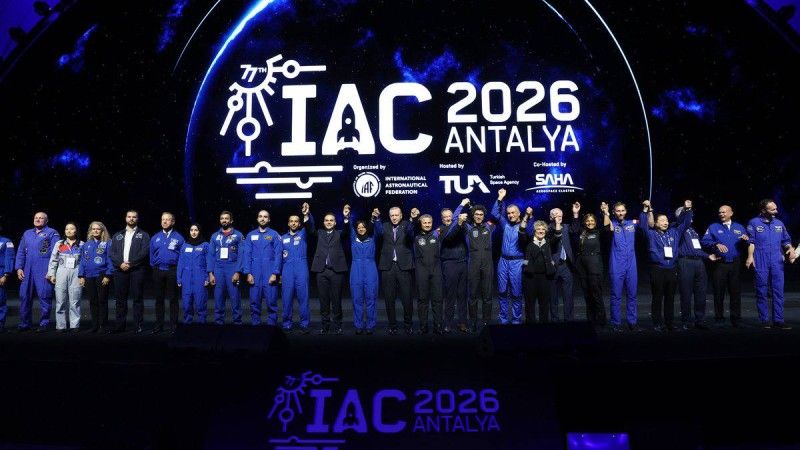
Photo. Republic of Türkiye Ministry of Industry and Technology / X
During the 77th International Astronautical Congress (IAC 2026), held in Antalya, the Turkish defence firm ASELSAN unveiled a physical prototype of a satellite designed for the GÖKBAĞI mega-constellation. This project, promoted internationally under the name „ASTRALINK”, was developed to address the specific requirements of Turkish state institutions.
In domestic media and industry discussions, the venture has been dubbed the „Turkish Starlink”, a term that reflects Ankara’s ambition to establish its own distributed telecommunications and navigation infrastructure. The presentation of the prototype by ASELSAN CEO Ahmet Akyol served as a highlight of the congress, underscoring Türkiye’s aspirations within the space technology sector, which encompasses both commercial and defence-related applications.
Orbital architecture and operational schedule
The core of the GÖKBAĞI project involves the creation of a dense constellation of 198 satellites operating in Low Earth Orbit (LEO). Utilising LEO allows for significantly lower data transmission latency and higher bandwidth compared to traditional satellites positioned in Geostationary Orbit (GEO).
According to the schedule presented by the company’s management, the first units are set to be launched into space between 2028 and 2029, marking the beginning of the construction of an operational fleet. Ultimately, nearly two hundred interconnected satellites will form an integrated orbital network, ensuring continuous connectivity and operational redundancy.
GÖKBAĞI, Yakın yörünge (LEO) uydu ağı ile Askeri 5G teknolojilerini tek altyapıda buluşturacak. . Karasal şebekelerin olmadığı bölgelerde, dünyanın herhangi bir noktasında, güvenli ve kesintisiz haberleşme GÖKBAĞI ile mümkün olacak. ✅ Güvenli ve kriptolu haberleşme ✅ Yüksek veri kapasitesi ✅ Hareket halindeyken kesintisiz bağlantı ✅ Elektronik harp ortamında yüksek dayanıklılık #ASELSAN 🌐 GÖKBAĞI will integrate a Low Earth Orbit (LEO) satellite constellation with Military 5G technologies into a single communications infrastructure. . In areas where terrestrial networks are unavailable, GÖKBAĞI will enable secure and uninterrupted communication anywhere in the world. ✅ Secure, encrypted communication ✅ High data capacity ✅ Seamless connectivity on the move ✅ High resilience in electronic warfare environments
— ASELSAN (@aselsan) July 7, 2026
Integrated circuit design and AESA technology
A key feature of the GÖKBAĞI project is its vertical technological integration. Rather than merely assembling off-the-shelf components, ASELSAN designs satellites from the ground up, utilising its own proprietary semiconductor micro-components:
- Dedicated Integrated Circuits: To maximise spectral efficiency and beam management, ASELSAN engineers are developing proprietary Beam-Forming Integrated Circuits (BFICs).
- Digital AESA Receivers: In parallel with the space segment, the company is developing advanced ground and platform-based infrastructure centred on Active Electronically Scanned Array (AESA) antennas. Unlike traditional parabolic antennas, which require mechanical steering, AESA receivers track satellites digitally without mechanically repositioning the antenna.
- Operational Application of AESA Technology: The elimination of moving mechanical parts enhances reliability, while a low radar signature (low observability) allows these terminals to be installed on a wide range of platforms – from unmanned aerial vehicles (UAVs) to mobile ground-based or maritime systems.

GÖKBAĞI within the context of the Turkish space and defence ecosystem
The development of the GÖKBAĞI project is part of a broader, coordinated division of roles within the Turkish space sector:
- ASELSAN: Responsible for the Low Earth Orbit (LEO) satellite constellation GÖKBAĞI as well as microelectronics, advanced payloads, and radar systems. To meet production demands, the company is continuously expanding its engineering team (currently numbering over 10,000 engineers, with a total workforce exceeding 15,000) and investing in the expansion of its facilities in Oğulbey.
- TUSAŞ (Turkish Aerospace Industries): Focuses on geostationary satellites (in collaboration with TÜBİTAK) and next-generation observation satellites, including the HÜRSAT project, a small Earth-observation satellite with sub-metre resolution, which was unveiled during the same congress.
- ROKETSAN: Engaged in the development of indigenous launch vehicles and rocket systems capable of delivering payloads into orbit.
- Fergani: Conducts research and development focused on space-based navigation systems.
- Complementary systems: The presentation also highlighted synergies with other key national programmes, such as the GÖKTÜRK-3 radar satellite (equipped with a SAR instrument, enabling surface observation under all weather conditions, even through cloud cover), the Türksat 6A telecommunications satellite, and the multi-layered air defence system known as "Çelik Kubbe" ("Steel Dome").
Strategic objectives: Sovereignty in connectivity
The analytical dimension of this project extends beyond purely commercial data transmission. The primary mission of the GÖKBAĞI system is to strengthen Türkiye’s technological independence in secure connectivity.
In the context of modern armed conflicts, reliance on external providers of navigation or telecommunication services poses a significant operational risk. The goal of the GÖKBAĞI system is to establish a domestic communication layer that reduces the dependence of the Turkish Armed Forces and state agencies on foreign satellite infrastructure.
Conclusions
The GÖKBAĞI/ASTRALINK project represents a qualitative leap in the development of Türkiye’s advanced technology sector. By integrating a planned constellation of 198 satellites in Low Earth Orbit (LEO), proprietary microelectronic solutions, including BFIC chips under development, and satellite terminals using AESA technology, Ankara aims to strengthen its autonomous connectivity capabilities. The first satellite launches, targeted for 2028–2029, will serve as a litmus test for the technological maturity of Türkiye’s entire space ecosystem.


