












- ANALIZA
- WIADOMOŚCI
The International Space Summit: A leap for Europe, but not for the world

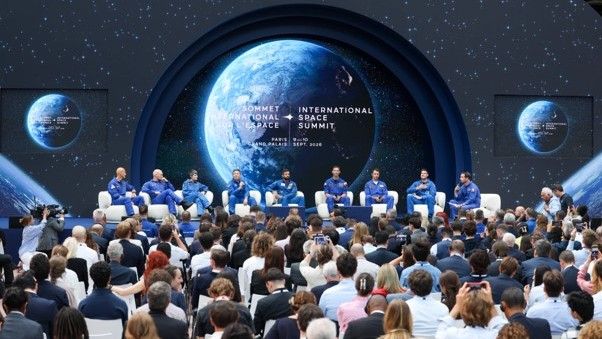
Photo. France Diplomacy
The summit showed a mobilised Europe, but a largely indifferent world.
Taking place in Paris on 9–10 September, the International Space Summit was another grand event organised by the Élysée around a major global issue, following the Nuclear Energy Summit in March 2026 and the AI Action Summit in February 2025. All three exemplify France’s increasingly active “summit diplomacy”: bringing national leaders and senior officials to Paris’s world-famous venues to build momentum around strategic issues while giving France influence over the international debate that would otherwise be difficult to achieve.
There is little doubt today that space urgently needs such a debate on the development of an effective orbital and cislunar governance regime. The old governance and regulatory frameworks are increasingly ill suited to the realities of the new space age. The militarisation of orbit is putting growing pressure on the Outer Space Treaty, the burgeoning number of communications satellites is making frequency allocation more difficult than ever for the ITU, while space debris and the number of active objects in orbit are growing at an unsustainable pace.
From its inception, the International Space Summit was meant to address these challenges by gathering countries, international bodies and space actors across the globe. At the same time, from the outset it was clear that it would have a strong European undertone, with France planning to push forward with its space autonomy agenda. Balancing these two ambitions, however, proved harder than its organisers could have anticipated.
Limited global commitment
Even before it began, the summit was overshadowed by reports that Washington had pressured American space companies not to attend. The current US administration has been critical of EU space policies aimed at strengthening European independence in launch services, satellite infrastructure and data, while favouring European suppliers over competitors from third countries. SpaceX, Blue Origin, Stoke Space and Starcloud ultimately cancelled their participation, forcing the organisers to scrap several planned announcements. Still, other American companies attended, as did an official US delegation at the Grand Palais.
The final count showed delegations from 90 countries and international organisations, compared with the 120 initially announced, alongside representatives of around 1,100 companies. Among them was China, reinforcing the French argument that the summit was genuinely global and inclusive, as well as India, another major non-Western space power. A notable absentee was Russia, which remains rightly isolated by much of Europe over its war against Ukraine, but nevertheless continues to be an influential space actor.
The broad participation did not, however, translate into comparable support for the three space declarations promoted by Paris ahead of the summit. The documents on the sustainable use of outer space, space-based scientific data, and the ITU’s regulatory framework for frequency management were signed by most European countries and some states from the Americas, Asia and Africa. Yet each of them notably, and most importantly, lacked the signatures of the other major space powers: the United States, China and India, depriving them of genuinely global political weight.

A mobilised continent
For these reasons, the summit’s global ambition can hardly be considered fulfilled, although it did provide an opportunity to discuss space issues among almost all major space powers, which in itself is a positive. What worked far better for France, however, was the European side of the event. This is where we could see actual momentum, political will and even concrete action, something the continent is not always known for.
The weekend preceding the summit witnessed the first successful launch of a private European rocket, which was also the first orbital launch conducted from continental Europe. The gathering itself became an occasion to conclude around 50 contracts and agreements worth more than €20 billion, mostly between European companies, strengthening demand, production capacity and industrial consolidation. At the centre of attention were, among others, new Ariane 6 launch agreements, industrial contracts advancing the IRIS² programme, and the procurement of 229 additional OneWeb satellites.
In his speech, President Emmanuel Macron announced that France would invest €20 billion in space through 2030 and backed the VORTEX S reusable spaceplane, developed by France’s Dassault Aviation in cooperation with Germany’s OHB. For her part, European Commission President Ursula von der Leyen effectively signalled the Commission’s support for Project Bromo, the proposed merger of the space activities of Airbus, Thales and Leonardo into a single European company with the scale and critical mass needed to compete with American and Chinese rivals.
But perhaps in the long term, the fact that the event re-energised the debate on the future of Europe’s space sector and capabilities will prove even more consequential. The aggregation of demand for European launchers, reform of ESA’s geographical return principle, European preference in contracting, and sovereign crewed launch capability all returned to the table with renewed force, making them even harder for decision-makers to ignore.
This does not mean that the continent is free from internal disagreements over its strategic direction. France and Germany, which co-chaired the summit, did not appear fully united behind a common vision, especially given the telling absence of Chancellor Merz, who did not find time to attend. The main bone of contention, as so often, boils down to the degree of European autonomy and integration, which Paris traditionally seeks to expand further than Berlin would prefer.

Hard power before soft influence
The summit thus exposed both the growing global frictions surrounding space and the fact that Europe’s own policy has yet to fully crystallise. What it demonstrated beyond doubt, however, was the unprecedented dynamism of the European space sector, increasingly matched by political will as leaders finally recognise the domain’s critical importance to the continent’s strategic interests.
The rest of the world may not be particularly interested in embracing Europe’s vision for the future of space. Yet only by expanding its own footprint, capabilities and industrial weight can Europe hope to gain a stronger voice in shaping it. In this case, Europe’s big steps must come before any global leaps.


