












- ANALIZA
- WIADOMOŚCI
Europe reacted. But could it stop Russia?

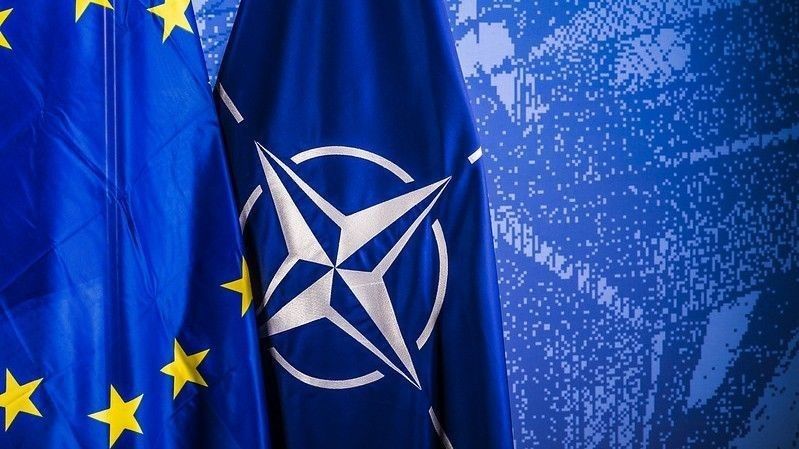
Russia’s full-scale invasion of Ukraine triggered an immediate response from both the European Union and NATO, but the two organisations entered the crisis with fundamentally different instruments and responsibilities. While the EU focused on sanctions, economic pressure and reducing Europe’s dependence on Russian energy, NATO concentrated on deterrence, reinforcing its eastern flank and preventing the war from spreading to Allied territory. The conflict therefore became a test not only of Western unity, but also of whether institutions created for a different security environment were capable of responding effectively to a large-scale war in Europe.
Russia’s invasion of Ukraine on 24 February 2022 became one of the most serious challenges to the European security architecture since the end of the Cold War, demonstrating that the assumptions on which much of the post-1991 order had been built were no longer sufficient. The attack showed that a major military power was prepared to use conventional force to pursue territorial and political objectives, while simultaneously exploiting energy dependence, disinformation, cyber activity and economic pressure as additional instruments of influence. In this sense, the war was not only an attack on Ukraine, but also a direct challenge to the broader security system developed in Europe after the collapse of the Soviet Union.
The European Union reacted immediately, with an extraordinary meeting of the European Council convened on the day of the invasion and a rapid political condemnation of Russia’s actions. In the following weeks, the EU introduced successive sanctions aimed at Russian individuals, financial institutions, companies and strategic sectors of the economy, while simultaneously attempting to limit Moscow’s access to European markets and capital. Because the Union possesses substantial economic, financial and regulatory instruments, its response was concentrated primarily on increasing the costs of aggression and weakening Russia’s ability to benefit from its economic relations with Europe.
The war also exposed one of Europe’s most serious strategic vulnerabilities: its dependence on Russian fossil fuels. For years, Russia had remained one of the principal suppliers of gas, oil and other energy resources to EU member states, which gave Moscow considerable economic leverage and complicated the process of imposing restrictions. Following the invasion, the Union therefore accelerated efforts to diversify supplies, reduce dependence on Russian energy and protect households and businesses from rapidly increasing prices, while the broader economic effects of the conflict were visible in fuel, fertiliser and food markets across Europe.
The conflict also affected global food security, particularly because Ukraine had been one of the world’s most important agricultural exporters. The disruption of Black Sea routes and the destruction of transport infrastructure created pressure on international markets, forcing the EU and other actors to develop alternative mechanisms for maintaining Ukrainian exports. These measures demonstrated that the consequences of the war extended far beyond the battlefield and that economic, energy and food security had become closely connected with the broader European response to Russian aggression.
See also 

NATO faced a different challenge because Ukraine was not a member of the Alliance and therefore was not protected by Article 5 of the North Atlantic Treaty. The organisation was not legally obliged to enter the war directly and, from the beginning, had to balance support for Ukraine with its principal responsibility of protecting Allied territory and avoiding an uncontrolled escalation into a direct NATO–Russia conflict. This distinction became fundamental to the Alliance’s response and explains why NATO concentrated on strengthening deterrence, increasing its military presence on the eastern flank and preparing for the possibility that the war could spread beyond Ukraine.
Russia’s actions also effectively destroyed the political foundations of the NATO–Russia relationship created after the Cold War. The 1997 NATO–Russia Founding Act had been based on the assumption that cooperation, consultation and transparency could reduce tensions and contribute to European stability, but the annexation of Crimea in 2014 and the full-scale invasion in 2022 demonstrated how far Moscow had moved away from those principles. The extraordinary NATO summit convened on 25 February 2022 therefore had a dual purpose: to condemn Russia’s actions and to demonstrate that any attempt to extend the conflict into Allied territory would encounter a collective military response.
The eastern flank quickly became one of the central elements of the Alliance’s response, particularly for Poland, the Baltic states and other members of the Bucharest Nine. These countries argued that Russia’s actions required not only political condemnation, but also a visible and credible reinforcement of NATO’s military posture. The objective was to strengthen deterrence by demonstrating that Allied territory would be defended and that any further escalation would carry consequences significantly different from those associated with an attack on a non-member state.
The institutional distinction between NATO and the European Union was particularly visible during the first months of the war. The EU could directly use sanctions, financial restrictions and trade instruments, whereas NATO’s role was concentrated on military deterrence and collective defence, while individual Allied states supplied weapons and equipment to Ukraine through national or multinational mechanisms. This division of responsibilities did not mean that the organisations acted separately, but rather that each relied on the instruments available within its institutional framework.

The war therefore demonstrated both the strength and the limitations of the Western response. The European Union and NATO were able to react rapidly, maintain political cohesion and impose substantial economic and military costs on Russia, but neither institution had been able to prevent the invasion itself. That distinction is important because it raises a broader question about the effectiveness of the European security system: whether institutions designed primarily to respond to crises are capable of deterring an aggressor before the decision to use force has already been taken.
The experience of Ukraine suggests that future deterrence will require closer integration of military, economic, technological and political instruments. Sanctions imposed after aggression begins may weaken the aggressor, and military reinforcement after an attack may protect neighbouring states, but neither instrument automatically guarantees prevention. For the European Union and NATO, one of the central lessons of the war is therefore that credible deterrence must be visible before a crisis reaches the stage of open conflict, and that economic dependence, military readiness and political cohesion are increasingly parts of the same security equation.


